Facts
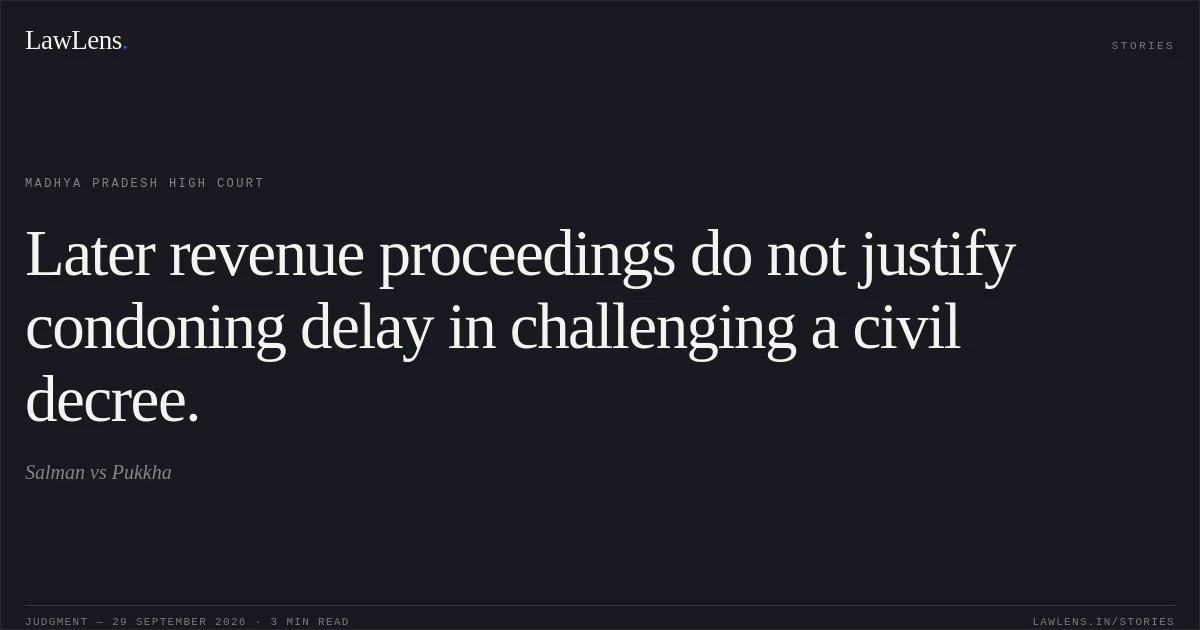
The respondents obtained a decree for permanent injunction against the appellants, affirmed by the First Appellate Court on 18 July 2008.
Source reference: para. 1–6, 8–14The appellants filed this second appeal on 26 February 2019, delayed by 3,785 days, and sought condonation of delay.
Source reference: para. 1–6, 8–14They argued that they had pursued remedies before the Revenue Courts in good faith, relying on Section 14 of the Limitation Act and legal advice.
Source reference: para. 1–6, 8–14The Revenue proceedings had been initiated by the respondents to enforce the civil decree; the appellants’ challenge to the Revenue authorities’ orders was dismissed by the Additional Commissioner on 7 December 2018.
Source reference: para. 1–6, 8–14The respondents opposed condonation, emphasizing that the appellants knew of the civil decree and had not timely appealed it.
Source reference: para. 1–6, 8–14Issues
1. Whether the time spent in the Revenue Courts could be excluded under Section 14 of the Limitation Act, or otherwise constituted sufficient cause to condone the 3,785-day delay
Source reference: para. 3–4, 12–142. Whether the appellants’ reliance on counsel’s advice and the principle in Rafiq v. Munshilal justified condonation of the delay
Source reference: para. 5, 15–18Law Applied
Section 5 of the Limitation Act permits condonation of delay where sufficient cause is shown; the request must be supported by a satisfactory explanation.
Source reference: para. 3–5, 18Section 14 allows exclusion of time spent prosecuting, with due diligence and in good faith, another proceeding against the same party where that proceeding could not be entertained because of a defect of jurisdiction or a cause of like nature.
Source reference: para. 3–5, 18The Court relied on Rajneesh Kumar v. Ved Prakash and Nitin Mahadeo Jawale v. Bhaskar Mahadeo Mutke for the principle that a litigant’s allegation of counsel negligence, by itself, does not justify condoning long and inordinate delay; litigants must remain vigilant about their rights and proceedings.
Source reference: para. 15, 17It also referred to Salil Dutta v. T.M. & M.C. Private Ltd. on the need to reject an unsupported attempt to place the entire blame on counsel.
Source reference: para. 16Rafiq v. Munshilal and Kashi Bai v. State of M.P. were distinguished as inapplicable to the circumstances.
Source reference: para. 18Reasoning
The decree concerned interference with the respondents’ possession, a matter within the Civil Court’s jurisdiction; the appellants’ remedy was to file the second appeal within limitation.
Source reference: para. 12The Revenue proceedings were initiated by the respondents after the civil decree, and the appellants knew by the Sub-Divisional Officer’s order of 30 April 2012 that the civil decree was binding on the Revenue authorities.
Source reference: para. 13They nevertheless did not appeal the civil decree and instead pursued a further Revenue appeal, which was dismissed in 2018.
Source reference: para. 13The Court therefore found that the appellants’ claim of prosecuting a remedy before the wrong forum was unsupported by the record and that the explanation for the delay was unsatisfactory.
Source reference: para. 14The asserted reliance on counsel and Rafiq did not alter that conclusion, particularly given the appellants’ prolonged inaction and the fact that the Revenue proceedings were initiated by the respondents.
Source reference: para. 15–18Holding
The Court held that the appellants had not shown sufficient cause to condone the 3,785-day delay and found no ground to exclude the time spent in the Revenue proceedings.
It dismissed I.A. No. 1398/2019 and, consequently, dismissed the second appeal as barred by limitation.
Source reference: para. 19Acts & Sections Cited
3 provisions across 2 statutes referred to in this judgment. Each provision opens on LawLens.
Code of Civil Procedure, 19081
Limitation Act, 19632
Original Court PDF
SalmanvsPukkha
Click to open original judgment
Original judgment, available to read, download and summarize on LawLens.in