Facts
The petitioner was selected for appointment as Sub-Inspector (Executive) in the CISF and was issued a provisional offer of appointment. During character verification, he disclosed FIR No. 483/2022, lodged by him, and a counter-FIR No. 488/2022, registered against him under various provisions of the IPC, including Section 325. The disputes arose from a neighbourhood altercation between persons known to each other. The matter was subsequently compromised, and the offence under Section 325 IPC was compounded under Section 320(8) CrPC, resulting in the petitioner’s acquittal. The petitioner disclosed the FIR, compromise and acquittal during verification; the local police character verification report was stated to contain no adverse material
Source reference: p.3, para. 3(a)–(b)The CISF Screening Committee nevertheless declared the petitioner unsuitable for training, and he was barred from joining. In earlier proceedings, the High Court directed the authorities to take a decision on his candidature. Thereafter, the respondent issued the impugned letter dated 23 March 2026 cancelling his provisional appointment
Source reference: pp.3–4, para. 3(c)–(e)Issues
Whether the petitioner could be declared unsuitable for appointment in the CISF despite his acquittal following compounding of the offence under Section 320(8) CrPC and his truthful disclosure of the criminal case?
Source reference: p.11, para. 19; pp.15–16, paras. 21–22Whether Clause 2(V) of the MHA Policy Guidelines dated 1 February 2012, concerning acquittals in serious-offence cases on account of hostile witnesses, fear of reprisal or benefit of doubt, applied to the petitioner’s compromise-based acquittal?
Source reference: pp.6–8, paras. 12–13; p.17, para. 24Whether the CISF’s decision to cancel the petitioner’s provisional appointment was arbitrary and liable to be quashed?
Source reference: pp.4–6, paras. 4–9; p.17, para. 25Law Applied
The Court applied Section 320(8) CrPC, under which composition of an offence has the effect of an acquittal of the accused
Source reference: p.16, para. 22Under the MHA Policy Guidelines dated 1 February 2012, involvement in specified serious offences may ordinarily render a candidate unsuitable, but the second proviso to Clause 2(III) protects a candidate who has been finally acquitted; Clause 2(V) generally excludes candidates charge-sheeted for serious offences who are acquitted on benefit of doubt or because witnesses turned hostile due to fear of reprisal
Source reference: pp.7–8, para. 12The Court relied on Avtar Singh v. Union of India, (2016) 8 SCC 471, which recognises the employer’s power to examine antecedents even after truthful disclosure of a concluded criminal case, but requires a contextual and lawful assessment
Source reference: pp.9–10, para. 15It followed Bikramjit Mondal v. Union of India, W.P.(C) 6238/2025, holding that a compromise-based acquittal under Section 320(8) CrPC, particularly where the complainant does not wish to prosecute, attracts the benefit of the second proviso to Clause 2(III) and does not fall within Clause 2(V)
Source reference: pp.11–15, para. 20The Court also relied on the Supreme Court’s decision in Union of India & Anr. v. Srikanta Gorain & Ors., SLP(C) Nos. 3419–3421/2026, which held that suitability decisions in disciplined forces must be based on sound reasons, careful consideration of relevant factors and non-arbitrary exercise of power
Source reference: pp.16–17, para. 23Reasoning
The Court found the petitioner’s case materially similar to Bikramjit Mondal. Although Section 325 IPC was among the offences invoked, the criminal proceedings ended through a compromise and compounding under Section 320(8) CrPC, which legally operated as an acquittal
Source reference: p.16, para. 22The acquittal was not based on benefit of doubt or on witnesses turning hostile due to fear of reprisal; consequently, the restrictive condition in Clause 2(V) of the MHA Guidelines was not attracted
Source reference: p.17, para. 24The petitioner had also made truthful disclosures and had not attempted to secure appointment by concealment or deception, a factor expressly recognised in the Supreme Court’s decision in Srikanta Gorain
Source reference: pp.16–17, para. 23While the CISF could scrutinise antecedents and suitability, that discretion had to be exercised objectively and for sound reasons. Treating the petitioner’s compromise-based acquittal as an automatic disqualification, without evidence of coercion, fear or reprisal and without adequate application of mind, was arbitrary
Source reference: p.17, paras. 23–25Holding
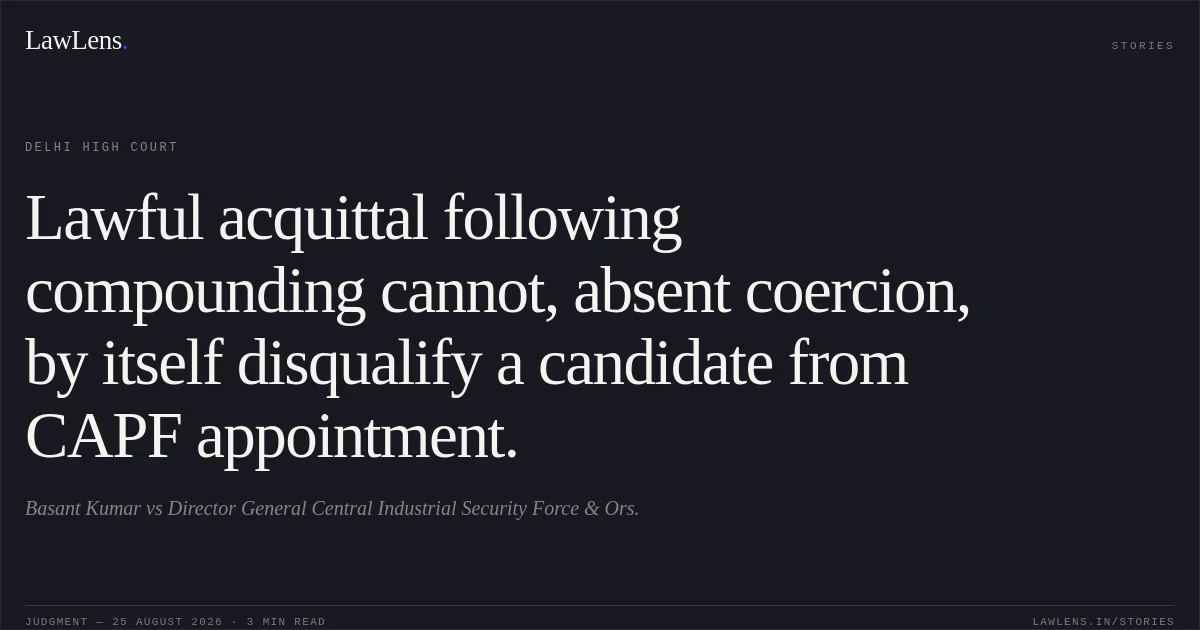
The Court held that the petitioner’s acquittal pursuant to compounding under Section 320(8) CrPC attracted the protection of the second proviso to Clause 2(III) of the MHA Guidelines, and that Clause 2(V) did not apply in the absence of any material showing fear of reprisal or coercion
The impugned letter dated 23 March 2026 and the decision declaring the petitioner unsuitable were quashed
Source reference: p.17, para. 25His appointment in the CISF was revived, with continuity of service, seniority and pay fixation; however, he was denied back wages
Source reference: p.18, para. 26The respondents were directed to comply within four weeks, and the writ petition was allowed accordingly
Source reference: p.18, paras. 27–28Acts & Sections Cited
13 provisions across 2 statutes referred to in this judgment. Each provision opens on LawLens.
Indian Penal Code, 1860
Code of Criminal Procedure, 19731
Original Court PDF
Basant KumarvsDirector General Central Industrial Security Force & Ors.
Click to open original judgment
Original judgment, available to read, download and summarize on LawLens.in
![Courts will not interfere with transfers absent mala fides or violation of statutory rules.. M Ramya vs EMPLOYEES STATE INSURANCE CORPORATION (ESIC). CAT - ['Chennai']. LawLens](/stories/thumbnails/courts-will-not-interfere-with-transfers-absent-mala-fides-or-violation-of-statutory-rules-a6845e9ca6f548fca284c51c8351957f.webp)
![Courts cannot direct one-time recruitment age relaxation absent authority in the governing rules or advertisement.. UT OF PUDUCHERRY vs M ANDAL. CAT - ['Chennai']. LawLens](/stories/thumbnails/courts-cannot-direct-one-time-recruitment-age-relaxation-absent-authority-in-the-governing-895d78fde47143e2a8ed0207c4b6a44f.webp)
![A review cannot correct an allegedly erroneous decision absent an error apparent on the record.. Ajit Kumar Jha vs RAILWAY BOARD. CAT - ['Delhi']. LawLens](/stories/thumbnails/a-review-cannot-correct-an-allegedly-erroneous-decision-absent-an-error-apparent-on-the-re-8ac952fd4eba470c92f7da20af72a220.webp)