Facts
The 100 petitioners, residents of Tehsil Mendhar, claimed to have worked for several years as casual/need-based laborers in the Public Health Engineering (PHE) Department
Source reference: para. 3(b)They alleged that despite continuous service, their wages remained unpaid for approximately three years
Source reference: para. 2The petitioners relied on a communication dated 23.10.2017 from the Assistant Executive Engineer (AEE) listing them as workers
Source reference: para. 3(d)the issuance of departmental identity cards [para. 3(e)], and their inclusion in the biometric attendance system
Source reference: para. 3(f)Conversely, the respondents issued Order No. 2 dated 23.06.2019 (erroneously cited as 2018 in parts of the pleadings), rejecting the petitioners' claims for wages on the grounds that they were never engaged by a competent authority
Source reference: para. 3(h)The matter was transferred from the Hon’ble High Court of Jammu & Kashmir to the Central Administrative Tribunal
Source reference: para. 1Issues
1. Whether the petitioners established a legal right to wages and regularization in the absence of formal appointment orders issued by a competent authority
Source reference: para. 92. Whether administrative documents, such as communications by an Assistant Executive Engineer, identity cards, or biometric attendance records, constitute a valid legal source of public employment
Source reference: para. 10, 113. Whether the impugned order dated 23.06.2019, which rejected the petitioners' claims, was arbitrary or legally infirm
Source reference: para. 17Law Applied
The Tribunal primarily applied the constitutional principles of public employment under Articles 14 and 16, emphasizing that equality is violated by illegal entry into service
Source reference: para. 12, 22It relied heavily on the landmark precedent Secretary, State of Karnataka v. Umadevi (3) (2006) 4 SCC 1, which established that regularization cannot be granted to persons appointed dehors the constitutional scheme or without following due recruitment process
Source reference: para. 12The Tribunal also applied the principle that service status cannot be founded on sympathy or unauthorized administrative notes but requires a valid source of right, such as a sanction against a post or a selection process
Source reference: para. 9, 11Reasoning
The Tribunal found that the petitioners failed to produce any foundational documents of employment, such as appointment orders, selection records, or official muster rolls maintained in the regular course of business
Source reference: para. 9It reasoned that the AEE lacked the competence to engage workers or bind the State through correspondence; thus, his communication could not serve as a "legal charter of employment"
Source reference: para. 11Regarding identity cards and biometric attendance, the Tribunal categorized these as "collateral circumstances" or "incidental acts" that do not confer legal status in the absence of a lawful appointment under the rules
Source reference: para. 10, 16Furthermore, the Tribunal noted that the petition was a "collective omnibus" filing that lacked individual particulars regarding dates of work or nature of duties for each of the 100 petitioners, making it unsuitable for writ-style relief
Source reference: para. 14, 21It concluded that where foundational facts are seriously disputed, the Tribunal cannot conduct a roving factual enquiry to declare employment status
Source reference: para. 15Holding
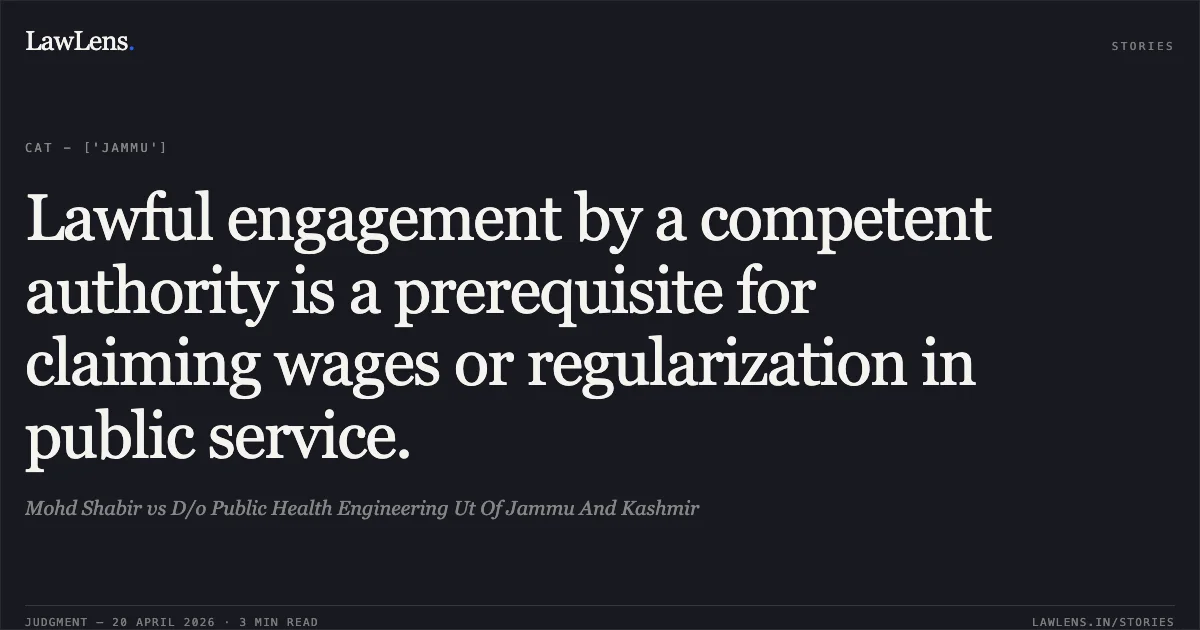
The Tribunal dismissed the Transfer Application, holding that the petitioners failed to establish any valid engagement by a competent authority or a legal basis for regularization
The Tribunal answered the issues by stating that unauthorized entry into public service through the "backdoor" creates no enforceable right to wages or permanency, and administrative inconsistencies in subordinate paperwork do not override the requirement for legal appointment
Source reference: para. 13, 17The prayer to quash Order No. 2 dated 23.06.2019 and the demand for unpaid salary were denied
Source reference: para. 25No order as to costs
Source reference: para. 26Original Court PDF
Mohd ShabirvsD/o Public Health Engineering Ut Of Jammu And Kashmir
Click to open original judgment
Original judgment, available to read, download and summarize on LawLens.in