Facts
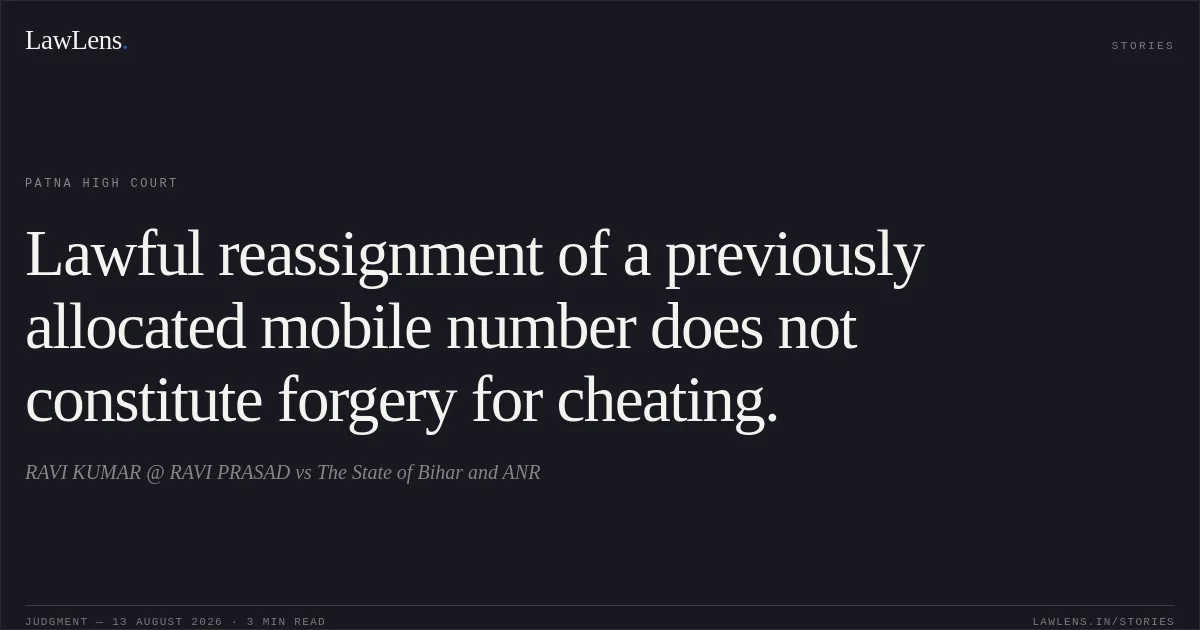
The complainant alleged that his uncle, Sunil Kumar, had been allotted Airtel mobile number 8002002222, which was sent to a local mechanic after a technical fault. Upon its return, the number allegedly ceased to display the tower location. The complainant subsequently claimed that the same number had been allotted to accused Ravi Kumar and that the accused persons were using it pursuant to a conspiracy. It was further alleged that, despite service of legal notices, the accused demanded ₹70,000 for returning the number, causing business loss to the complainant’s uncle.
Source reference: p. 2The complaint was filed alleging offences under Sections 358, 465, 468 and 120B of the Indian Penal Code and Sections 65 and 66 of the Information Technology Act. After considering the complaint and the inquiry witnesses, the Judicial Magistrate took cognizance against the petitioner under Sections 468 and 120B IPC and issued summons by order dated 4 May 2018.
Source reference: pp. 2–3The petitioner approached the High Court under Section 482 CrPC, contending that the number had been allotted to him lawfully after the original subscriber failed to recharge it for more than 90 days. He stated that he had obtained the number after submitting the requisite Customer Application Form and that it was subsequently ported from Airtel to Aircel through Mobile Number Portability.
Source reference: p. 3Issues
Whether the allegations in the complaint, taken at face value, disclosed the commission of forgery for the purpose of cheating under Section 468 IPC by the petitioner?
Source reference: pp. 3–5Whether the materials on record disclosed a prima facie offence under Section 120B IPC or otherwise justified continuation of the criminal proceedings against the petitioner?
Source reference: pp. 3–5Whether the cognizance order was liable to be quashed under the principles governing the High Court’s inherent jurisdiction under Section 482 CrPC?
Source reference: pp. 4–6Law Applied
The Court applied Section 468 IPC, which criminalises forgery committed with the intention that the forged document or electronic record be used for cheating. It also considered Section 120B IPC concerning criminal conspiracy and exercised its inherent jurisdiction under Section 482 CrPC to prevent abuse of the process of court and secure the ends of justice.
Source reference: p. 4The Court relied on State of Haryana v. Bhajan Lal, 1992 Supp (1) SCC 335, particularly the principles that quashing may be justified where the allegations, even if accepted in their entirety, do not prima facie constitute an offence; where the uncontroverted allegations and supporting material do not disclose commission of any offence; or where the proceeding is manifestly attended with mala fides.
Source reference: pp. 4–5Reasoning
The Court found that the complaint did not contain any specific allegation that the petitioner had created, altered or used a forged document or electronic record with the intention of cheating, which is an essential factual foundation for Section 468 IPC.
Source reference: pp. 4, 6The petitioner’s acquisition of the mobile number was, on the stated facts, pursuant to the telecommunications company’s policy after the number had remained inactive for the prescribed period, followed by submission of the required customer form and lawful network porting. Mere use of a number previously allotted to another subscriber did not, without more, constitute forgery or establish the requisite criminal conspiracy. Applying categories 1, 3 and 7 of Bhajan Lal, the Court held that the allegations did not prima facie disclose an offence and that continuation of the proceedings would amount to abuse of process.
Source reference: pp. 3, 5–6Holding
The High Court held that no criminal case under Sections 468 or 120B IPC was made out against the petitioner on the allegations and materials presented.
It accordingly set aside and quashed the cognizance order dated 4 May 2018 passed in Complaint Case No. 275 of 2017 by the Judicial Magistrate First Class, Raxaul at Motihari, insofar as it concerned Ravi Kumar @ Ravi Prasad. The quashing petition was allowed, and a copy of the order was directed to be transmitted to the trial court.
Source reference: p. 6Acts & Sections Cited
8 provisions across 3 statutes referred to in this judgment. Each provision opens on LawLens.
Indian Penal Code, 18603
Information Technology Act, 20002
Code of Criminal Procedure, 19733
Original Court PDF
RAVI KUMAR @ RAVI PRASADvsThe State of Bihar and ANR
Click to open original judgment
Original judgment, available to read, download and summarize on LawLens.in