Facts
The Applicants were appointed developers under a registered Development Agreement dated 12 November 2007, executed with Respondent Nos. 2–4, which included an arbitration clause in Clause 39.
Source reference: paras. 2, 14After disputes arose, Respondent Nos. 2–4 terminated the agreement by notice dated 18 December 2015; the Applicants disputed the termination and relied, among other matters, on subsequent discussions and a payment of ₹10 lakh in 2017.
Source reference: paras. 4, 29Respondent No. 1 later acquired leasehold rights in the property under a deed dated 13 August 2024.
Source reference: para. 5The Applicants invoked arbitration against the Respondents in April 2026 and applied under Section 11 of the Arbitration and Conciliation Act, 1996. Respondent No. 1 denied being bound by the arbitration clause; Respondent Nos. 2–4 objected that the claims were time-barred.
Source reference: paras. 5, 7–8Clerical discrepancy: The operative order’s clause (i) identifies the application as Commercial Arbitration Application (L) No. 11740 of 2026, although the judgment heading and the rest of the decision identify it as Arbitration Application (L) No. 27816 of 2026.
Source reference: heading; para. 37(i)Issues
Whether Respondent No. 1, having acquired leasehold rights in the property, was prima facie a party to or bound by the arbitration agreement in Clause 39.
Source reference: paras. 13–19, 21–26Whether the Applicants’ claims against Respondent Nos. 2–4 should be refused referral at the Section 11 stage on limitation grounds.
Source reference: paras. 27–34Law Applied
Under Section 11(6-A) of the Arbitration and Conciliation Act, 1996, the referral court’s inquiry is limited, but where a non-signatory is sought to be joined, it must consider whether there is a prima facie basis to treat that person as a party to the arbitration agreement; a complex determination may be left to the tribunal under Section 16. Ajay Madhusudan Patel v. Jyotrindra S. Patel and Cox & Kings Ltd. v. SAP India (P) Ltd. were relied on for these principles.
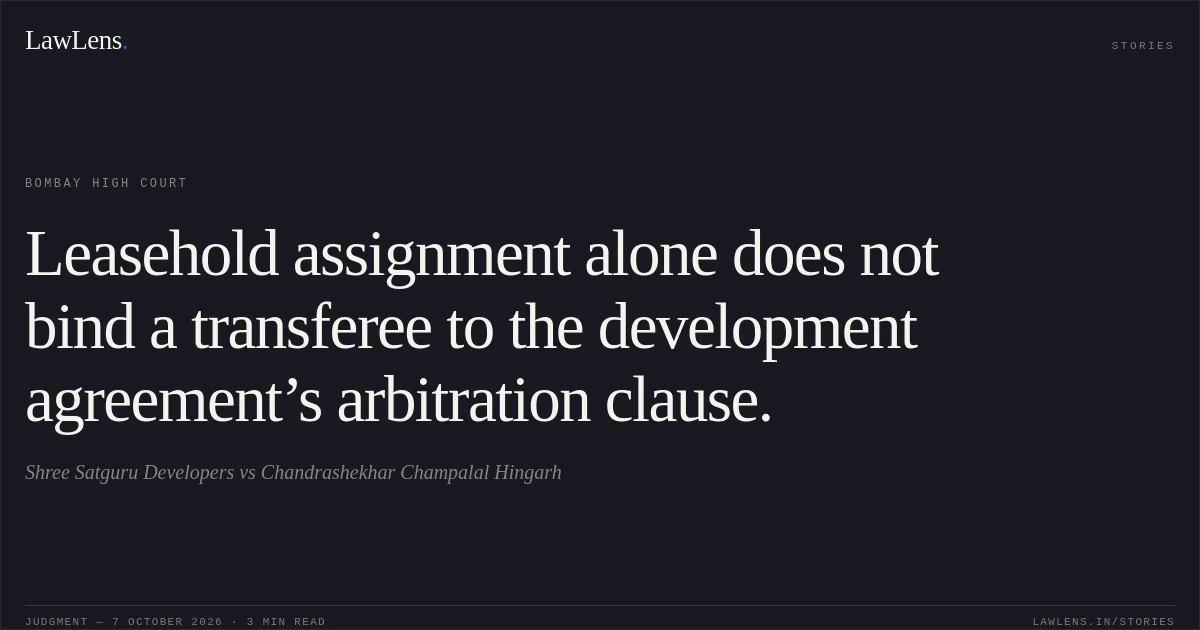
Source reference: paras. 10–12, 21–22A transfer of an interest in property, without more, does not establish assignment or adoption of a separate development agreement or its arbitration clause.
Source reference: paras. 16–20Under SBI General Insurance Co. Ltd. v. Krish Spinning, the referral court should not undertake an intricate evidentiary inquiry into limitation of the underlying claims; that issue is generally left to the arbitral tribunal, while the timeliness of the Section 11 application is considered at the referral stage.
Source reference: paras. 27–29The tribunal may determine jurisdictional objections under Section 16.
Source reference: paras. 28–30Reasoning
Clause 39 applied to disputes “between the parties hereto” and provided for appointment of an arbitrator by those parties. Respondent No. 1 was not a signatory, and the material showed an assignment of leasehold rights—not an assignment of the Development Agreement, acceptance of its obligations, or adoption of its arbitration clause. Its redevelopment proposal, knowledge of the Applicants’ asserted rights, and the tenants’ consent terms did not supply the necessary prima facie agreement to arbitrate.
Source reference: paras. 14–26By contrast, Respondent Nos. 2–4 were parties to the 2007 agreement containing Clause 39. Although the termination notice dated 18 December 2015 and the 2026 invocation raised a substantial delay, the Applicants relied on intervening discussions, payment, and other conduct. The Court held that the effect of those matters on limitation required consideration by the tribunal rather than a detailed determination under Section 11.
Source reference: paras. 27–35Holding
The Court partly allowed the application and referred the disputes between the Applicants and Respondent Nos. 2–4 to arbitration under Clause 39, appointing Mr. Amrut Joshi as sole arbitrator, subject to statutory disclosure requirements. The limitation objection was left open for determination by the tribunal under Section 16.
The application against Respondent No. 1 was rejected because no sufficient basis was shown to treat it as a party to the arbitration agreement.
Source reference: paras. 36–37Acts & Sections Cited
3 provisions across 1 statute referred to in this judgment. Each provision opens on LawLens.
Arbitration and Conciliation Act, 19963
Original Court PDF
Shree Satguru DevelopersvsChandrashekhar Champalal Hingarh
Click to open original judgment
Original judgment, available to read, download and summarize on LawLens.in