Facts
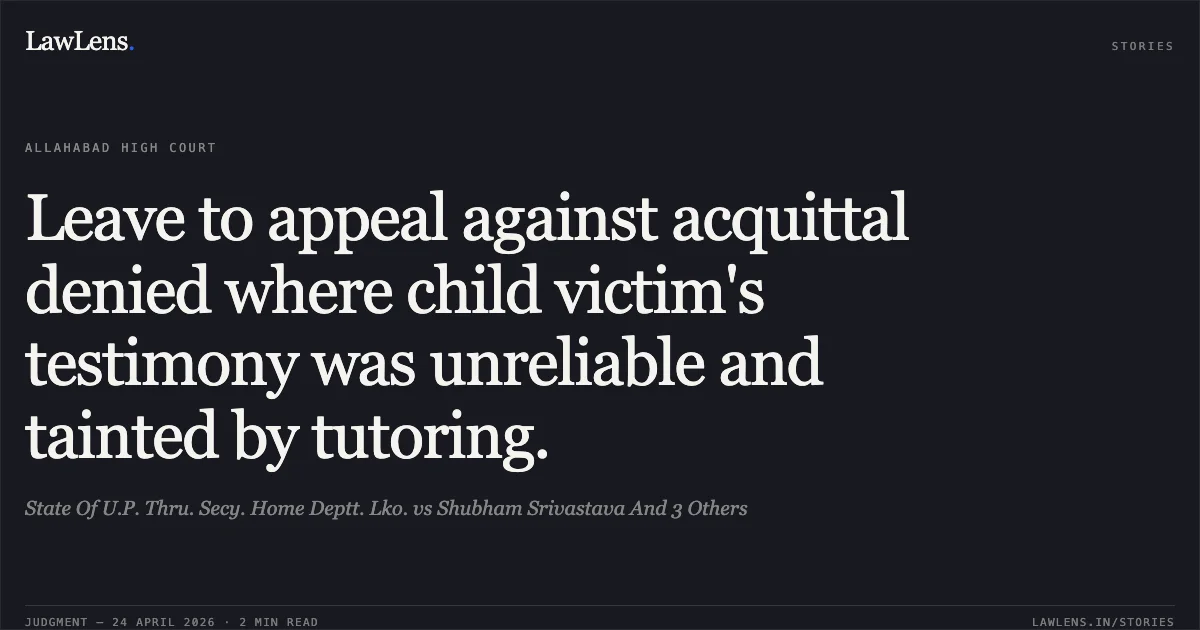
The State filed an application under Section 378(3) of the CrPC seeking leave to appeal against the acquittal of the respondent for offences under Sections 377, 504, 506 of the IPC and Section 3/4 of the POCSO Act.
Source reference: para. 2The prosecution alleged that on 09.04.2020, the accused committed an unnatural offence with the informant's seven-year-old son on a terrace, witnessed by the victim's elder brother.
Source reference: para. 3The FIR was lodged six days later on 15.04.2020.
Source reference: para. 3The Trial Court acquitted the accused, noting a delay in the FIR, lack of medical corroboration, non-examination of the eye-witness brother, and a pre-existing rent dispute between the parties.
Source reference: para. 8, 19Issues
1. Whether the State established a prima facie case or arguable points warranting the grant of leave to appeal against the judgment of acquittal.
Source reference: para. 14-152. Whether the Trial Court’s appreciation of evidence was perverse or suffered from manifest illegality requiring appellate interference.
Source reference: para. 16, 22Law Applied
The court applied Section 378(3) of the CrPC, which mandates that an appeal against acquittal cannot be entertained without the leave of the High Court.
Source reference: para. 11The presumption of innocence is reinforced by an acquittal and interference is only permitted for "substantial and compelling reasons" as established in Ramesh v. State of Haryana and Jafarudheen v. State of Kerala.
Source reference: para. 11-12At the leave stage, the court must see if a prima facie case or "arguable points" are raised rather than deciding the merits of the acquittal as per State of Maharashtra v. Sujay Mangesh Poyarekar.
Source reference: para. 14Rule of "adverse inference" where the best available evidence (an eyewitness) is withheld by the prosecution.
Source reference: para. 20Reasoning
The Court found that the prosecution failed to provide a prima facie basis to challenge the acquittal. First, the medical evidence conducted seven days post-incident showed no injuries, failing to corroborate the victim's testimony.
Source reference: para. 17-18The Court noted the significant six-day delay in lodging the FIR, which remained unexplained.
Source reference: para. 18The prosecution’s failure to examine the victim’s elder brother—the sole alleged eyewitness—led to an adverse inference against the State’s version.
Source reference: para. 20Regarding the victim’s testimony (PW2), the Court observed that the child witness "blew hot and cold," admitting in cross-examination that he was not on the terrace during the incident and that the case was maliciously filed due to a rent dispute.
Source reference: para. 21The Court reasoned that the conduct of the informant, who shift premises on the same day the FIR was finally lodged, supported the defense theory of malicious prosecution over rental arrears.
Source reference: para. 19Holding
The Court held that the Trial Court had taken a "best probable view" based on the evidence and that its findings were reasonable and plausible.
Finding no arguable points or manifest perversity, the High Court refused the prayer for leave to appeal and dismissed the application. The memorandum of appeal was consequently dismissed.
Source reference: para. 23Acts & Sections Cited
7 provisions across 3 statutes referred to in this judgment. Each provision opens on LawLens.
Code of Criminal Procedure, 19732
Indian Penal Code, 18603
Original Court PDF
State Of U.P. Thru. Secy. Home Deptt. Lko.vsShubham Srivastava And 3 Others
Click to open original judgment
Original judgment, available to read, download and summarize on LawLens.in