Facts
The petitioners were the original plaintiffs in Regular Civil Suit No. 225 of 2018, which was decreed by the Principal Senior Civil Judge, Rajkot, on 15 March 2019, including directions to the Revenue Authorities concerning mutation of their names in the subject land.
Source reference: paras. 8–8.1; pp. 4–5The State, which was not a party to the suit, subsequently sought leave to appeal against the decree.
Source reference: paras. 4–4.2, 8.2–10; pp. 2–5On 3 October 2020, the 7th Additional District Judge, Rajkot, granted the State leave to maintain the appeal without issuing notice to the petitioners or the original defendant.
Source reference: paras. 4–4.2, 8.2–10; pp. 2–5The State’s delay in filing the appeal was later condoned on 6 November 2025.
Source reference: paras. 4.2–4.3; pp. 2–3The petitioners challenged both orders under Article 227 of the Constitution, contending that the leave order had been passed in breach of natural justice.
Source reference: para. 3; p. 2Although the petitioners had approached the High Court after more than five years and their review application before the Appellate Court remained pending, the High Court entertained the challenge because the impugned order had been passed without hearing the affected parties.
Source reference: paras. 5–6, 11; pp. 3, 6Issues
Whether the Appellate Court could grant a non-party State leave to appeal against the civil decree without issuing notice to and hearing the parties affected by the decree
Source reference: paras. 8.2–10; pp. 4–5Whether the order granting leave to appeal, and the consequential order condoning delay in filing the appeal, were liable to be set aside for violation of the principles of natural justice
Source reference: paras. 4.2–4.3, 11–12; pp. 2–3, 6Whether the High Court should exercise its supervisory jurisdiction under Article 227 despite the petitioners’ delay in approaching the Court and the pendency of their review application
Source reference: paras. 3, 5.1, 11; pp. 2–3, 6Law Applied
The Court exercised supervisory jurisdiction under Article 227 of the Constitution of India.
Source reference: para. 3; p. 2The governing principle of natural justice requires that persons whose rights or interests may be affected by an order must be given notice and a reasonable opportunity of hearing before the order is passed.
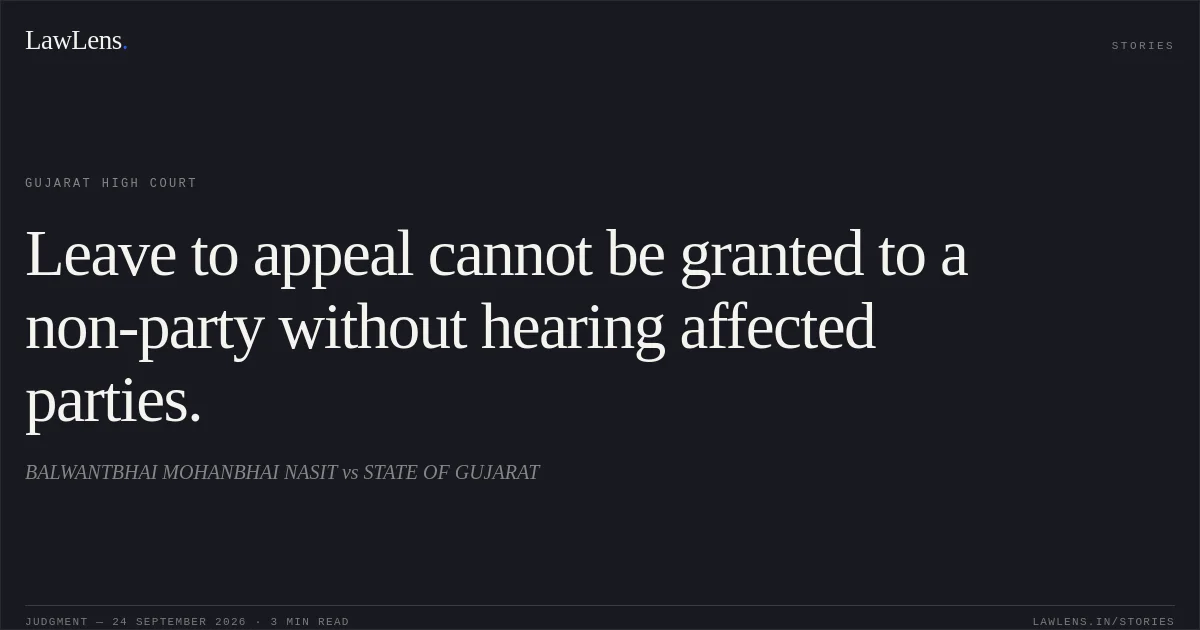
Source reference: paras. 9–10; p. 5Where a person who was not a party to the original suit seeks leave to maintain an appeal against the decree, the Appellate Court must hear the original parties before granting such leave.
Source reference: para. 10; p. 5The Court also observed that, in a leave-to-appeal matter, a separate application for condonation of delay is not ordinarily required when the appeal is dependent upon the grant of leave.
Source reference: para. 13; p. 6Reasoning
The State was not a party to the original suit but claimed to be affected by the decree and therefore sought leave to appeal. While the State could seek such leave, the Appellate Court was required to issue notice to the original plaintiffs and defendant because granting leave would enable a third party to challenge the decree affecting their rights.
Source reference: paras. 8.2–10; pp. 4–5The State was unable to show that any notice had been served or that the petitioners had been heard before the leave order was passed.
Source reference: paras. 6, 9; pp. 3, 5The High Court consequently found the order to have been passed in “flagrant violation” of natural justice.
Source reference: paras. 9–10; p. 5Although the challenge was delayed and a review application was pending, those factors did not justify sustaining an order fundamentally vitiated by denial of hearing, particularly since the delay in filing the appeal had itself subsequently been condoned and the petition was filed soon thereafter.
Source reference: para. 11; p. 6The Court therefore set aside both the leave order and the consequential delay-condonation order, without deciding the merits of the State’s proposed appeal.
Source reference: paras. 12–14; pp. 6–7Holding
The petition was allowed.
The High Court quashed and set aside the order dated 3 October 2020 granting the State leave to appeal and remanded the leave application to the Appellate Court for fresh consideration after hearing the affected parties.
Source reference: para. 12; p. 6The consequential order dated 6 November 2025 condoning delay was also set aside.
Source reference: paras. 12–13; pp. 6–7If the appeal had already been registered, the Appellate Court was directed to de-register it; if leave was later granted, the appeal could be re-registered and numbered in accordance with law.
Source reference: paras. 12–13; pp. 6–7The Court clarified that it had expressed no opinion on the merits and that all rights and contentions remained open before the Appellate Court.
Source reference: para. 14; p. 7Rule was made absolute, with no order as to costs.
Source reference: para. 15; p. 7Original Court PDF
BALWANTBHAI MOHANBHAI NASITvsSTATE OF GUJARAT
Click to open original judgment
Original judgment, available to read, download and summarize on LawLens.in