01Facts
The plaintiff sued for partition of seven properties, claiming they were joint-family properties.
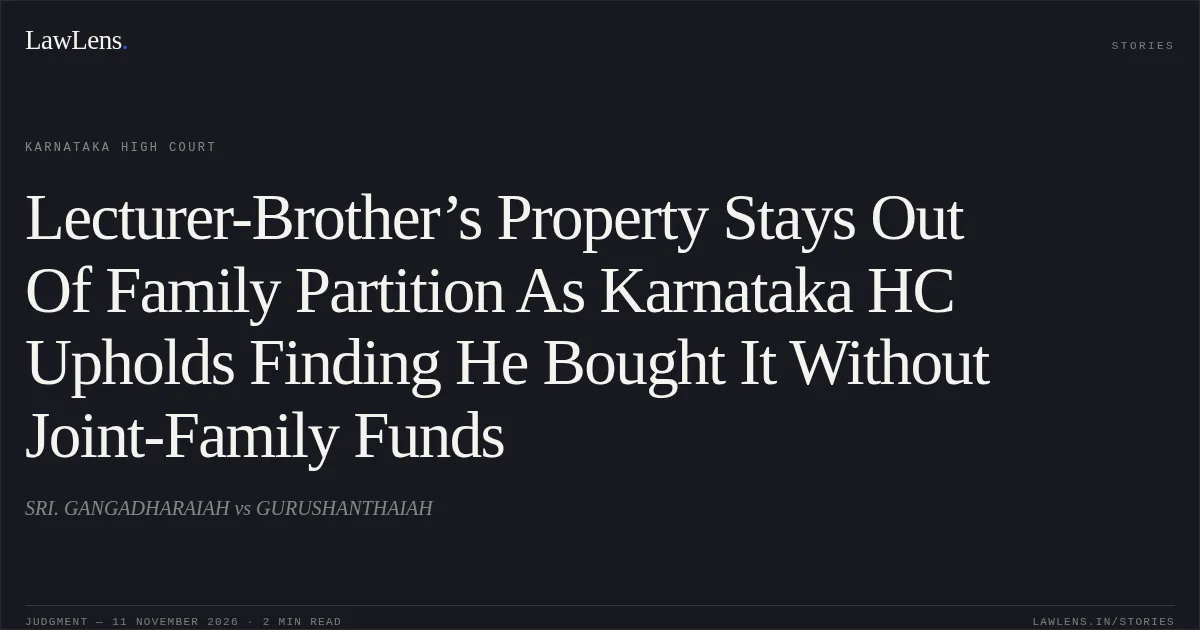
The Trial Court decreed shares in Items 1–6 but held Item 7 to be the separate, self-acquired property of defendant No. 2, who had purchased it in 1992.
The First Appellate Court affirmed that finding and dismissed the plaintiff’s appeal.
The plaintiff challenged the refusal of a share in Item 7 in this second appeal.
pp. 3, 15–16The concurrent findings were based on evidence that defendant No. 2 was a government teacher/lecturer, had separate income, obtained and repaid loans, and constructed on the property using his own funds.
pp. 10–12, 16–1702Issues
i.Whether Item 7 was a joint-family property in which the plaintiff was entitled to a share, or defendant No. 2’s separate, self-acquired property.
pp. 3, 16–17ii.Whether the concurrent findings that Item 7 was self-acquired disclosed a substantial question of law warranting interference under Section 100 CPC.
p. 2403Law Applied
Section 100 of the Code of Civil Procedure limits a second appeal to cases involving a substantial question of law; concurrent findings of fact are not ordinarily disturbed unless they are shown to be perverse, capricious, or affected by legal error.
p. 24In determining whether the property was joint-family or self-acquired, the courts considered its source of acquisition and the evidence concerning the purchaser’s independent income and funds.
The High Court cited no precedent in its reasoning.
Provisions in the judgment · 2 · Linked ones open on LawLens
Code of Civil Procedure, 1908 Section 100
Hindu Succession Act, 1956 Section 6
04Reasoning
The High Court found that the Trial Court and First Appellate Court had considered the sale deed, revenue records, evidence of defendant No. 2’s employment, loan documents and repayment, and evidence of construction funded from his earnings and borrowings.
pp. 10–12, 16–17The plaintiff produced no contrary evidence sufficient to unsettle those findings.
The High Court therefore held that the concurrent factual determination was supported by legal and acceptable evidence and was not perverse or otherwise legally infirm; no substantial question of law arose.
p. 2405Holding
The Court answered the challenge against the plaintiff: Item 7 remained the separate, self-acquired property of defendant No. 2, and the plaintiff was not entitled to a share in it.
p. 24Finding no substantial question of law warranting intervention, the High Court dismissed the second appeal at the admission stage.
p. 24Original Court PDF
SRI. GANGADHARAIAHvsGURUSHANTHAIAH
Click to open original judgment
Original judgment, available to read, download and summarize on LawLens.in