Facts
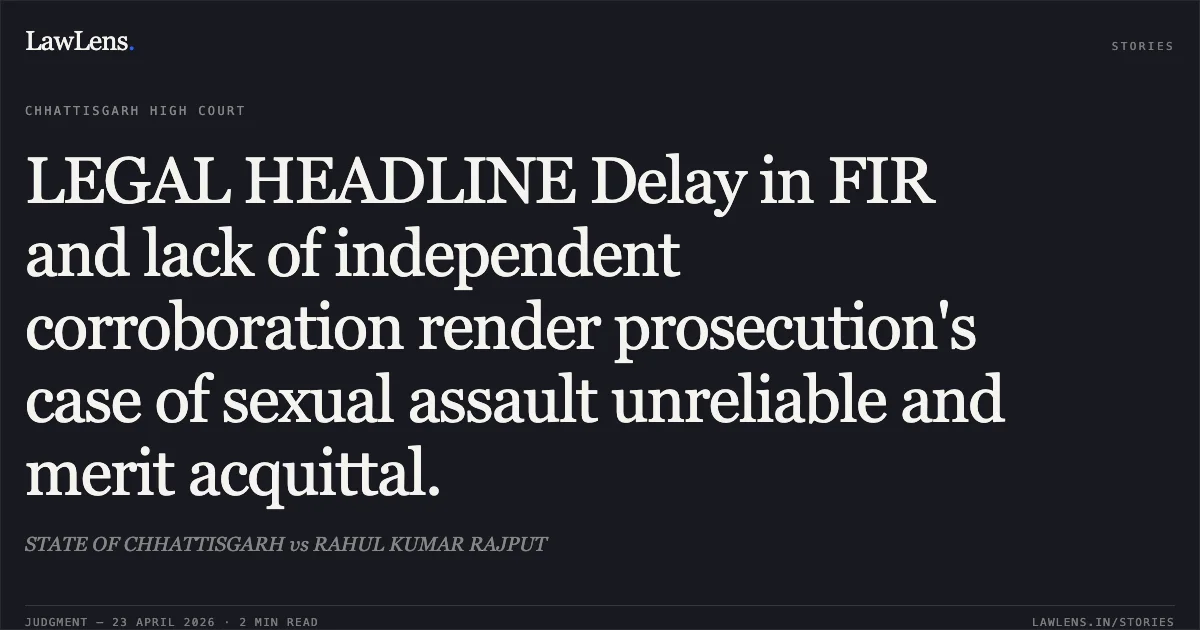
The State of Chhattisgarh sought leave to appeal under Section 378(3) of the CrPC against a judgment dated 21.11.2022 passed by the Additional Sessions Judge (F.T.C.), Durg, which acquitted the respondent of charges under Sections 376 (rape) and 506 (criminal intimidation) of the IPC
Source reference: p. 1-2The prosecution alleged that on 05.04.2021, the respondent called the victim (a former cook) to his house under the pretext of washing clothes and forcibly committed rape
Source reference: p. 2The victim did not report the matter immediately; the FIR was lodged over a month later
Source reference: p. 5The Trial Court acquitted the accused after finding material inconsistencies in the victim's testimony and an unexplained delay in reporting
Source reference: p. 4-5Issues
1. Whether the findings of the Trial Court were perverse, illegal, or based on a misapprehension of evidence such that the judgment of acquittal warranted interference by the High Court
Source reference: p. 3-42. Whether the prosecution established the guilt of the accused beyond reasonable doubt, specifically regarding the absence of consent and the allegation of criminal intimidation
Source reference: p. 4-5Law Applied
The Court applied Section 375 of the IPC defining rape and consent, and Section 376 for punishment
Source reference: p. 5Procedurally, it relied on Section 378(3) of the CrPC regarding leave to appeal against acquittal
Source reference: p. 1The Court emphasized the precedent set in State of Rajasthan v. Kistoora Ram (2022), which dictates that an appellate court should not interfere with an acquittal unless the view taken by the trial court is "impossible or perverse" or if two views are possible
Source reference: p. 6-7Reasoning
The High Court observed that the victim was a 39-year-old major, meaning statutory presumptions against consent did not apply
Source reference: p. 5The Court noted that the prosecution version relied solely on the uncorroborated testimonies of the victim (PW-1) and her husband (PW-3)
Source reference: p. 5Crucially, the Court found material omissions in the victim's deposition: while her written complaint mentioned a death threat, she failed to mention this during her examination-in-chief, undermining the charge under Section 506 IPC
Source reference: p. 5Furthermore, her conduct—failing to disclose the incident to her family or neighbors immediately and the one-month delay in filing an FIR—was deemed inconsistent with normal human conduct, even accounting for social trauma
Source reference: p. 5-6The Court reasoned that since the Trial Court’s view was a plausible interpretation of the evidence, it should not be substituted simply because another view might exist
Source reference: p. 6Holding
The High Court refused to grant leave to appeal, holding that the State failed to prove the Trial Court's judgment was perverse or unjust
The Court affirmed that the prosecution failed to establish the case beyond reasonable doubt. Consequently, the CRMP for leave to appeal was rejected, and the appeal was dismissed
Source reference: p. 5, 7Acts & Sections Cited
5 provisions across 2 statutes referred to in this judgment. Each provision opens on LawLens.
Indian Penal Code, 18603
Code of Criminal Procedure, 19732
Original Court PDF
STATE OF CHHATTISGARHvsRAHUL KUMAR RAJPUT
Click to open original judgment
Original judgment, available to read, download and summarize on LawLens.in