Facts
The writ petitioners sought to be recorded as bargadars (sharecroppers) regarding specific land, claiming their predecessors were recorded bargadars and that they continued cultivation after their demise
Source reference: p. 2Initially, the private respondents (owners) obtained a permanent injunction against the petitioners in a civil appeal
Source reference: p. 3Subsequent attempts to record the petitioners as bargadars were set aside by the Writ Court due to lack of notice to the owners
Source reference: p. 3The Block Land & Land Reforms Officer (BL & LRO) eventually rejected the petitioners' claim because they failed to establish the exact identity of the land and failed to produce receipts proving the delivery of the landlord's share of produce
Source reference: p. 4The Appellate Authority reversed this, but the West Bengal Land Reforms and Tenancy Tribunal subsequently set aside the Appellate Authority's order, restoring the BL & LRO’s rejection
Source reference: p. 2, 4The petitioners challenged the Tribunal's decision via the present writ petition
Source reference: p. 2Issues
1. Whether mere possession and cultivation of land are sufficient to establish a status of bargadarship under the West Bengal Land Reforms Act, 1955
Source reference: p. 4-52. Whether the delivery of a share of the produce to the landlord is a mandatory requirement for a claimant to be recognized as a bargadar
Source reference: p. 4-5Law Applied
The court applied the provisions of the West Bengal Land Reforms Act, 1955, regarding the definition and recording of bargadars
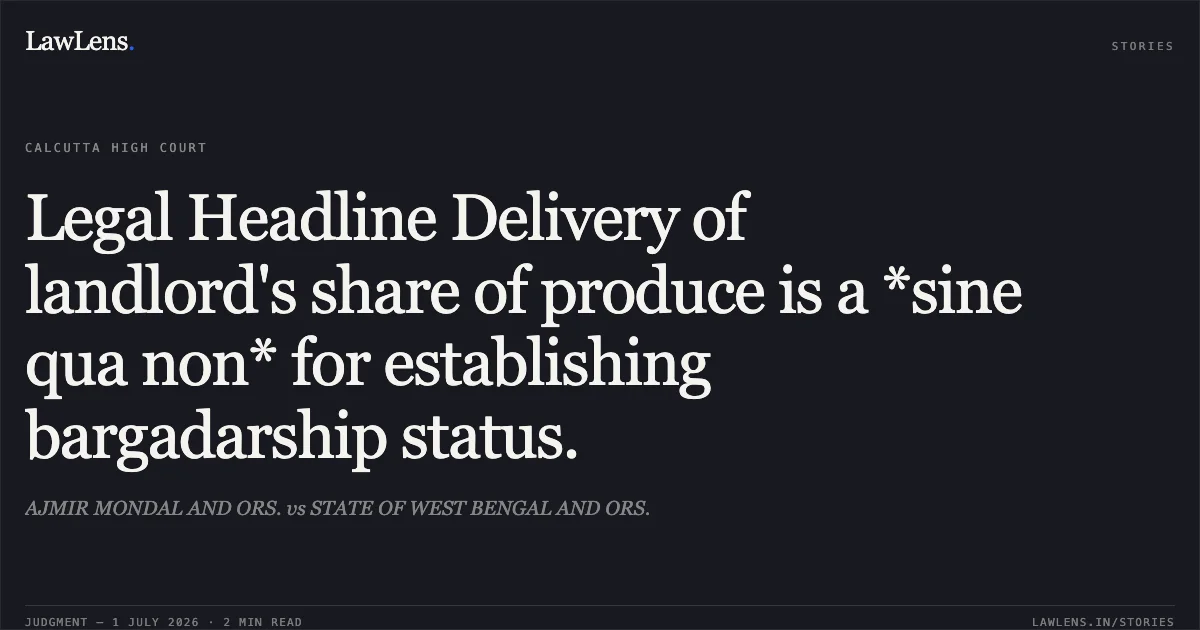
Source reference: p. 2the essence of bargadarship lies in the relationship of share-cropping, where the delivery of the landlord’s share of produce is a sine qua non (essential condition) for such status
Source reference: p. 4Abdul Jalil Mondal vs. State of West Bengal (1987), Gopal Chandra Das vs. State of West Bengal (1995), and Sk. Sattar vs. State of West Bengal (2006), which establish that the burden of proof lies on the claimant to provide cogent evidence of this relationship, specifically through receipts or proof of delivery of produce
Source reference: p. 4-5Reasoning
The Court found that the Appellate Authority erred by focusing solely on "cultivation and possession" while ignoring the mandatory legal requirement of share delivery
Source reference: p. 4since the petitioners could not produce any receipts or evidence showing that they had handed over the landlord's share of the crops, the essential legal element of the owner-bargadar relationship was missing
Source reference: p. 5The Court noted that the BL & LRO had correctly identified two fatal flaws: the inability to identify the specific land and the lack of crop-share receipts
Source reference: p. 4the Tribunal was legally justified in reversing the Appellate Authority’s decision because absence of such proof is fatal to a claim of bargardarship
Source reference: p. 5Holding
The Court held that mere possession or cultivation is insufficient to claim bargadarship in the absence of evidence proving the delivery of the landlord's share of the produce
The High Court dismissed the writ petition and affirmed the judgment of the West Bengal Land Reforms and Tenancy Tribunal dated March 31, 2026. All interim orders were vacated, and no costs were awarded
Source reference: p. 5Acts & Sections Cited
11 provisions across 2 statutes referred to in this judgment. Each provision opens on LawLens.
west bengal land reforms act, 19558
Original Court PDF
AJMIR MONDAL AND ORS.vsSTATE OF WEST BENGAL AND ORS.
Click to open original judgment
Original judgment, available to read, download and summarize on LawLens.in