Facts
The Petitioner Society entered into a Development Agreement (DA) in 2013 for property redevelopment with the Respondent Developer
Source reference: para. 3Following defaults in statutory dues, corpus payments, and transit rent, the Society filed a Section 9 Petition in 2017 seeking interim protection
Source reference: para. 4On December 14, 2017, the Court attached various personal assets of the partners and issued a blanket injunction against the Developer from alienating any properties across all their projects
Source reference: para. 30, 32Subsequently, thirty-one interim applications were filed by third parties (allottees/tenants from unrelated projects and family members) seeking to recover dues or intervene in the proceedings
Source reference: paras. 11-14An Arbitral Tribunal was finally constituted in September 2024, and a Section 17 Order was passed in February 2026
Source reference: para. 5, 7Issues
1. Whether a Section 9 Court preserves jurisdiction to entertain applications from third parties who are not signatories to the arbitration agreement
Source reference: paras. 20-212. Whether the Court should continue exercising jurisdiction under Section 9 once an Arbitral Tribunal has been constituted and has passed orders under Section 17
Source reference: paras. 22, 243. Whether blanket injunctions affecting unrelated projects should be maintained or relegated to the Arbitral Tribunal for reconsideration
Source reference: paras. 34, 39Law Applied
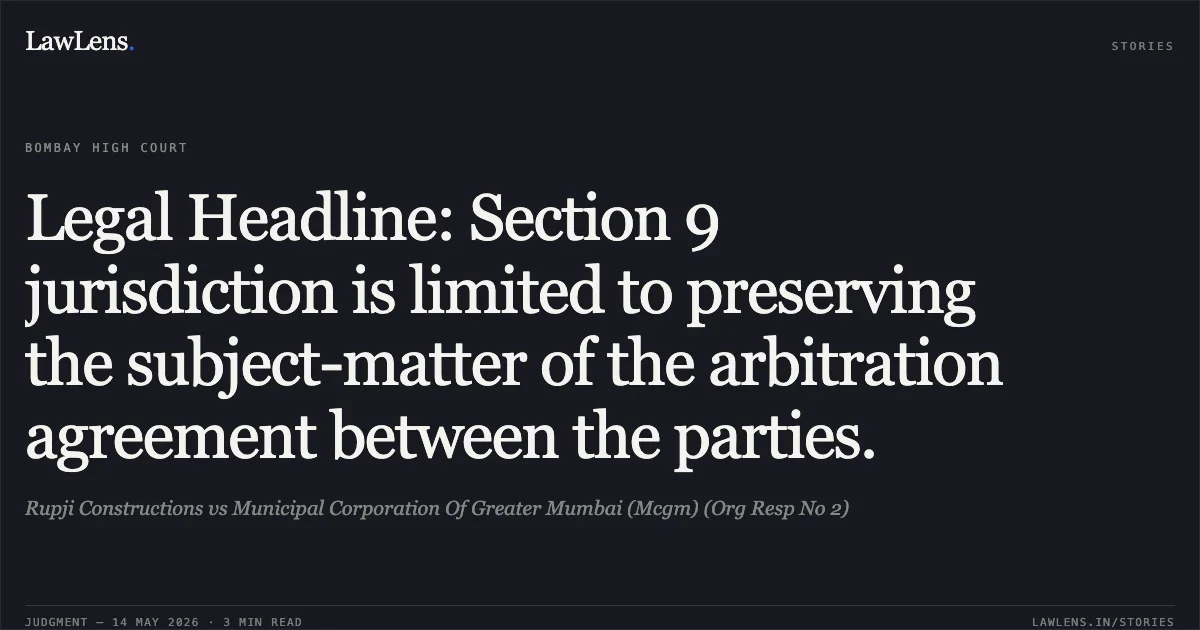
The Court applied Section 9 and Section 17 of the Arbitration and Conciliation Act, 1996, noting that the jurisdiction is limited to "parties" as defined under Section 2(1)(h) for the preservation of the "subject-matter of the arbitration agreement"
Source reference: paras. 19-21The Court relied on the principle from Firm Ashok Traders v. Gurumukh Das Saluja regarding the necessity of a manifest intent to arbitrate
Source reference: para. 23The Court integrated the doctrine of "veritable parties" or "non-signatories" as established in Cox and Kings Ltd. v. SAP India (P) Ltd., ASF Buildtech v. Shapoorji Pallonji, and Adavya Projects v. Vishal Structurals, which requires a non-signatory to show demonstrable proximity, consent, or a de facto connection to the dispute to be impleaded
Source reference: paras. 27-28Reasoning
The Court reasoned that Section 9 is not a standalone equity jurisdiction but is strictly aid-of-arbitration; therefore, the Society is the only "protectee" under this specific DA
Source reference: para. 21The Court found that third-party decree-holders from unrelated projects lack privity and cannot "shoo-in" to Section 9 proceedings to execute money decrees obtained in other forums
Source reference: paras. 27, 41Regarding the continuation of the December 2017 blanket injunction, the Court observed that under Section 9(3), once a Tribunal is formed, the Court must refrain from entertaining applications unless Section 17 is inefficacious
Source reference: para. 22The Court concluded that since the Society’s claims (damages of ~Rs. 18.65 Crores) are now before the Tribunal, the Tribunal is the proper forum to assess whether the security currently held in Court (over Rs. 11 Crores) is sufficient or surplus
Source reference: paras. 34-37Holding
The Court disposed of the Section 9 Petition and all 31 Interim Applications and held that third parties with no privity have no standing to intervene
The Court directed: (i) the Arbitral Tribunal to assess within three months the amount required to secure the Society's claim; (ii) any surplus funds to be released to the Developer, subject to orders from other competent execution courts; (iii) Respondent partner Tejal Rupji to honor his undertaking to clear third-party decrees within 12 months of such release; and (iv) the Court Commissioner to handover all materials to an official Registry-designated Commissioner and be paid fees of Rs. 2,50,000
Source reference: para. 70(C), 70(D), 70(F), 70(G)Acts & Sections Cited
7 provisions across 1 statute referred to in this judgment. Each provision opens on LawLens.
Arbitration and Conciliation Act, 19967
Original Court PDF
Rupji ConstructionsvsMunicipal Corporation Of Greater Mumbai (Mcgm) (Org Resp No 2)
Click to open original judgment
Original judgment, available to read, download and summarize on LawLens.in