Facts
The Petitioners (Trustees of the Parsi Punchayet) are landlords of Flat No. 2, Patel Building, Dadar. One Baji B. Patel was the original tenant who died on 23.04.1993
Source reference: para 3.1The Respondent, Katty J. Mistry, claiming to be Baji's first cousin (mother's sister's daughter), filed an application under the Bombay Rent Act for recognition as a tenant
Source reference: para 3.1The Petitioners contested this, alleging she was a trespasser who broke into the premises after Baji’s death
Source reference: para 4.4The Trial Court declared the Respondent a tenant
Source reference: para 5The Appellate Bench confirmed this status but set aside the finding that she was "residing" with the deceased at the time of death
Source reference: para 5, 12Issues
1. Whether a person can be recognized as a tenant under Section 5(11)(c)(i) of the Bombay Rent Act solely as an "heir" if they were not residing with the deceased tenant at the time of death.
Source reference: para 11, 182. Whether the Respondent successfully proved her status as a legal heir of the deceased tenant under the Indian Succession Act.
Source reference: para 13, 14Law Applied
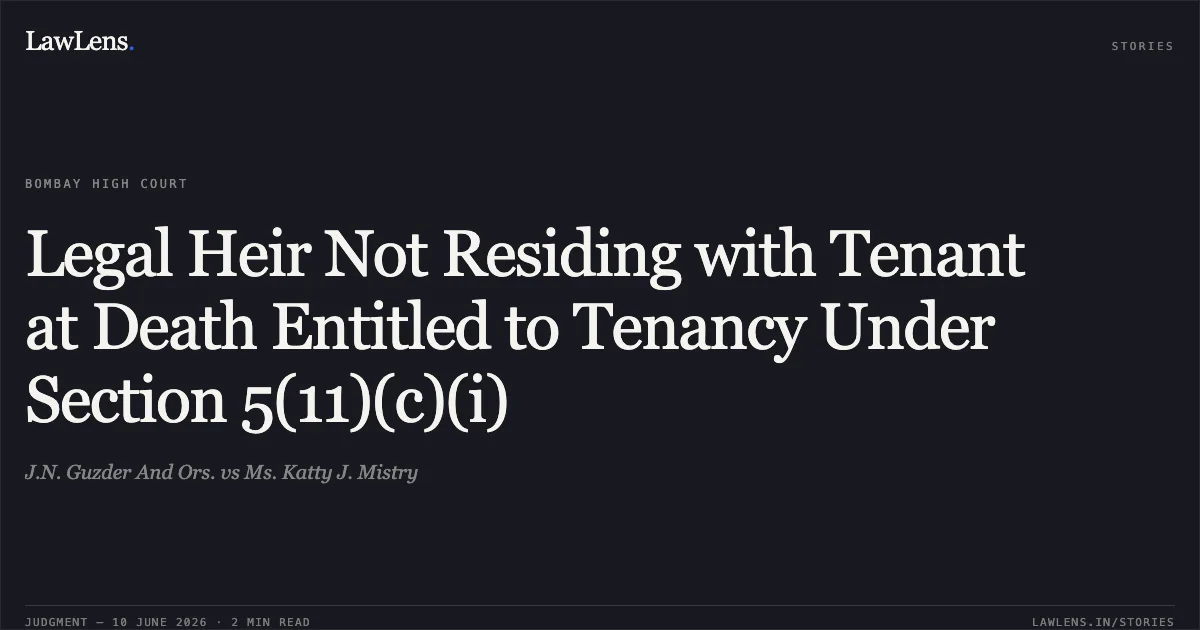
The court primarily applied Section 5(11)(c)(i) of the Bombay Rents, Hotel and Lodging House Rates Control Act, 1947, which defines "tenant" to include family members residing with the tenant at the time of death or, in their absence, any heir as decided by the Court
Source reference: para 18The Court interpreted the word "or" in this section as disjunctive, separating the requirement of residence from the status of heirship
Source reference: para 19The Court relied on Sections 50 and 55 of the Indian Succession Act, 1925 (and Schedule II, Part II, Clause 4) to determine heirship for Parsi intestacy
Source reference: para 14The court distinguished Kailasbhai Shukaram Tiwari v. Jostna Laxmidas Pujara regarding the definition of "family member"
Source reference: para 23The court applied the principle from Rajaram Brindavan Upadhyaya v. Ramraj Raghunath Upadhyaya that rent laws do not supersede rights of inheritance under personal law
Source reference: para 25Reasoning
The Court reasoned that Section 5(11)(c)(i) consists of two distinct parts: the first requires residence with the tenant; the second, applicable in the "absence of such member," allows any "heir" to be recognized
Source reference: para 19Since the Appellate Court found no family member was residing with Baji, the Respondent’s claim shifted to the second part
Source reference: para 20The Court found that the Respondent provided an undisputed genealogy proving she was Baji’s first cousin (mother’s sister’s daughter)
Source reference: para 13Crucially, she produced Unit Trust Certificates from 1988–1992 where she was a joint-holder with the deceased, corroborating their relationship prior to the litigation
Source reference: para 14As the Petitioner failed to produce any other rival heirs and the Respondent qualified as an heir under Parsi succession law, her claim was valid regardless of her non-residency
Source reference: para 16, 20Holding
The Court answered the issues in the affirmative, holding that under the second part of Section 5(11)(c)(i), an heir is not required to prove residence with the deceased tenant to claim tenancy
The Respondent's status as a first cousin and legal heir was supported by evidence and concurrent findings of the lower courts. The Writ Petition was dismissed, and the orders of the Small Causes Court declaring the Respondent as the tenant were upheld
Source reference: para 13, 28, 29Acts & Sections Cited
3 provisions across 2 statutes referred to in this judgment. Each provision opens on LawLens.
Indian Succession Act, 19252
Maharashtra Rent Control Act, 19991
Original Court PDF
J.N. Guzder And Ors.vsMs. Katty J. Mistry
Click to open original judgment
Original judgment, available to read, download and summarize on LawLens.in