Facts
The respondent/plaintiff claimed that Late Naveen Kumar Tiwari, father and husband of the appellants, borrowed a total of ₹2,60,000 from her through three transactions: ₹60,000 in cash on 29 September 2014 and ₹1,00,000 each by cheque on 19 December 2014 and 1 May 2017.
Source reference: p.2On 1 May 2017, the deceased executed a Promissory Note-cum-Receipt acknowledging the aggregate liability and undertaking repayment by 31 July 2018.
Source reference: p.2He subsequently issued two cheques of ₹50,000 each dated 10 July 2018, both of which were dishonoured.
Source reference: p.2After learning of his death on 1 August 2018, the plaintiff served a legal notice on the appellants, his wife and son, and instituted a recovery suit for ₹2,60,000 with interest.
Source reference: pp.2–3The appellants denied the loan, challenged the authenticity of the promissory note and cheques, disputed the plaintiff’s evidence, and contended that legal heirs could not be personally liable without proof that they had inherited the deceased’s estate.
Source reference: pp.3–4The Trial Court decreed the suit; the First Appellate Court affirmed the decree, holding that the promissory note constituted an acknowledgment extending limitation under Section 18 of the Limitation Act, 1963.
Source reference: pp.6–8The appellants then preferred the present Regular Second Appeal under Section 100 CPC.
Source reference: p.1Issues
1. Whether the plaintiff proved that Late Naveen Kumar Tiwari had received a friendly loan of ₹2,60,000 from her.
Source reference: p.4, Issue (i); pp.9–102. Whether the Promissory Note-cum-Receipt dated 1 May 2017 was validly executed and whether the appellants proved it to be forged or fabricated.
Source reference: p.4, Issues (ii)–(iii); pp.9–103. Whether the two cheques dated 10 July 2018 were issued by the deceased towards discharge of his loan liability.
Source reference: p.5, Issue (iv); p.114. Whether the acknowledgment contained in the promissory note extended the limitation period under Section 18 of the Limitation Act, 1963.
Source reference: pp.7–105. Whether the appellants, as legal representatives, were liable for the deceased’s debt, and whether the decree could be enforced against the estate inherited by them.
Source reference: p.5, Issue (v); pp.11–136. Whether the concurrent findings of the courts below raised any substantial question of law warranting interference under Section 100 CPC.
Source reference: p.8, para. 37; p.13, para. 58Law Applied
The Court applied Section 100 of the Code of Civil Procedure, 1908, under which a Regular Second Appeal is maintainable only where a substantial question of law arises; concurrent findings of fact are ordinarily not interfered with in the absence of perversity or legal error.
Source reference: p.1; p.13, para. 58Section 18 of the Limitation Act, 1963 provides that a written and signed acknowledgment of a subsisting liability gives rise to a fresh limitation period from the date of acknowledgment; the Court treated the Promissory Note-cum-Receipt as such an acknowledgment of the earlier loan transactions.
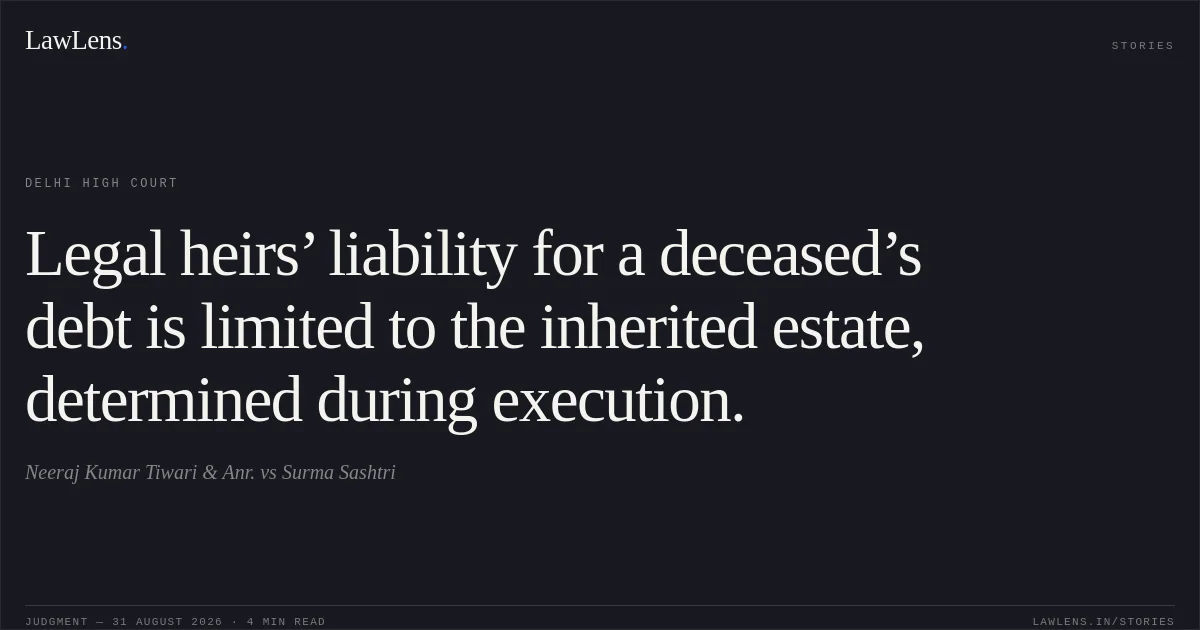
Source reference: pp.7–10Under Section 50 CPC, a decree against a legal representative is enforceable only to the extent of the deceased’s estate that has come into the legal representative’s hands; the Court held that the precise extent of the inherited estate could be determined at the execution stage.
Source reference: pp.11–12The Court also relied on the evidentiary value of consistent oral testimony, attesting-witness testimony, contemporaneous financial records, and the appellants’ failure to seek signature verification or produce documents supporting their plea of forgery.
Source reference: pp.9–11Reasoning
The Court found the loan transaction proved through the plaintiff’s testimony, her bank statement showing the two cheque payments and the corresponding cash withdrawal, the Promissory Note-cum-Receipt, and the evidence of the attesting witnesses.
Source reference: pp.9–10PW-2’s admission that he had not witnessed the earlier loans was not treated as a contradiction because the plaintiff’s case was that the earlier advances had occurred separately; his relevant testimony concerned execution of the promissory note.
Source reference: p.10, para. 42The promissory note specifically consolidated and acknowledged the three advances, thereby extending limitation under Section 18 from 1 May 2017.
Source reference: pp.9–10The two dishonoured cheques further corroborated the deceased’s continuing liability, while the appellants neither effectively disputed the signatures nor produced forensic or other evidence establishing fabrication.
Source reference: p.11The Court also relied on the appellants’ admitted receipt of the legal notice without reply.
Source reference: pp.11–12On the question of the appellants’ liability, the Court held that they were properly impleaded as the deceased’s legal representatives, while enforcement remained limited to the estate inherited by them.
Source reference: p.12, para. 51The courts below inferred that property at RZ-B-59, Arjun Park, Najafgarh, had belonged to the deceased and had been transferred and sold shortly after his death.
Source reference: pp.12–13The appellants’ failure to produce the relevant sale deed or other title documents justified the adverse inference that the property represented part of the deceased’s estate.
Source reference: pp.12–13Since both courts had returned concurrent findings based on documentary and oral evidence, and no substantial question of law was demonstrated, appellate interference under Section 100 CPC was unwarranted.
Source reference: p.13, para. 58Holding
The High Court dismissed the Regular Second Appeal, holding that the plaintiff had proved the ₹2,60,000 loan, the valid execution of the Promissory Note-cum-Receipt, and the deceased’s liability evidenced additionally by the dishonoured cheques.
The acknowledgment dated 1 May 2017 validly extended limitation under Section 18 of the Limitation Act.
Source reference: pp.7–10The appellants were liable as legal representatives only to the extent of the deceased’s estate in their hands, with the question of satisfaction against that estate falling substantially within execution proceedings.
Source reference: p.12The concurrent judgments and decree for ₹2,60,000 with interest and costs were therefore upheld, and the pending applications were disposed of.
Source reference: p.13, para. 58Acts & Sections Cited
4 provisions across 2 statutes referred to in this judgment. Each provision opens on LawLens.
Code of Civil Procedure, 19083
Limitation Act, 19631
Original Court PDF
Neeraj Kumar Tiwari & Anr.vsSurma Sashtri
Click to open original judgment
Original judgment, available to read, download and summarize on LawLens.in