Facts
The Appellants (Saleem, Maya, and Roshani) were convicted by the Trial Court under Sections 302/201/34 of the IPC for the murder of Dr. Ashok Kumar Bansal
Source reference: p. 2The prosecution alleged that Roshani (the deceased's wife) and her paramour Saleem, aided by Maya and Savitri, administered intoxicants to the deceased before killing him with danda blows and a knife, subsequently disposal of the body in a jheel at Kusumpur Pahari
Source reference: p. 3The case rested primarily on the testimony of PW-2 (the deceased’s 10-year-old daughter), who claimed to have witnessed the murder through a brick jaali
Source reference: p. 3, 34The case further relied on the recovery of skeletal remains following alleged disclosure statements by the Appellants
Source reference: p. 4Savitri's appeal abated upon her death
Source reference: p. 3Issues
1. Whether the testimony of the child witness (PW-2) was reliable and sufficient to sustain a conviction under Section 302 IPC
Source reference: p. 29, 342. Whether the disclosure statements and subsequent recoveries were admissible and valid under Section 27 of the Indian Evidence Act
Source reference: p. 40, 493. Whether the prosecution established a complete chain of circumstantial evidence to prove guilt beyond a reasonable doubt
Source reference: p. 51Law Applied
the court applied Section 118 of the Indian Evidence Act regarding the competency of child witnesses and Section 4 of the Oaths Act, 1969
Source reference: p. 30the court must record satisfaction regarding the child’s capacity to understand the duty of truth and screen for tutoring
Source reference: p. 31-33applying Section 27 of the Evidence Act as an exception to Sections 25 and 26, requiring the accused to be in "police custody" and the information to "distinctly relate" to the fact discovered
Source reference: p. 40-48The "five golden principles" for circumstantial evidence from Sharad Birdhichand Sarda v. State of Maharashtra were also applied
Source reference: p. 51Reasoning
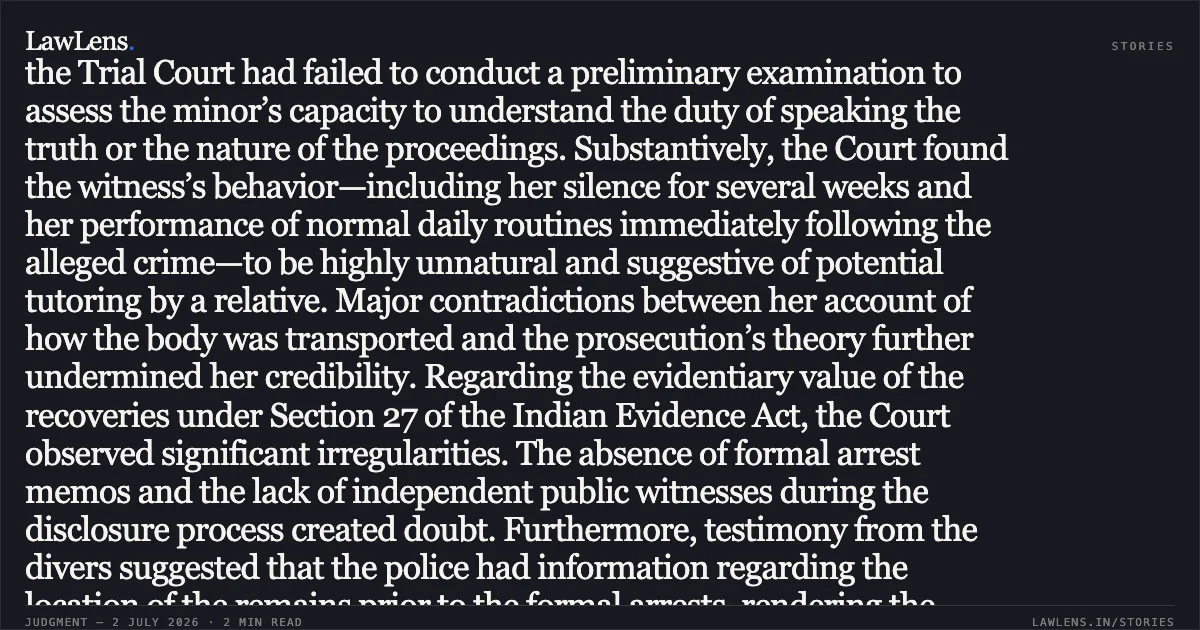
The High Court found the testimony of PW-2 unreliable due to material contradictions regarding the visibility of the crime through the jaali, the non-existence of an electricity meter, and the mode of transporting the body (car vs. bicycle)
Source reference: p. 34-37The court observed PW-2’s conduct was unnatural, as she did not raise an alarm or inform teachers/neighbors, remaining silent for days after the alleged murder of her father
Source reference: p. 38the Trial Court failed to conduct a preliminary examination of the child witness to assess competency
Source reference: p. 33Regarding the Section 27 recoveries, the High Court noted the absence of arrest memos and the lack of independent witnesses during disclosures
Source reference: p. 49the diver (PW-9) testified that police summoned him before the alleged arrests/disclosures occurred, suggesting the police already knew the body's location and rendering the "discovery" a "rediscovery" inadmissible under law
Source reference: p. 50The discrepancy in medical evidence regarding the deceased's height and the timing of death further weakened the prosecution's case
Source reference: p. 50Holding
The High Court held that the prosecution failed to prove the charges beyond a reasonable doubt
The court answered that PW-2 was not a "sterling witness" and the disclosures were legally flawed
Source reference: p. 37, 50The Judgment and Order of Sentence passed by the Trial Court were set aside, and the Appellants were acquitted
Source reference: p. 53The personal bonds and sureties were discharged
Source reference: p. 53Acts & Sections Cited
7 provisions across 3 statutes referred to in this judgment. Each provision opens on LawLens.
Indian Penal Code, 18603
Code of Criminal Procedure, 19732
Original Court PDF
Roshani & AnrvsState
Click to open original judgment
Original judgment, available to read, download and summarize on LawLens.in


