Facts
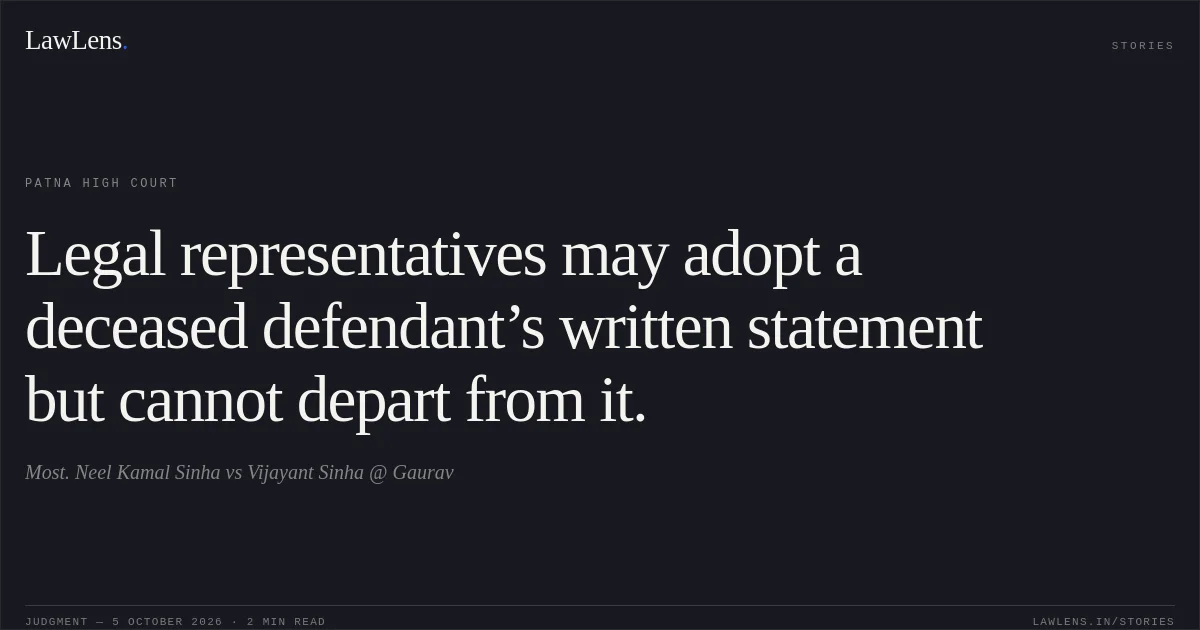
The petitioners—widow and daughters of Lalan Prasad Sinha—challenged an order dismissing their applications to adopt the written statement filed by Lalan in a probate proceeding concerning a Will dated 3 December 2002.
Source reference: p. 2–3Lalan had contested the Will and died while the proceeding was pending; his legal heirs were substituted and continued to contest the case, including by cross-examining the applicant’s witnesses.
Source reference: p. 2–3They sought permission to adopt Lalan’s written statement, contending that they had no independent pleadings and relied on his defence.
Source reference: p. 2–3The trial court rejected their applications dated 5 December 2025 by order dated 7 February 2026
Source reference: p. 2–3Issues
1. Whether the substituted legal representatives could adopt and rely on the written statement filed by the deceased defendant to contest the probate proceeding
Source reference: p. 3–52. Whether, after relying on the deceased defendant’s written statement, the petitioners could retract from or depart from its averments
Source reference: p. 6Law Applied
Order XXII Rule 4(2) of the Code of Civil Procedure permits the legal representative of a deceased defendant to raise defences available to the deceased, except defences personal to that deceased defendant.
Source reference: p. 4–6In Bal Kishan v. Om Parkash, AIR 1986 SC 1952, the Supreme Court recognised that a legal representative may file an additional written statement or objections raising such available pleas.
Source reference: p. 4–6In Jagdish Chander Chatterjee v. Sri Kishan, (1972) 2 SCC 461, the Court held that legal representatives may advance contentions the deceased could have raised, save those personal to the deceased; they may also assert an independent title.
Source reference: p. 4–6Vidyawati v. Manmohan, (1995) 5 SCC 431, was cited for these principles concerning the rights and defences of legal representatives
Source reference: p. 4–6Reasoning
The petitioners had been substituted as Lalan’s legal representatives and continued the contest on the basis of his defence.
Source reference: p. 3–6Applying Order XXII Rule 4(2) and the cited Supreme Court authorities, the High Court held that they could rely on the pleas available to Lalan, since they did not seek to advance an independent case and asserted that their challenge rested on his written statement.
Source reference: p. 3–6The court therefore found the trial court’s rejection of their applications unsustainable.
Source reference: p. 3–6Their reliance on that written statement, however, meant they could not retract from or deviate from its averments
Source reference: p. 3–6Holding
The High Court set aside the impugned order and allowed the civil miscellaneous application.
It permitted the petitioners to contest the proceeding on the basis of Lalan’s written statement, but barred them from retracting from or departing from its averments.
Source reference: p. 6–7The trial court was requested to dispose of the probate case expeditiously, without unnecessary adjournments, and both parties were directed to cooperate
Source reference: p. 6–7Original Court PDF
Most. Neel Kamal SinhavsVijayant Sinha @ Gaurav
Click to open original judgment
Original judgment, available to read, download and summarize on LawLens.in