Facts
The claimant sought compensation under Section 166 of the Motor Vehicles Act, 1988, alleging that a bus negligently struck his motorcycle on 21 May 2011, causing injuries.
Source reference: pp. 3–4, paras. 3–4He died while the claim petition was pending, and his legal representatives continued the proceeding as a death claim.
Source reference: p. 4, para. 6; p. 6, para. 15The Tribunal dismissed the petition, finding that the claimants had not established a nexus between the accident injuries and the claimant’s death.
Source reference: p. 4, para. 8His legal representatives appealed under Section 173(1) of the Act.
Source reference: p. 2Issues
Whether dismissal of the claim petition for failure to prove a nexus between the accidental injuries and the claimant’s death was justified
Source reference: p. 6, para. 13Law Applied
Under Section 166 of the Motor Vehicles Act, a claim for compensation may be pursued by legal representatives where the claimant dies during the pendency of the proceeding; however, where they seek to pursue it as a death claim, they must establish a causal nexus between the accidental injuries and the death.
Source reference: p. 6, para. 15The Court relied on Dhannalal Alias Dhanraj (Dead) through LRs v. Nasir Khan & Others, 2025 INSC 1177, for the right of legal representatives to continue the claim following the claimant’s death during its pendency, subject to proof of that nexus.
Source reference: p. 6, para. 15Reasoning
The Court found no medical evidence connecting the injuries to the claimant’s death.
Source reference: p. 7, para. 16The doctor who had treated him at Apoorva Hospital did not testify that the injuries could have caused death and described them as non-serious and non-fatal.
Source reference: p. 7, para. 16The disability certificate recorded fractures to the second and third phalanges of the left leg, which the Court considered insufficient, without supporting evidence, to presume a fatal connection.
Source reference: p. 7, para. 17The claimants had not examined the doctor who treated the claimant at Bapuji Hospital, where he died, or produced a post-mortem report.
Source reference: p. 8, para. 18In the absence of material proving the required nexus, the Court found no basis to interfere with the Tribunal’s dismissal.
Source reference: p. 8, para. 19Holding
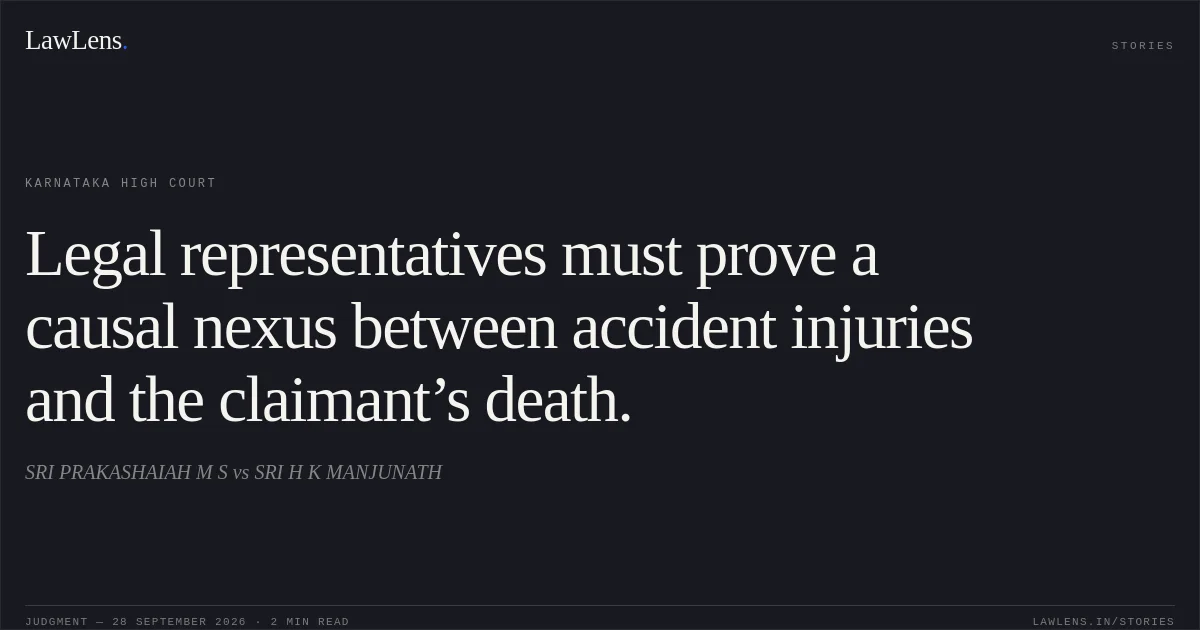
The Court answered the issue in the affirmative, holding that dismissal of the death claim was justified because the claimants had not proved a causal link between the accident injuries and the claimant’s death.
The appeal was dismissed, and the Tribunal’s award was left undisturbed.
Source reference: p. 8, para. 19Acts & Sections Cited
2 provisions across 1 statute referred to in this judgment. Each provision opens on LawLens.
Motor Vehicles Act, 19882
Original Court PDF
SRI PRAKASHAIAH M SvsSRI H K MANJUNATH
Click to open original judgment
Original judgment, available to read, download and summarize on LawLens.in