Facts
The appellants, sons and legal representatives of late Chikkamunivenkatappa @ Chikkapillappa, claimed that the schedule properties were the self-acquired properties of Avani Doddamuniga and had devolved through a settlement deed upon Doddamunivenkatappa @ Munivenkata.
Source reference: pp.2–4The latter allegedly executed a Will in favour of his brother, Chikkamunivenkatappa, the appellants’ father. The record principally refers to the Will as having been executed in 1957, although the trial court’s framed point refers to a Will dated 23 December 2006. The testator died in 1960 and the legatee died in 2019.
Source reference: pp.2–4The appellants stated that they discovered the Will in a wooden box while demolishing an old house in 2023 and thereafter filed a petition seeking probate.
Source reference: pp.2–4A citation was published in a Kannada daily, but no person entered appearance or contested the petition. The appellants examined themselves and produced documentary evidence.
Source reference: pp.4–6The I Additional District and Sessions Judge, Kolar, dismissed the petition, holding that the appellants were neither executors nor beneficiaries under the Will and observing that the long delay and circumstances of discovery created suspicion.
Source reference: pp.4–6The appellants challenged that order under Section 378 of the Indian Succession Act, 1925.
Source reference: p.1Issues
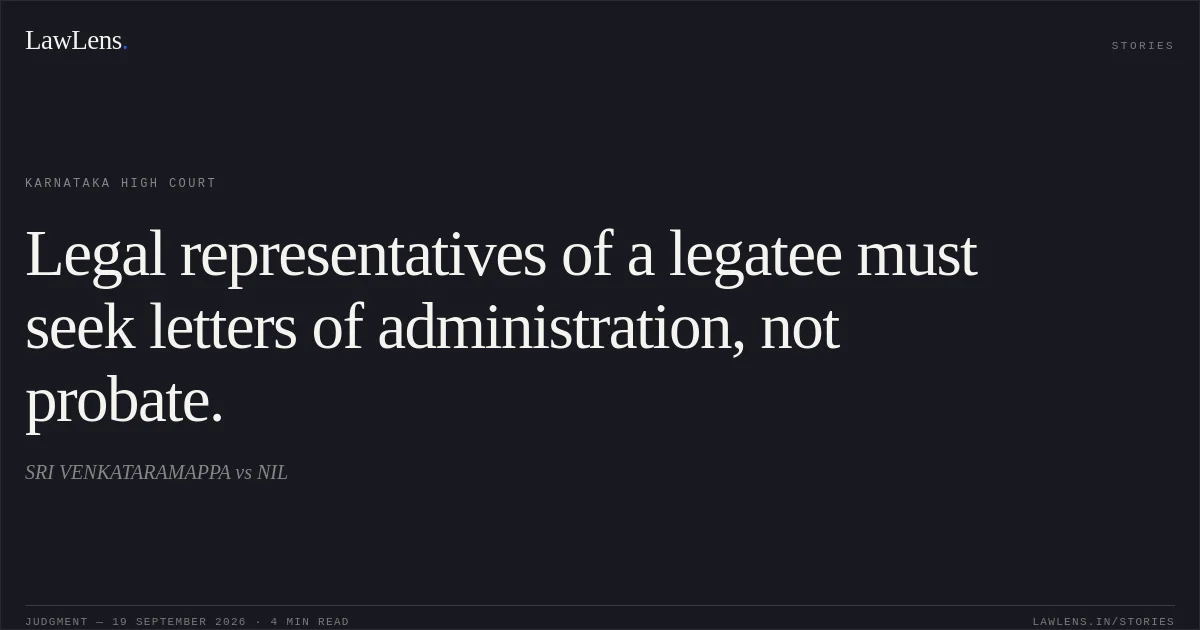
Whether the legal representatives of a legatee, who are not executors appointed under the Will, could maintain a petition for grant of probate.
Source reference: pp.13–15Whether the appellants’ claim ought to have been considered as one for letters of administration with the Will annexed under Section 278 of the Indian Succession Act, 1925.
Source reference: pp.9–10, 14–15Whether the delay in seeking testamentary relief and the circumstances surrounding the discovery of the Will raised issues of suspicion requiring adjudication on evidence rather than summary dismissal.
Source reference: pp.10–12, 14–16Whether the probate proceedings should be remitted for reconsideration after issuance of appropriate citations and notice to interested persons, including the legal representatives of the original owner.
Source reference: pp.15–16Law Applied
The Court applied Sections 222 and 232 of the Indian Succession Act, 1925, under which probate is ordinarily granted to an executor appointed expressly or by implication under the Will, whereas a person claiming through a legatee must ordinarily seek letters of administration with the Will annexed under Section 278.
Source reference: pp.9–10The Court relied on Kunvarjeet Singh Khandpur v. Kirandeep Kaur, (2008) 8 SCC 463, holding that no fixed limitation period is prescribed for applications for probate or letters of administration; the right to apply is continuing and accrues when it becomes necessary to apply, although unexplained delay—particularly delay exceeding three years—may generate suspicion that must be explained.
Source reference: pp.10–12The Court also recognised that the genuineness, due execution and attestation of the Will, as well as suspicious circumstances and delay, must be examined by the competent court on the facts of the case.
Source reference: pp.12–16Reasoning
The High Court held that the trial court correctly noticed that the appellants were not executors and that the Will had been made in favour of their father, who was the legatee.
Source reference: pp.13–15Consequently, the appellants’ petition for probate was procedurally defective because probate could not ordinarily be granted to legal representatives of a beneficiary who was not an executor.
Source reference: pp.13–15However, the proper consequence was not dismissal solely on that ground. The appellants could seek amendment and pursue letters of administration under Section 278.
Source reference: pp.13–15The Court further held that the 64-year delay, the asserted discovery of the Will in a wooden box, and the absence of an earlier application by the legatee were matters raising suspicion, but these issues required consideration by the trial court in light of the governing principles on continuing testamentary rights and delay.
Source reference: pp.10–12, 14–16Since the properties allegedly continued to stand in the name of the deceased legatee, and interested persons had not been properly brought before the court, the matter required fresh consideration after appropriate citations and notices.
Source reference: p.16Holding
The appeal was allowed in part.
The High Court set aside the order dated 14 August 2024 dismissing P & SC No. 149/2023 and remitted the matter to the I Additional District and Sessions Judge, Kolar, for fresh consideration in accordance with law.
Source reference: p.17The appellants were granted liberty to amend the petition to seek letters of administration and to implead necessary or proper parties, including the legal representatives of Doddamunivenkatappa, the original owner.
Source reference: pp.15–17The trial court was directed to reconsider the delay, the alleged suspicious circumstances, and the genuineness of the Will after issuing appropriate citations and notices.
Source reference: pp.15–17The Court also directed the Karnataka State Legal Services Authority to pay the appointed amicus curiae an honorarium of ₹10,000.
Source reference: pp.17–18Acts & Sections Cited
7 provisions across 2 statutes referred to in this judgment. Each provision opens on LawLens.
Indian Succession Act, 19256
Limitation Act, 19631
Original Court PDF
SRI VENKATARAMAPPAvsNIL
Click to open original judgment
Original judgment, available to read, download and summarize on LawLens.in