Facts
The appellants were the heirs and legal representatives of deceased original respondent Nos. 3 and 4, who had been parties to Arbitration Dispute No. 4 of 2003.
Source reference: para. 1–2An arbitral award was rendered on 18 October 2021.
Source reference: para. 1–2The original respondent No. 4, the mortgagor, died during the arbitration proceedings, and the appellants were substituted as his heirs and legal representatives.
Source reference: para. 3Under the award, original respondent No. 3 was discharged from liability, while the sale proceeds recovered from the mortgaged property of original respondent No. 4 were directed to be adjusted against his liability; related proceedings were also directed to be withdrawn.
Source reference: para. 4The bank had initiated proceedings under the Securitisation and Reconstruction of Financial Assets and Enforcement of Security Interest Act, 2002 (“SARFAESI Act”), concerning the mortgaged property.
Source reference: para. 5–6The Debt Recovery Tribunal rejected the challenge to those proceedings on 16 August 2012, and an appeal under Section 18 of the SARFAESI Act remained pending before the DRAT.
Source reference: para. 5–6The property was subsequently sold in a SARFAESI auction in 2016, and the recovered amount was deposited with the bank.
Source reference: para. 7The appellants challenged the arbitral award under Section 34 of the Arbitration and Conciliation Act, 1996, particularly on the ground that the mortgaged property was new-tenure/restricted-tenure land and could not have been mortgaged or sold without statutory permission.
Source reference: para. 10–12The Section 34 challenge was rejected, leading to the present First Appeal.
Source reference: para. 10–12Issues
Whether the arbitral award directing adjustment of the SARFAESI auction proceeds against the liability of the deceased mortgagor suffered from patent illegality or was otherwise liable to be set aside under Section 34 of the Arbitration and Conciliation Act, 1996.
Source reference: para. 7–10Whether the pendency of the appellants’ appeal under Section 18 of the SARFAESI Act enabled them to challenge the arbitral award or the findings concerning the mortgaged property.
Source reference: para. 8, 13Whether the appellants, as heirs and legal representatives of the deceased mortgagor, could dispute the mortgage on the ground that the property was new-tenure or restricted-tenure land.
Source reference: para. 11–14Law Applied
The Court applied Section 34 of the Arbitration and Conciliation Act, 1996, under which interference with an arbitral award is limited and is justified only on recognised statutory grounds, including patent illegality or conflict with the fundamental policy of Indian law.
Source reference: para. 5–6It also considered the SARFAESI Act, 2002, including the statutory recovery proceedings and the appellate remedy under Section 18.
Source reference: para. 5–6The Court held that an arbitral tribunal is competent to determine disputes arising from the contractual relationship between the parties, and its findings cannot be lightly interfered with unless they disclose patent illegality or violation of fundamental legal principles.
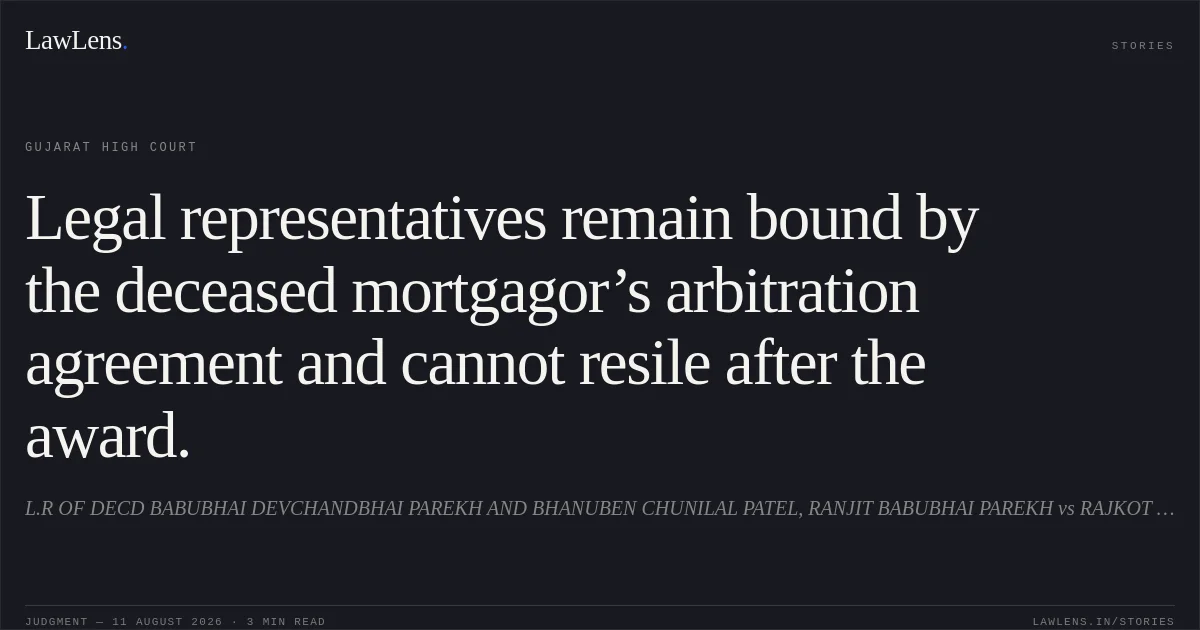
Source reference: para. 10–11Contractual terms, including the arbitration agreement, remain binding on the contracting party and, subject to law, on his heirs and legal representatives after his death.
Source reference: para. 13–14Reasoning
The Court found that the arbitral award did not impose a continuing recovery liability on the deceased mortgagor independently of the SARFAESI recovery; rather, it directed that the amount realised from the 2016 auction of the mortgaged property be adjusted against his liability.
Source reference: para. 4, 7Therefore, the pendency of the appellants’ SARFAESI appeal did not establish any patent illegality in the award or justify interference under Section 34.
Source reference: para. 8–10The Court further held that the deceased mortgagor had voluntarily mortgaged the property to secure the loan and had agreed to the bank’s right to invoke arbitration for recovery of dues.
Source reference: para. 12–14Having succeeded to his rights and obligations, the appellants could not resile from the contractual arrangement or reopen the mortgage-related objections in the appeal against the arbitral award.
Source reference: para. 12–14The Court also noted that the arbitral tribunal’s determination was made in accordance with the contracts and the arbitration clause, and that the award’s direction regarding adjustment of sale proceeds did not suffer from patent illegality.
Source reference: para. 9, 14Holding
The Court answered the issues against the appellants.
It held that the arbitral award was neither patently illegal nor beyond the tribunal’s jurisdiction, and that the pending SARFAESI appeal did not entitle the appellants to challenge the award or reopen the validity of the mortgage.
Source reference: para. 9–14The First Appeal was accordingly dismissed, the order passed in the Section 34 proceedings was upheld, and no order as to costs was made.
Source reference: para. 15Acts & Sections Cited
2 provisions across 2 statutes referred to in this judgment. Each provision opens on LawLens.
Securitisation and Reconstruction of Financial Assets and Enforcement of Security Interest Act, 20021
Arbitration and Conciliation Act, 19961
Original Court PDF
L.R OF DECD BABUBHAI DEVCHANDBHAI PAREKH AND BHANUBEN CHUNILAL PATEL, RANJIT BABUBHAI PAREKHvsRAJKOT NAGRIK SAHKARI BANK LTD
Click to open original judgment
Original judgment, available to read, download and summarize on LawLens.in