Facts
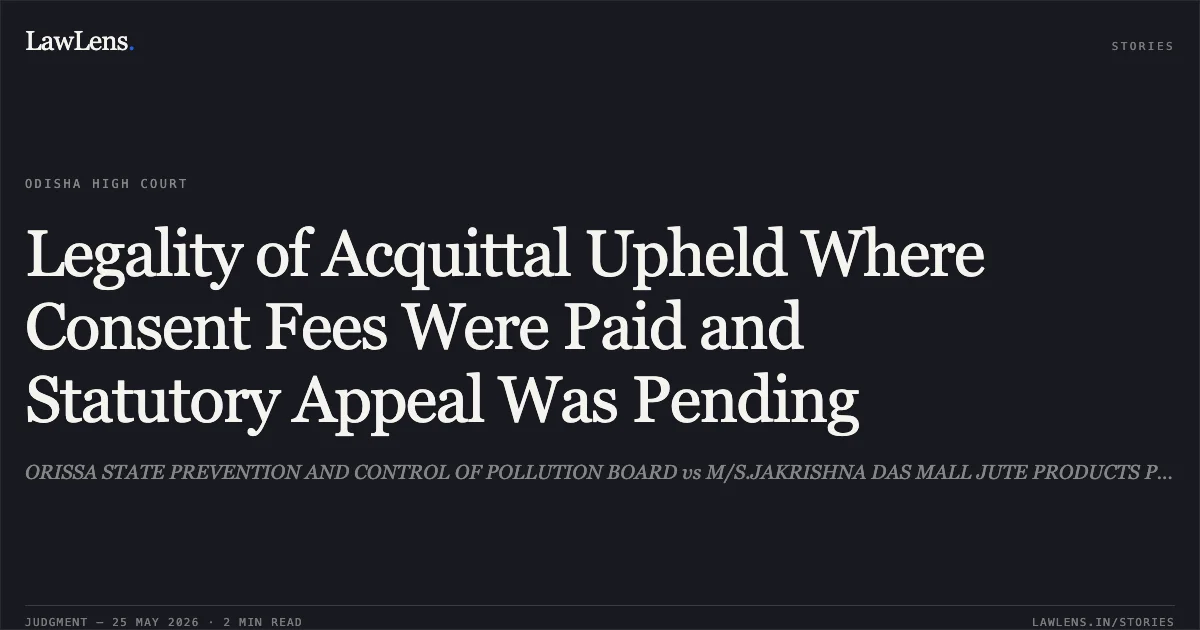
The Appellant Board initiated a complaint against the Respondents under Section 44 of the Water (Prevention and Control of Pollution) Act, 1974
Source reference: p. 2It was alleged that the Respondent-company, a medium-scale industry commissioned in 1975, discharged sewage and trade effluent into an open nala without obtaining statutory consent from the Board
Source reference: p. 2-3While the Respondents later applied for consent, the Board alleged a contravention of Sections 25 and 26 of the Act due to non-payment of prescribed consent fees
Source reference: p. 3The trial court (S.D.J.M., Balasore) dismissed the complaint on 31.05.1994, observing that the accused had paid initial fees and had a pending appeal regarding the computation of additional fees
Source reference: p. 3-4The Board challenged this acquittal through the present appeal. During the pendency of the appeal, the Respondent-company obtained a valid sanction to discharge effluents for the period 2026–2031
Source reference: p. 5Issues
1. Whether the findings of the trial court in dismissing the complaint for lack of cause of action were legally sustainable or perverse
Source reference: p. 5-62. Whether the subsequent compliance and obtaining of valid consent by the industry rendered the prosecution unnecessary
Source reference: p. 5Law Applied
The Court applied Section 44 of the Water (Prevention and Control of Pollution) Act, 1974, which provides penalties for contravention of Section 25 or Section 26 regarding restrictions on new outlets and discharges
Source reference: p. 2The Court further relied on the established principle of criminal jurisprudence that if two views are possible from the evidence, the one favoring the accused must be accepted, and a judgment of acquittal should not be interfered with unless it suffers from legal infirmity or perversity
Source reference: p. 6Reasoning
The Court scrutinized the trial court's reasoning which found that the prosecution lacked a cause of action because a dispute regarding the quantum of "further fees" was still pending before an appellate forum (Department of Environment)
Source reference: p. 4The High Court noted that the Respondents had already paid the acknowledged consent fees and had actively pursued legal remedies against higher demands
Source reference: p. 4Furthermore, the Court observed that the environmental objectives of the Act were being met, as the Board’s counsel confirmed the industry was currently functioning with a valid sanction effective until 2031
Source reference: p. 5The Court found that the trial court's conclusion—that the dispute over fee computation precluded a criminal conviction—was a "possible view" based on the documents produced (Ext. C, E, 21, and 7)
Source reference: p. 4, 6Holding
The Court held that the trial court’s judgment did not suffer from perversity and that the findings were sustainable on the face of the record
Given that the industry is now in compliance with the Act with a valid sanction until 2031, the Court found no merit in the appeal. The appeal was dismissed, and the acquittal of the Respondents was upheld
Source reference: p. 5-6Acts & Sections Cited
4 provisions across 2 statutes referred to in this judgment. Each provision opens on LawLens.
Code of Criminal Procedure, 19731
Water (Prevention and Control of Pollution) Act, 19743
Original Court PDF
ORISSA STATE PREVENTION AND CONTROL OF POLLUTION BOARDvsM/S.JAKRISHNA DAS MALL JUTE PRODUCTS PVT. LTD
Click to open original judgment
Original judgment, available to read, download and summarize on LawLens.in