Facts
The State of Himachal Pradesh historically engaged in ad hoc and contractual appointments for sanctioned posts to manage financial constraints
Source reference: paras. 5-7Over decades, various judicial pronouncements, including those in Taj Mohammad and Lekh Ram, mandated that contractual employees appointed via Recruitment & Promotion (R&P) Rules be granted service benefits, including seniority, upon regularization
Source reference: paras. 52, 170In response to these "troubling judgments" and citing a potential 21-year seniority overhaul and financial burden, the State enacted the Himachal Pradesh Recruitment and Conditions of Service of Government Employees Act, 2024 ("the Act")
Source reference: paras. 63, 118The Act retrospectively redefined "contractual service" as "regularization" (Section 8) and declared that service benefits such as seniority and increments would only accrue from the date of regularization, effectively withdrawing benefits previously granted by court mandates (Section 6)
Source reference: para. 64Thousands of employees challenged the Act’s constitutionality
Source reference: para. 2Issues
1. Whether the State Legislature has the competence to enact a law that directly nullifies or overrules final judicial mandates and mandamus issued by competent courts
Source reference: para. 1632. Whether the Act violates the "separation of powers" doctrine and the "Rule of Law" by intruding into the judicial sphere
Source reference: paras. 171, 1953. Whether the Act is "manifestly arbitrary" and violative of Articles 14 and 16 of the Constitution of India
Source reference: paras. 147, 191Law Applied
Article 309 of the Constitution regarding the power to regulate public services, noting it cannot be used to bypass the Constitutional scheme
Source reference: paras. 166, 191The court relied on the "Separation of Powers" doctrine and the "Rule of Law", which are basic features of the Constitution
Source reference: paras. 171, 174Principle from Janapada Sabha Chhindwara v. Central Provinces Syndicate Ltd. and Dr. Jaya Thakur v. Union of India, which establish that while a legislature may remove the legal basis of a judgment retrospectively, it cannot directly overrule a court's decision or nullify a mandamus
Source reference: paras. 157, 163Equality Clause under Article 14, stating that "manifest arbitrariness" is a ground to strike down plenary legislation
Source reference: paras. 149, 171Reasoning
The Court reasoned that the Act was not a "validating statute" intended to cure a technical defect in prior law, but a "mischievous" attempt to overwrite judicial interpretations of the Constitutional scheme
Source reference: paras. 168-170, 195The Court observed that Section 3 of the Act envisages an "extra-constitutional" mode of recruitment where persons perform government duties without being in "public service" until regularization, which creates a legal vacuum for pre-regularization engagement
Source reference: paras. 172, 196By making Section 8 retrospective, the State sought to "legislatively overrule" settled rights to seniority and increments already upheld by the Supreme Court, which the Court deemed a "transgression of constitutional limitations"
Source reference: paras. 195, 199The Court rejected the State’s defense of "financial constraints," ruling that paucity of funds cannot be used by a "Model Employer" to evade mandatory legal duties or balance budgets on the backs of employees
Source reference: paras. 176-178The Act was found discriminatory as it targeted only those appointed after 2003, while the State had already extended similar benefits to those appointed earlier
Source reference: para. 197Holding
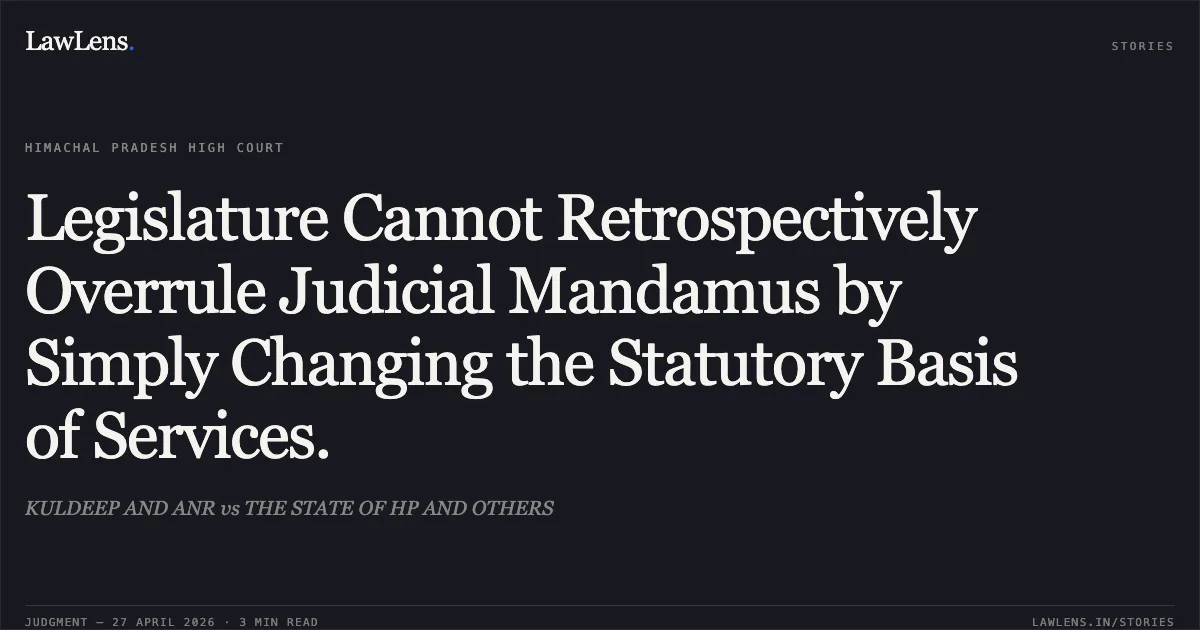
The Court answered the issues in the affirmative, declaring the Himachal Pradesh Recruitment and Conditions of Service of Government Employees Act, 2024, unconstitutional, ultra vires, and void ab initio
The Court held that the State cannot use its legislative power to nullify a mandamus or sit in appeal over judicial decisions
Source reference: para. 174The entire Act was quashed as Sections 3 and 5 to 9 were found to be in "flagrant violation" of the Constitutional framework
Source reference: para. 201The Court ordered the State to restore and ensure the extension of all service benefits, including seniority and increments, to the affected employees in accordance with prior judicial verdicts within three months
Source reference: para. 203Acts & Sections Cited
11 provisions across 3 statutes referred to in this judgment. Each provision opens on LawLens.
Limitation Act, 19631
Code of Civil Procedure, 19081
Motor Vehicles Act, 1988
Original Court PDF
KULDEEP AND ANRvsTHE STATE OF HP AND OTHERS
Click to open original judgment
Original judgment, available to read, download and summarize on LawLens.in