01Facts
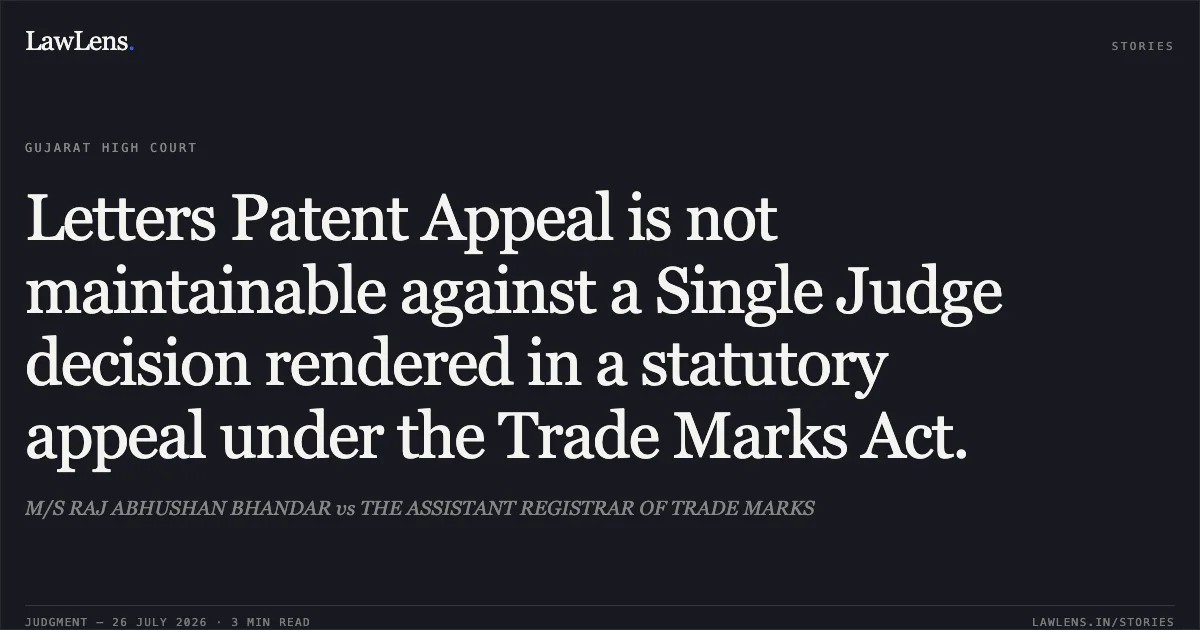
The appellant challenged a common judgment dated 11.07.2025 passed by a learned Single Judge of the Gujarat High Court.
p. 2This judgment was rendered in a statutory appeal under Section 91 of the Trade Marks Act, 1999, which in turn challenged an order of the Trademark Registry, Ahmedabad.
p. 2When the intra-court Letters Patent Appeal (LPA) was filed before the Division Bench, the respondent raised a preliminary objection regarding its maintainability, arguing that a second level of appeal is barred under the current statutory framework.
pp. 2-302Issues
i.1. Whether the Registrar of Trade Marks, in exercise of adjudicatory functions, qualifies as a tribunal having the "trappings of a Court"
p. 45 / para. 75ii.2. Whether Section 100A of the Code of Civil Procedure (CPC) bars a Letters Patent Appeal against an order passed by a Single Judge in a statutory appeal under Section 91 of the Trade Marks Act, 1999
p. 45 / para. 75iii.3. Whether the legislative omission of a second appeal provision in the Trade Marks Act, 1999 (as compared to the 1958 Act) implies an exclusion of the Letters Patent Appeal
p. 46 / para. 7503Law Applied
Section 100A of the CPC, which prohibits further appeals from a judgment/order of a Single Judge decided in an appellate capacity.
p. 6, 85Clause 15 of the Letters Patent, which restricts intra-court appeals to original jurisdictions and excludes judgments passed in exercise of appellate jurisdiction over subordinate courts.
p. 7, 79The "trappings of a court" test from Associated Cement Companies Ltd. v. P.N. Sharma and Kamal Kumar Dutta v. Ruby General Hospital Ltd. to determine the quasi-judicial nature of the Registrar.
p. 58, 71Principle of Legislative Intent, noting that the repeal of the 1958 Act (which specifically allowed a second appeal under Section 109(5)) and its replacement with the 1999 Act indicated a conscious deletion of that right.
p. 3, 82Provisions in the judgment · 30 · Linked ones open on LawLens
Arbitration and Conciliation Act, 1996 Section 49Section 50
Code of Civil Procedure, 1908 Section 4Section 104
Commercial Courts Act, 2015 Section 13
General Clauses Act, 1897 Section 8
Indian Succession Act, 1925 Section 299
Bombay High Court (Letters Patent) Act, 1866. Section 15
Patents Act, 1970 Section 77Section 79Section 80
Trade Marks Act, 1999 18 provisions
Section 3Section 5Section 9Section 11Section 18Section 19Section 20Section 21Section 22Section 28Section 57Section 91Section 127Section 128Section 129Section 131Section 132Section 157Tribunals Reforms Act, 2021 Section 21
04Reasoning
The Court reasoned that the Registrar of Trade Marks exercises the State's inherent judicial power, possessing powers to receive evidence, administer oaths, and award costs executable as a decree, thus satisfying the "trappings of a court" test.
pp. 68-70Consequently, the Single Judge’s review of the Registrar’s order under Section 91 constitutes the exercise of "appellate jurisdiction" over a tribunal.
p. 85The Court held that Section 100A of the CPC contains a non-obstante clause that overrides the Letters Patent, meaning no "further appeal" lies once a Single Judge has decided an appeal from an original order of a tribunal.
p. 73, 85The Court distinguished the Delhi High Court's view in Promoshirt SM SA, favoring the Calcutta High Court's reasoning in Glorious Investment Ltd., emphasizing that the 2021 amendment to the TM Act only changed the forum of appeal (from Board to High Court) but did not restore the second-tier appeal deleted during the transition from the 1958 Act.
pp. 82-84, 8705Holding
The Court upheld the preliminary objection and held that the Letters Patent Appeals are not maintainable.
pp. 87-88It concluded that since the Registrar is a tribunal with the trappings of a court, and the Single Judge acted in an appellate capacity, Section 100A of the CPC and the restrictive language of Clause 15 of the Letters Patent expressly bar a second intra-court appeal.
pp. 85-86The appeals were dismissed without prejudice to the parties' rights to challenge the merits in appropriate higher forums.
p. 88Original Court PDF
M/S RAJ ABHUSHAN BHANDARvsTHE ASSISTANT REGISTRAR OF TRADE MARKS
Click to open original judgment
Original judgment, available to read, download and summarize on LawLens.in