Facts
The appellant, a Deputy Registrar of Periyar University, was removed from service after a One-man Commission found certain charges proved, including that he influenced the grant of affiliation to a college managed by his wife, owned a house purchased without University permission, and possessed a car without obtaining the requisite permission
Source reference: para. 4–5, 13–15The writ court set aside the removal, holding that the findings were unsupported by evidence and based on conjecture.
Source reference: para. 7, 23On the University’s appeal under Clause 15 of the Letters Patent, the Division Bench reappraised the inquiry materials, reversed the writ court, and restored the removal order.
Source reference: para. 7, 23Saravanan appealed to the Supreme Court.
Source reference: para. 1–3Issues
1. Whether the writ court was entitled under Article 226 to interfere with the disciplinary findings as perverse and unsupported by evidence
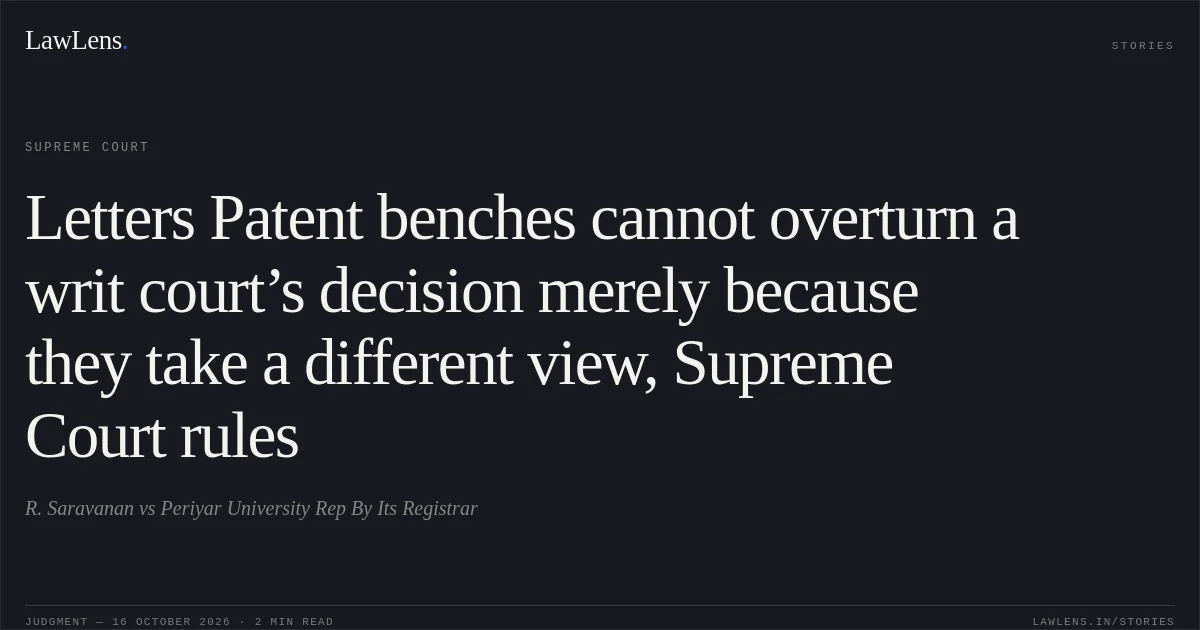
Source reference: para. 18, 20–212. Whether a Letters Patent Bench may reverse a writ court’s decision merely because it takes a different view of the facts, and what limits govern its appellate interference
Source reference: para. 1, 27–29Law Applied
Article 226 empowers the High Court to issue certiorari for jurisdictional error, breach of natural justice, or a finding based on no evidence; under Syed Yakoob v. K.S. Radhakrishnan, a no-evidence finding is an error of law, although the writ court does not ordinarily reappreciate evidence as an appellate court.
Source reference: para. 18Disciplinary findings must rest on evidence and a preponderance of probabilities; conjecture and surmise alone cannot establish misconduct.
Source reference: para. 16–17The Tamil Nadu Civil Services (Discipline and Appeal) Rules, 1955, including Rule 17(g), and Chapter VIII, Clause 13 of the University Statutes governed the inquiry and appointment of an inquiry authority.
Source reference: para. 9, 12Under Clause 15 of the Madras Letters Patent, a Division Bench may review questions of fact and law, but should give due weight to the writ court’s exercise of discretion and interfere only on cogent grounds where the findings are demonstrably erroneous or the mistake is glaring—not merely because it would reach a different conclusion.
Source reference: para. 27–29Reasoning
The Supreme Court held that the writ court had not impermissibly reassessed the evidence; it had identified the absence of evidentiary support for the Commission’s findings.
Source reference: para. 13–17, 20, 23The Commission inferred that Saravanan “could have” influenced the affiliation decision based on his position, treated loan repayments and failure to produce title documents as proof of ownership of the house, and found misconduct in the car purchase for want of permission, without sufficient evidence establishing the charged misconduct.
Source reference: para. 13–17, 20, 23Those findings were therefore susceptible to review under Article 226 as perverse and based on conjecture.
Source reference: para. 13–17, 20, 23Although the Letters Patent Bench had authority to examine facts, it reversed the writ court by reappraising the materials and drawing its own inferences, without identifying a cogent or glaring error in the writ court’s reasoning.
Source reference: para. 23, 28–30Holding
The Court held that the writ court was justified in setting aside the removal order and that the Division Bench had no sufficient ground to interfere with that decision.
The appeal was allowed; the Division Bench’s judgment was set aside and the writ court’s decision in W.P. No. 23936 of 2013 was restored.
Source reference: para. 30–31No order as to costs was made.
Source reference: para. 30–31Acts & Sections Cited
2 provisions across 1 statute referred to in this judgment. Each provision opens on LawLens.
Code of Civil Procedure, 19082
Original Court PDF
R. SaravananvsPeriyar University Rep By Its Registrar
Click to open original judgment
Original judgment, available to read, download and summarize on LawLens.in