Facts
On January 9, 2022, a Bolero Pick-Up (TN 57 BZ 5627) driven by the first respondent struck and killed Jeyachandran while he was standing near Vanjipalayam Privu
Source reference: para. 3The claimants (widow, minor children, and parents) sought compensation under Section 166 of the Motor Vehicles Act, 1988
Source reference: para. 4The appellant Insurance Company contested liability, arguing that the vehicle’s Fitness Certificate (FC) had expired on December 28, 2021—twelve days prior to the accident—constituting a fundamental breach of policy conditions
Source reference: para. 5The Motor Accident Claims Tribunal, Dharapuram, ordered the Insurance Company to pay the compensation and subsequently recover it from the owner ("Pay and Recover")
Source reference: para. 6The appellant challenged this liability before the High Court
Source reference: para. 7Issues
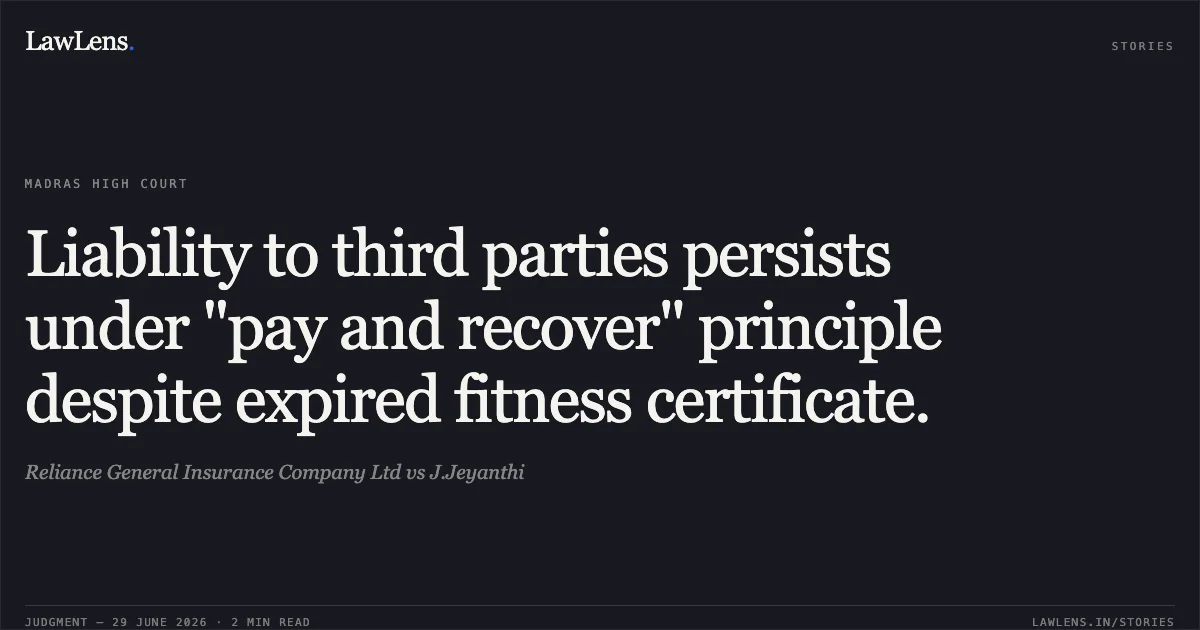
1. Whether the lack of a valid Fitness Certificate at the time of the accident absolves the Insurance Company of the liability to pay compensation to a third party
Source reference: para. 7 / 92. Whether the "Pay and Recover" principle is applicable in cases involving a statutory refraction such as an expired Fitness Certificate
Source reference: para. 9Law Applied
Section 173 of the Motor Vehicles Act, 1988, regarding appeals
Source reference: p. 1The principle that non-possession of a Fitness Certificate is a "fundamental statutory refraction," as established in The Commissioner v. K. Marayammal (2024)
Source reference: para. 9The "Pay and Recover" doctrine applied in C.M.A (MD) No. 685 of 2015, which protects third-party claimants despite policy violations by the insured
Source reference: para. 9Reasoning
The Court acknowledged that the Fitness Certificate (Ex.P6) had indeed expired on December 28, 2021, while the accident occurred on January 9, 2022
Source reference: para. 9While affirming that driving without an FC is a statutory violation that technically absolves the insurer of final liability, the Court prioritized the socio-economic status of the claimants. It noted that the deceased was a third party and the sole breadwinner for a family including two minor children
Source reference: para. 9Since the vehicle had previously held a valid FC until just days before the accident, the Court reasoned that the deviation was not so gross as to deny immediate relief to the victims. Consequently, it found the Tribunal’s application of the "Pay and Recover" method to be a proper exercise of equitable jurisdiction to ensure third-party indemnification while preserving the insurer’s right to seek reimbursement from the tortfeasor
Source reference: para. 9Holding
The High Court dismissed the appeal and confirmed the Tribunal's award dated December 5, 2025
The Court held that the "Pay and Recover" method was appropriate given the facts of the case, directing the Insurance Company to pay the claimants first and then recover the amount from the vehicle owner due to the breach of policy conditions regarding the Fitness Certificate
Source reference: para. 9All connected miscellaneous petitions were closed without costs
Source reference: p. 6Acts & Sections Cited
2 provisions across 1 statute referred to in this judgment. Each provision opens on LawLens.
Motor Vehicles Act, 19882
Original Court PDF
Reliance General Insurance Company LtdvsJ.Jeyanthi
Click to open original judgment
Original judgment, available to read, download and summarize on LawLens.in