Facts
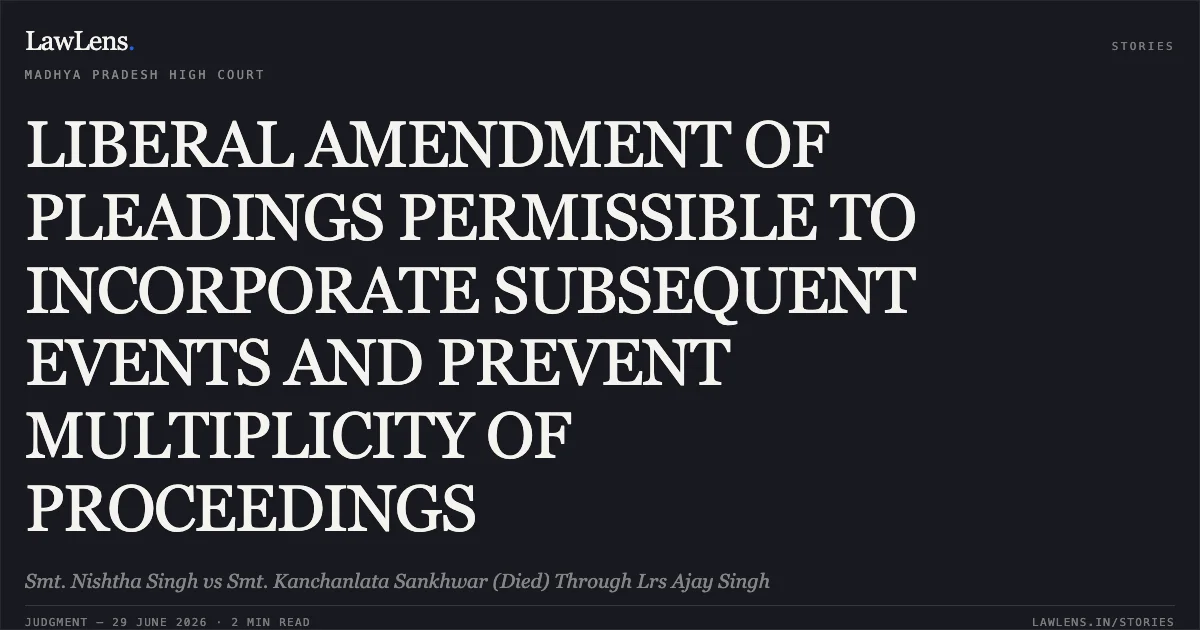
The original plaintiff, Smt. Kanchan Lata, filed a suit for eviction and recovery of arrears of rent against the petitioner/defendant under Sections 12(1)(a), 12(1)(c), and 12(1)(o) of the MP Accommodation Control Act, 1961.
Source reference: para 3.1During the pendency of the suit, the original plaintiff died (17-05-2021), and her legal heirs (LRs) were impleaded.
Source reference: para 3.2The LRs moved an application under Order 6 Rule 17 r/w Section 151 of the CPC to amend the plaint, asserting that under a Will, the property devolved to respondent No. 3, who requires it for her own residence.
Source reference: para 3.3The petitioner challenged the trial court’s order dated 23-04-2026, which allowed the amendment, contending it changed the nature of the suit from commercial to residential and was intended to harass her.
Source reference: para 4Issues
1. Whether the trial court erred in allowing the amendment application under Order 6 Rule 17 CPC, and whether such amendment changes the nature of the suit.
Source reference: para 4 / para 102. Whether the amendment was necessary for the effective adjudication of the controversy and to avoid multiplicity of proceedings.
Source reference: para 7 / para 11Law Applied
The court primarily applied Order 6 Rule 17 of the Code of Civil Procedure (CPC), 1908, governing the amendment of pleadings.
Source reference: para 8Dinesh Goyal @ Pappu v. Suman Agarwal (Bindu) (2024), which emphasizes a liberal approach to amendments to determine the real question in controversy, provided they do not cause injustice or withdraw a clear admission.
Source reference: para 8.1 / para 9Life Insurance Corporation of India v. Sanjeev Builders Pvt. Ltd. (2022), outlining that amendments should be allowed if they avoid multiplicity of proceedings and arise from subsequent events.
Source reference: para 8.2Reasoning
The court found that the amendment was necessitated by a subsequent event—the death of the original plaintiff—which occurred during the pendency of the suit.
Source reference: para 7The High Court rejected the petitioner’s argument that the nature of the suit had changed; it noted that the original plaint already alleged the tenant was using residential premises for commercial purposes, and the amendment merely specified the LRs' residential need.
Source reference: para 10Since the trial had not yet commenced (evidence stage), the court reasoned that the petitioner would have ample opportunity to file a rebuttal, thus suffering no prejudice.
Source reference: para 7Applying the principles from Dinesh Goyal, the court held that the trial court acted within its jurisdiction to ensure effective adjudication and prevent further litigation.
Source reference: para 9 / para 11Holding
The High Court dismissed the petition, holding that the trial court’s order was neither palpably illegal nor a jurisdictional error.
The court affirmed the decision to allow the amendment as it was based on subsequent events and necessary for the determination of the controversy. The petition was disposed of with no interference under Article 227 of the Constitution.
Source reference: para 11 / para 13The petitioner was granted liberty to file a consequential amendment to her written statement.
Source reference: para 12Acts & Sections Cited
1 provisions across 1 statute referred to in this judgment. Each provision opens on LawLens.
Code of Civil Procedure, 19081
Original Court PDF
Smt. Nishtha SinghvsSmt. Kanchanlata Sankhwar (Died) Through Lrs Ajay Singh
Click to open original judgment
Original judgment, available to read, download and summarize on LawLens.in