Facts
The petitioners, two corporate entities (Som Distilleries Pvt. Ltd. and Som Distilleries and Breweries Pvt. Ltd.), held eight liquor licenses for distilling, brewing, and bottling.
Source reference: para. 4, 31In 2011, a truck containing 1,200 boxes of the petitioners' liquor was intercepted for transporting goods using forged permit books to evade revenue.
Source reference: para. 52, 72Consequently, several employees and directors, including the Managing Director (Surjeet Lal) and Director (Gurudarshan Arora), were convicted by a Sessions Court on 23.12.2023 under Sections 420, 467, 468, 471, and 120-B of the IPC and Section 34(2) of the M.P. Excise Act.
Source reference: para. 14, 52, 73Based on this conviction, the Excise Commissioner issued a Show Cause Notice (SCN) on 26.02.2024.
Source reference: para. 4The petitioners filed replies on 04.03.2024 and 18.07.2024.
Source reference: para. 5On 04.02.2026, the Excise Commissioner passed an order suspending all eight licenses.
Source reference: para. 2The petitioners challenged this suspension under Article 226, arguing that the licenses for the 2025-26 period were "fresh grants" and could not be suspended based on an SCN relating to the 2023-24 period.
Source reference: para. 4Issues
1. Whether the suspension of current licenses based on an SCN issued during a previous licensing year is valid under Section 31 of the M.P. Excise Act.
Source reference: para. 45, 492. Whether the conviction of servants, agents, and directors for fraud and excise violations justifies the suspension of the corporate licenses under Section 31(1) and Section 44 of the M.P. Excise Act.
Source reference: para. 47, 483. Whether the suspension order violated the principles of natural justice as contemplated under Section 31(1-A) of the Act.
Source reference: para. 46, 51Law Applied
The court primarily applied Section 31 of the M.P. Excise Act, 1915, which empowers authorities to cancel or suspend licenses if the holder or their servants/agents are convicted of excise offences, revenue-related offences, or any cognizable and non-bailable offence.
Source reference: para. 50It further relied on Section 44 of the M.P. Excise Act, which establishes the vicarious criminal liability of a licensee for the acts of their employees.
Source reference: para. 77The court applied Rule 3(11) of the M.P. Distillery Rules, 1995, and Rule 3(12) of the M.P. Foreign Liquor Rules, 1996, which stipulate that manufacturing licenses are renewed annually subject to continued compliance with the Act.
Source reference: para. 28, 32, 85Regarding corporate liability, the court considered the "alter ego" doctrine as discussed in Iridium India Telecom Limited v. Motorola Incorporated and others [(2011) 1 SCC 74], attributing the mens rea of controlling persons to the corporation.
Source reference: para. 36, 78Reasoning
The court rejected the petitioners' argument that the licenses were fresh grants, distinguishing the precedent in N.S. Shethna v. Vinubhai Harilal Panchal by noting that the M.P. Excise Rules explicitly provide for "renewal" subject to the observance of the Act.
Source reference: para. 85, 86It found that the requirements of Section 31(1-A)—recording reasons and providing an opportunity to be heard—were satisfied as the petitioners had submitted two detailed replies to the SCN.
Source reference: para. 52, 62On the merits, the court held that the conviction of the truck driver and cleaner under Section 34(2) of the Excise Act directly triggered Section 31(1)(c) because they were persons "acting on behalf" of the licensee.
Source reference: para. 64Furthermore, the conviction of the Managing Director and Directors for forgery and conspiracy (IPC 420, 467, etc.) constituted cognizable and non-bailable offences under Section 31(1)(d).
Source reference: para. 74The court emphasized that using forged permits constitutes a fraud on the revenue, and under Section 44, the licensee is liable for such acts unless they prove they took all reasonable precautions.
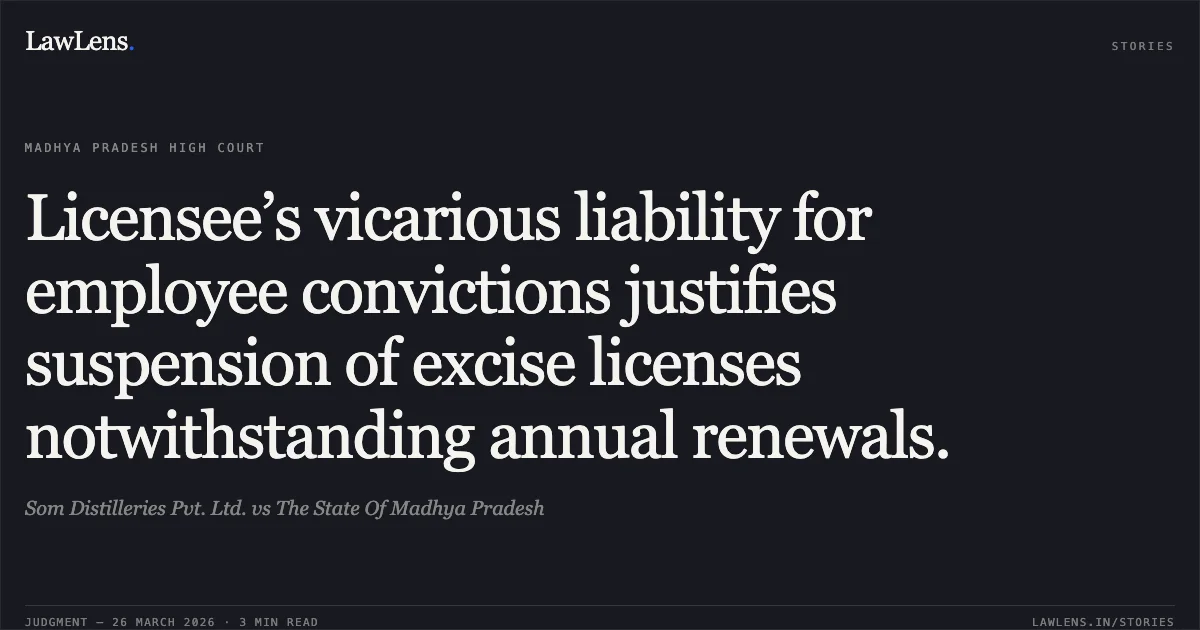
Source reference: para. 72, 77Finally, applying the doctrine of proportionality, the court held that since liquor trade is not a fundamental right, the state's interest in regulating revenue and penalizing fraud justified the suspension.
Source reference: para. 82, 90Holding
The High Court dismissed the writ petition, upholding the suspension order dated 04.02.2026.
(i) the licenses were renewals, not fresh grants, and remained subject to the pending SCN.
Source reference: para. 85(ii) the conviction of the company's directors and agents for excise and IPC offences provided sufficient legal grounds for suspension under Sections 31(1)(c) and (d).
Source reference: para. 74, 76(iii) the petitioners were afforded a reasonable opportunity to be heard through the SCN and subsequent replies.
Source reference: para. 62All pending applications were disposed of.
Source reference: para. 91Original Court PDF
Som Distilleries Pvt. Ltd.vsThe State Of Madhya Pradesh
Click to open original judgment
Original judgment, available to read, download and summarize on LawLens.in