Facts
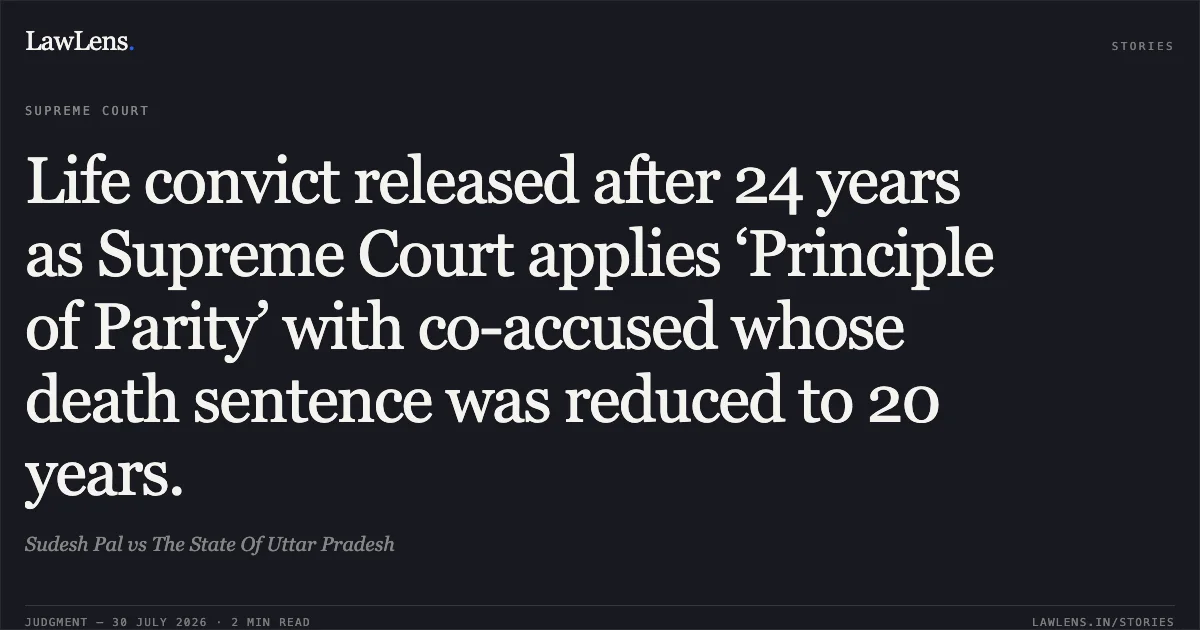
The applicant, Sudesh Pal, along with co-accused Madan and Ishwar, was convicted by the Sessions Court in 2015 under Section 302/149 of the IPC for a 2003 incident. The applicant and Madan were sentenced to death.
Source reference: p. 2-3On appeal, the Allahabad High Court commuted the applicant's death sentence to life imprisonment while upholding Madan’s death penalty.
Source reference: p. 3In 2023, the Supreme Court confirmed the applicant's life sentence but modified Madan’s death penalty to a fixed term of 20 years without remission. Madan was consequently released.
Source reference: p. 4-5The applicant filed this Miscellaneous Application seeking modification of his life sentence to 20 years on the grounds of parity, old age, and having already completed 24 years of incarceration with remission.
Source reference: p. 2, 5Issues
1. Whether the principle of parity in sentencing applies to an applicant whose sentence was already commuted to life by the High Court, when a co-accused (originally sentenced to death) subsequently received a fixed-term sentence of 20 years from the Supreme Court.
Source reference: p. 62. Whether the applicant is entitled to immediate release based on his period of incarceration exceeding the fixed term granted to the co-accused.
Source reference: p. 6, 7Law Applied
The Court primarily applied the Principle of Parity in sentencing.
Source reference: p. 6It operated under the framework of Section 302 read with Section 149 of the Indian Penal Code, 1860, regarding punishment for murder committed in prosecution of common object.
Source reference: p. 2-3The court exercised its discretionary power to modify sentences to a "fixed term" (e.g., twenty years) to serve the ends of justice while considering factors such as conduct, duration of incarceration, and the comparative culpability/sentencing of co-accused.
Source reference: p. 4, 6Reasoning
The Court analyzed the discrepancy between the sentences of the two primary accused. It noted that while the applicant’s sentence had been commuted to life earlier by the High Court, the co-accused Madan (who was initially viewed more severely by the High Court) eventually received a more favorable specific term of 20 years from the Supreme Court.
Source reference: p. 5, 6The State argued against parity, claiming Madan’s relief was based on a specific medical condition not present in the applicant’s case.
Source reference: p. 6However, the Court reasoned that since the co-accused—who was on a higher pedestal of punishment (death)—had his sentence restricted to 20 years and was released, the applicant (who was on a lower pedestal of life imprisonment) must also have his sentence restricted to the same period of 20 years to maintain judicial consistency and fairness.
Source reference: p. 6Holding
The Court answered the issues in the affirmative, holding that the principle of parity must be applied. The Court directed that the applicant’s life imprisonment be restricted to a term of 20 years.
Since the applicant had already completed 24 years of imprisonment with remission, the Court allowed the Miscellaneous Application and ordered his immediate release.
Source reference: p. 6, 7Original Court PDF
Sudesh PalvsThe State Of Uttar Pradesh
Click to open original judgment
Original judgment, available to read, download and summarize on LawLens.in