Facts
The appellant married the deceased on March 6, 2014. The complainant alleged that the appellant and his family harassed the deceased for a dowry of ₹2 lakh and a gold chain
Source reference: para. 4On June 6, 2014, within three months of marriage, the deceased died of 'Aluminium Phosphide' poisoning in her matrimonial home; post-mortem reports also revealed contusions on her head
Source reference: para. 4-5The Trial Court convicted the appellant under Sections 498-A, 304-B of the IPC, and Section 4 of the Dowry Prohibition Act, sentencing him to life imprisonment for the charge of dowry death
Source reference: para. 2 & 7The appellant challenged the sentence's severity, having already served approximately 14 years in custody including remissions
Source reference: para. 12Issues
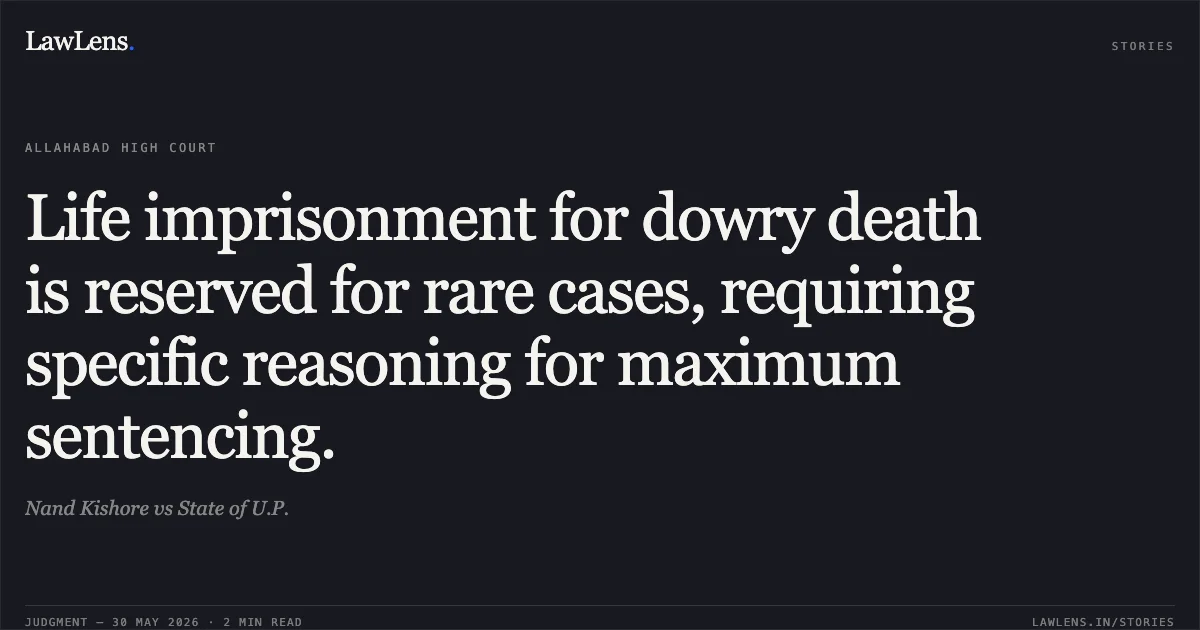
1. Whether the award of the maximum sentence of life imprisonment under Section 304-B IPC is mandatory or should be reserved for rare cases
Source reference: para. 132. Whether the Trial Court erred in failing to assign specific reasons for awarding the maximum sentence despite the presence of mitigating circumstances
Source reference: para. 18-19Law Applied
Section 304-B of the IPC, which prescribes a minimum of seven years’ imprisonment and a maximum of life imprisonment
Source reference: para. 2He*Hem Chand v. State of Haryana*, which established that life imprisonment under Section 304-B is an extreme punishment to be awarded only in rare cases
Source reference: para. 13-14"reformative approach" to sentencing as articulated in *K. Pounammal v. State*
Source reference: para. 16the requirement to balance aggravating and mitigating factors—such as criminal history, poverty, and age—under *Pramod Kumar Mishra v. State of U.P.*
Source reference: para. 19Reasoning
The Court observed that while the conviction was not challenged, the sentencing process was flawed because the Trial Court awarded the maximum punishment without assigning any cogent reasons
Source reference: para. 18-19The High Court noted that the appellant was a poor person with no prior criminal history and had already undergone significant "mental incarceration" by spending over 13 years in actual custody
Source reference: para. 11-12 & 17Applying the principles from *Hem Chand* and *Kashmira Devi*, the Court reasoned that the 14-year period already served (including remission) was sufficient to meet the ends of justice, especially since Section 304-B only mandates a seven-year minimum
Source reference: para. 13-15The Court emphasized that judicial orders must contain reasoning to be valid, and the Trial Court’s failure to address mitigating factors rendered the maximum sentence arbitrary
Source reference: para. 19Holding
The Court partly allowed the appeal
It upheld the conviction but modified the sentence for the offence under Section 304-B IPC from life imprisonment to the period already undergone (approx. 14 years)
Source reference: para. 20-21Regarding the sentence under Section 498-A IPC, the Court waived the ₹10,000 fine as the appellant had already served time exceeding the default sentence period
Source reference: para. 21The Court ordered the appellant’s immediate release upon execution of a bond under Section 437-A Cr.P.C.
Source reference: para. 23Acts & Sections Cited
5 provisions across 3 statutes referred to in this judgment. Each provision opens on LawLens.
Code of Criminal Procedure, 19732
Indian Penal Code, 18601
Original Court PDF
Nand KishorevsState of U.P.
Click to open original judgment
Original judgment, available to read, download and summarize on LawLens.in


