01Facts
The petitioners, as plaintiffs in O.S. No. 152 of 2017, sought a declaration of title over the "C" Schedule property and a permanent injunction.
¶ 3 · p. 3The suit had reached the stage of defence evidence, with the defendant's witness in the box.
¶ 3 · p. 3The plaintiffs then filed I.A. No. 4 of 2024 under Order VI Rule 17 CPC. It sought to strike out the plaint plan and substitute a new plan, add paragraphs 4(A) and 4(B) alleging post-suit encroachment and seeking a mandatory injunction, redefine the "C" Schedule as the "DEFG" (disputed) and "DEFG" (Koradu) portions, insert a new "D" Schedule, and claim a declaration over the Koradu portion.
¶ 3 · pp. 3–6The Trial Court dismissed the application on 19.08.2024, holding that the plaintiffs had virtually abandoned the original title relief, were attempting to change the cause of action, and that the amendment would alter the plaint's structure and necessitate a de novo trial.
¶ 4 · p. 6The certified copy was ready on 15.11.2024, but the present CRP under Article 227 was filed only on 22.10.2025.
¶ 5 · pp. 6–7In the interim, the defendant's evidence closed (13.08.2025), final arguments commenced (18.08.2025), and I.A. No. 5 of 2025 to reopen plaintiffs' evidence to examine the Tahsildar was dismissed on 08.10.2025.
¶ 5 · pp. 6–702Issues
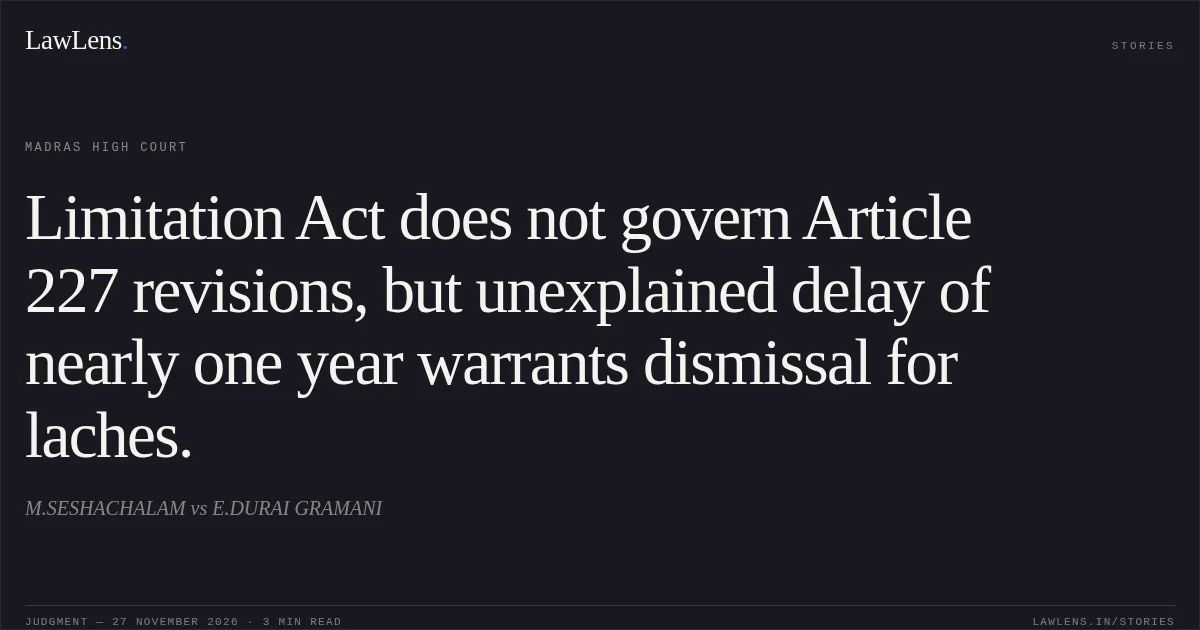
i.1. Whether the Civil Revision Petition under Article 227 of the Constitution, filed approximately one year after the impugned order, is liable to be rejected on the ground of laches.
¶ 5–6 · pp. 6–7ii.2. Whether the Trial Court's refusal to allow the amendment under Order VI Rule 17 CPC, on the ground that it alters the cause of action and structure of the plaint, warrants interference under Article 227.
¶ 7 · pp. 7–803Law Applied
The Court relied on Article 227 of the Constitution as the source of its supervisory jurisdiction over subordinate courts, which is limited to correcting jurisdictional errors or perversity.
¶ 7 · p. 8The Court acknowledged that the Limitation Act, 1963 does not strictly apply to revisions under Article 227, but held that such petitions must be filed within a reasonable time and are liable to dismissal for laches absent valid explanation.
¶ 6 · p. 7On amendment, the Court referred to Order VI Rule 17 CPC, under which the Trial Court assessed whether the proposed amendment changed the nature and structure of the plaint and necessitated a fresh trial.
¶ 4, 7 · p. 6, 8No precedents were cited in the judgment.
Provisions in the judgment · 2
Limitation Act, 1963 Section 25Section 27
04Reasoning
The Court first found the petition belated. The impugned order was dated 19.08.2024 and the copy was ready on 15.11.2024, yet the petition was filed on 22.10.2025, and in the meantime the trial had advanced to final arguments. Because the petitioners offered no valid reason for this delay, the Court held the petition liable to dismissal on laches.
¶ 5–6 · pp. 6–7On merits, the Court found no perversity or jurisdictional error. The Trial Court had considered the proposed amendment and concluded that the plaintiffs were recasting the property and their claim, which would change the suit's structure and require a fresh trial at a late stage. The Court therefore declined to interfere under Article 227.
¶ 4, 7 · p. 6, 8The judgment does not separately analyse the proviso to Order VI Rule 17 CPC or the cause-of-action test, and the explanation for the delay is not recorded.
05Holding
The Court held that the CRP is liable to be rejected for laches and, in any event, that the Trial Court's refusal to allow the amendment disclosed no perversity or jurisdictional error.
¶ 6–7 · pp. 7–8The CRP is dismissed and the order dated 19.08.2024 in I.A. No. 4 of 2024 in O.S. No. 152 of 2017 is confirmed. The Additional District Munsif Court, Kancheepuram, is directed to dispose of O.S. No. 152 of 2017 within two months of receipt of the order. No costs are awarded, and the connected miscellaneous petition is closed.
¶ 8 · p. 8Original Court PDF
M.SESHACHALAMvsE.DURAI GRAMANI
Click to open original judgment
Original judgment, available to read, download and summarize on LawLens.in