01Facts
The petitioner (wife) and respondent (husband) married on 02.03.1998 according to Hindu rites, and a daughter was born on 30.11.1999
p. 2 · ¶ 2(a)The petitioner alleges desertion and that the respondent remarried on 13.05.2011 while the marriage subsisted
p. 2 · ¶ 2(a) · ¶ 27The respondent denies any marriage, asserting that the petitioner was his housemaid
¶ 14A mutual consent divorce petition (HMOP No. 2738 of 2018) was dismissed on 26.03.2019 after the petitioner complained of coercion
p. 2 · ¶ 2(b)In MC No. 386 of 2019, the petitioner sought maintenance under s.125 Cr.P.C. The Family Court dismissed it on 30.09.2024, holding that no valid marriage was proved and that the petitioner, a Government employee with stable income, could maintain herself and was neither destitute nor vagrant
pp. 2–3 · ¶ 2(c)On the same day, the Family Court allowed the daughter's maintenance claim (MC No. 388 of 2019) at Rs.25,000 per month, relying on the same documents, including the birth certificate, ration card, power of attorney, and Aadhaar/voter ID
¶ 10That order was upheld in Crl. R.C. No. 1146 of 2025 on 22.07.2025, where this Court recorded the respondent's income as about Rs.1,30,000 per month as a Professor, plus rental income of Rs.2,00,000–5,00,000 per month and immovable property
¶ 11 · ¶ 38The petitioner had been unemployed when she filed her petition and now earns about Rs.31,000 per month
¶ 8 · ¶ 34She produced additional documents in revision, including engagement photographs, a marriage invitation, and sale deeds dated 01.07.2003 and 06.07.2005
¶ 602Issues
i.1. Whether the petitioner has established a marital relationship with the respondent for the purpose of claiming maintenance under s.125 Cr.P.C. (s.144 BNSS).
¶ 16(i) · ¶ 19–27ii.2. Whether the petitioner, being a Government employee earning Rs.31,000 per month, is disentitled from claiming maintenance.
¶ 16(ii) · ¶ 28–35iii.3. Whether the respondent has sufficient means to maintain the petitioner.
¶ 16(iii) · ¶ 36–39iv.4. Whether the impugned order dismissing the maintenance petition is sustainable in law.
¶ 16(iv) · ¶ 40–44v.5. If the above are answered in the petitioner's favour, what quantum of maintenance should be awarded.
¶ 16(v) · ¶ 45–4903Law Applied
The Court relied on s.125 Cr.P.C. (s.144 BNSS), which permits a Magistrate to order maintenance for a wife unable to maintain herself, with "wife" including a divorced woman who has not remarried, and which requires a sufficient-means husband.
¶ 17The Explanation to s.125(3) makes a husband's second marriage a just ground for the wife's refusal to live with him, and s.125(4)–(5) bar maintenance only for adultery, unjustified refusal to cohabit, or mutual living apart.
¶ 17, 43Under Chaturbhuj v. Sita Bai (2008), s.125 is a measure of social justice, and "unable to maintain herself" does not require complete destitution; the test is whether she can maintain herself at the standard she enjoyed in the matrimonial home.
¶ 18Under Badri Prasad (1978), Tulsa v. Durghatiya (2008), and Kamala v. M.R. Mohan Kumar (2019), long cohabitation raises a rebuttable presumption of marriage, a heavy burden lies on the party denying it, and strict proof of marriage is not required in summary s.125 proceedings.
¶ 22–24Under Shailja v. Khobbanna (2018) and Sunita Kachwaha v. Anil Kachwaha (2014), an earning wife is not automatically disentitled; the question is whether her income suffices to maintain her.
¶ 30–31, 90Rajnesh v. Neha (2021) sets out the criteria for quantum, including status of the parties, the wife's reasonable needs, the husband's income and liabilities, and the standard of living, while avoiding both extravagant and meagre awards.
¶ 32Bharat Hegde v. Saroj Hegde (Del HC, 2007) supplies a similar list of factors.
¶ 32Provisions in the judgment · 4 · Linked ones open on LawLens
Code of Criminal Procedure, 1973 Section 125
Bharatiya Nagarik Suraksha Sanhita, 2023 Section 144
Indian Penal Code, 1860 Section 494
Protection of Women from Domestic Violence Act, 2005 Section 19
04Reasoning
On the first issue, the Court held that the birth certificate, ration card, voter ID, power of attorney, and the mutual divorce petition all describe the petitioner as the respondent's wife. Together with long cohabitation and the daughter's birth, this raised a strong presumption of marriage that the respondent's bare denial did not rebut.
¶ 20–26His own admission of a second marriage in 2011 while the first marriage subsisted was treated as undermining his position.
¶ 27On the second issue, the Court held that the Family Court's reasoning, that stable employment bars maintenance, conflicts with Shailja and Sunita Kachwaha. Given the standard of living and inflation, Rs.31,000 per month is not shown to be sufficient.
¶ 29–35On the third issue, the Court relied on the findings in Crl. R.C. No. 1146 of 2025 about the respondent's income and assets, which the respondent had not shown to have materially changed.
¶ 37–39On the fourth issue, the Court held that although the mother's and daughter's claims must be examined independently, the findings on the relationship and the respondent's means in the daughter's case could not be ignored, as the documentary evidence was substantially similar. The Family Court's approach was technical and failed to apply the object of s.125 and the settled rule that an earning wife is not automatically disentitled, so the order was vitiated by material irregularity.
¶ 41–44On quantum, the Court weighed the petitioner's Rs.31,000 income against the respondent's Rs.1.3 lakh salary and substantial rental income, the duration of the marriage, the circumstances of separation, and her reasonable needs, and fixed Rs.25,000 per month as reasonable.
¶ 46–4905Holding
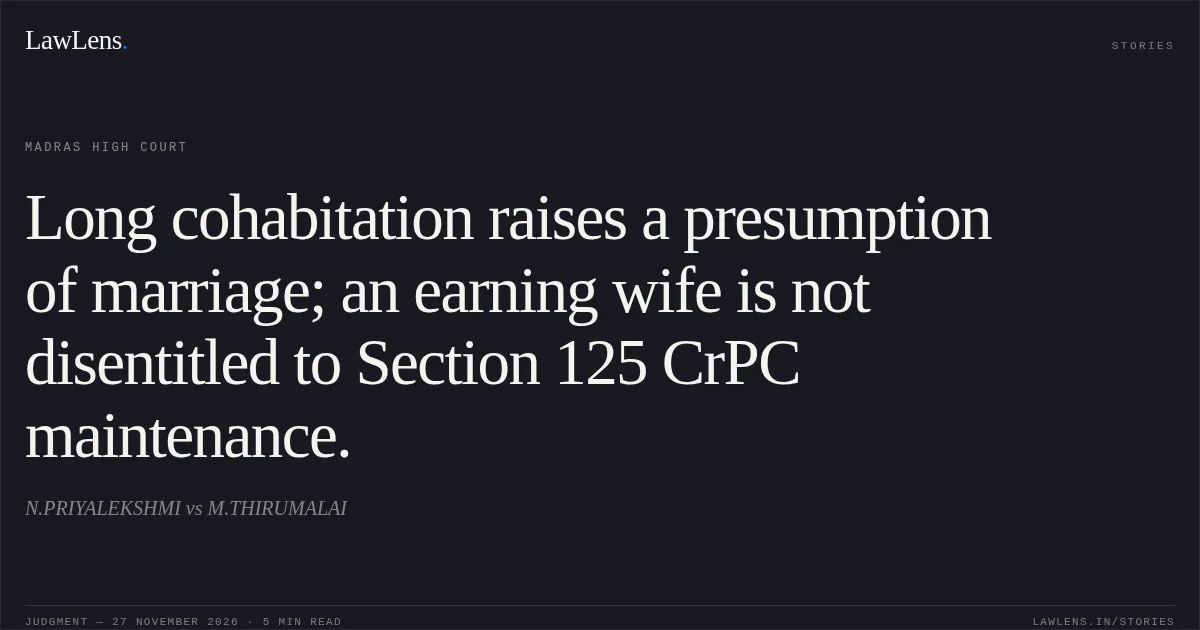
The Court answered all five questions in the petitioner's favour. It held that a marital relationship was established for s.125 purposes; that employment does not disentitle the petitioner to maintenance; that the respondent has sufficient means; and that the impugned order is unsustainable.
¶ 27 · ¶ 35 · ¶ 39 · ¶ 44, 51The Court set aside the order dated 30.09.2024 in MC No. 386 of 2019 and directed the respondent to pay the petitioner maintenance of Rs.25,000 per month from November 2026 onward, payable on or before the 10th of each succeeding English calendar month.
¶ 51 · ¶ 50No order as to costs was made, and the Registry was directed to send a copy to the Family Court.
¶ 52 · ¶ 53Original Court PDF
N.PRIYALEKSHMIvsM.THIRUMALAI
Click to open original judgment
Original judgment, available to read, download and summarize on LawLens.in