Facts
The respondent-landlord sought eviction under Section 14(1)(e) of the Delhi Rent Control Act, 1958, alleging that he and his son required the tenanted shop to start a confectionery business.
Source reference: pp. 1–3, 6–9; paras 1–4, 12The petitioner-tenant, who had been inducted in 1987, asserted that an Agreement to Sell dated 18 August 2000 had been executed in his favour, that he had paid consideration, and that his possession thereafter was protected by Section 53-A of the Transfer of Property Act, 1882 (“TP Act”).
Source reference: pp. 1–3, 6–9; paras 1–4, 12His suit for specific performance was dismissed as time-barred, and subsequent challenges were unsuccessful.
Source reference: pp. 1–3, 6–9; paras 1–4, 12The Rent Controller dismissed his application for leave to defend, treating the agreement and specific-performance proceedings as insufficient to raise a triable issue.
Source reference: pp. 1–3, 6–9; paras 1–4, 12The tenant challenged that order under Section 25-B(8) of the DRC Act
Source reference: pp. 1–3, 6–9; paras 1–4, 12Issues
1. Whether dismissal of the suit for specific performance as time-barred, by itself, justified rejecting the tenant’s separate defence under Section 53-A of the TP Act
Source reference: pp. 9–10, 12–13; paras 13, 15–162. Whether the Rent Controller’s failure to examine that defence warranted interference in revision under Section 25-B(8) of the DRC Act
Source reference: pp. 3–5, 13; paras 6–11, 17Law Applied
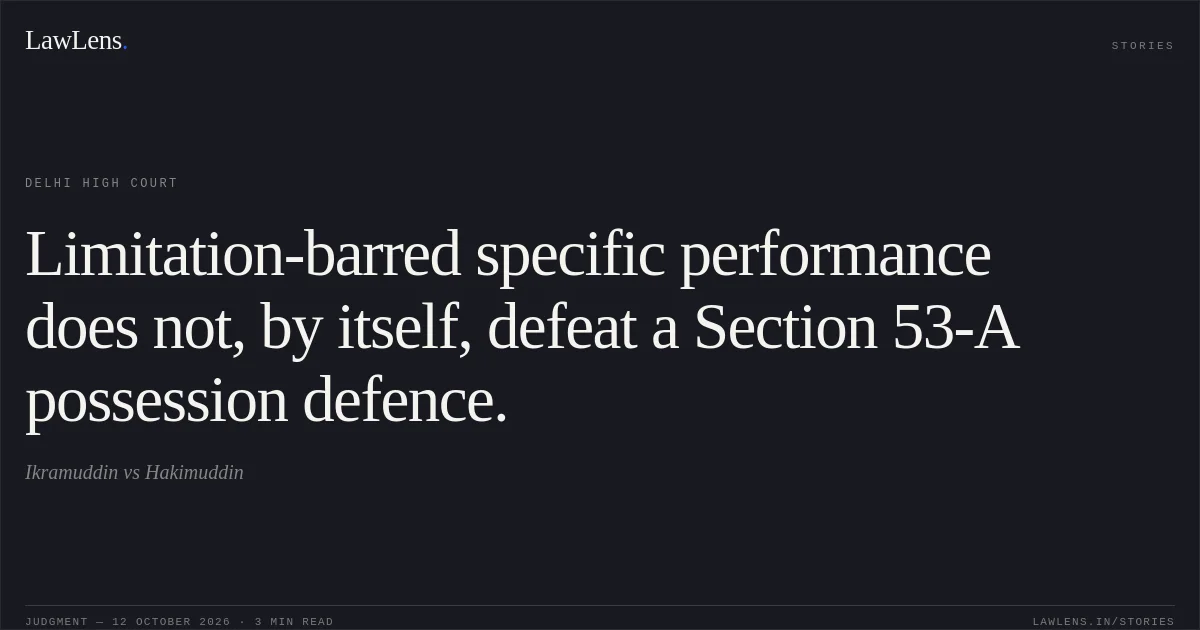
Section 53-A of the TP Act may be invoked as a defence to protect possession even where a suit for specific performance is barred by limitation; limitation generally bars the remedy of an action, not a defence, absent a statutory provision to that effect.
Source reference: pp. 9–12; para 14The defence is available only if the statutory requirements are met, including a written contract for consideration signed by the transferor, ascertainable terms, possession taken in part-performance, an act in furtherance of the contract, and performance or willingness to perform the transferee’s obligations (*Shrimant Shamrao Suryavanshi v. Prahlad Bairouva Suryavanshi*, 2002 (3) SCC 676)
Source reference: pp. 9–12; para 14Under *H.K. Sharma v. Ram Lal*, (2019) 4 SCC 153, the agreement’s terms must be examined to determine whether the requirements of Section 53-A are met
Source reference: p. 3; para 4Revision under Section 25-B(8) of the DRC Act is supervisory, not appellate; the High Court ordinarily does not reappreciate evidence, but may interfere where the decision-making process is materially flawed or a material plea has not been considered (*Abid-Ul-Islam v. Inder Sain Dua*, (2022) 6 SCC 30)
Source reference: pp. 3–5; paras 6–11In a leave-to-defend application under Section 25-B, a material defence which, if established, could disentitle the landlord to eviction may raise a triable issue
Source reference: pp. 13–14; para 17Reasoning
The Rent Controller rejected the Section 53-A plea as insignificant because the tenant’s specific-performance suit had failed, without independently considering whether the tenant could rely on Section 53-A as a defence or whether its statutory conditions were satisfied
Source reference: pp. 7–9, 12–13; paras 12, 16The High Court held that limitation alone could not dispose of that distinct defence.
Source reference: pp. 9–13; paras 13–17The respondent’s contention that the agreement did not record delivery of possession—and the relevance of *H.K. Sharma*—required examination of the agreement, the material on record and the applicable law.
Source reference: pp. 9–13; paras 13–17The High Court expressed no view on whether Section 53-A ultimately applied; it held only that the material plea required consideration by the Rent Controller.
Source reference: pp. 9–13; paras 13–17That omission amounted to an infirmity in the decision-making process warranting revisional interference
Source reference: pp. 9–13; paras 13–17Holding
The High Court set aside the eviction order and remanded the matter to the Rent Controller for de novo consideration of the application for leave to defend, particularly the Section 53-A plea, in accordance with law.
It left the merits of that plea open and disposed of the revision and pending applications; the matter was directed to be listed before the Rent Controller on 29 October 2026
Source reference: p. 14; paras 18–20Acts & Sections Cited
1 provisions across 1 statute referred to in this judgment. Each provision opens on LawLens.
delhi rent control act, 19581
Original Court PDF
IkramuddinvsHakimuddin
Click to open original judgment
Original judgment, available to read, download and summarize on LawLens.in