01Facts
The Plaintiff (Appellant) entered into a sale agreement dated 19.03.2010 with the Defendants (Respondents) for property Survey No. 75/12 for Rs. 9,30,000/-, of which Rs. 9,00,000/- was paid as earnest money.
p. 2Upon the Defendants' refusal to execute the deed and threats of third-party alienation, the Plaintiff issued a legal notice on 01.02.2011 and filed a suit for specific performance.
p. 2The Defendants contended the agreement was a mere "security document" for a separate transaction involving "Bangalore Buyers" and produced an alleged reconveyance deed.
pp. 2-3The Trial Court decreed specific performance.
p. 3The First Appellate Court confirmed the agreement's validity but denied specific performance, citing lack of readiness and willingness under Section 16(c) of the Specific Relief Act (SPA) because the legal notice was issued after the four-month period.
pp. 3-4The High Court further modified this, holding the agreement was only for security and affirmed the denial of specific performance.
pp. 4-602Issues
i.1. Whether the High Court, under Section 100 CPC, was justified in reversing concurrent findings of fact regarding the genuineness of the sale agreement.
¶ 10ii.2. Whether the Plaintiff established continuous readiness and willingness under Section 16(c) of the Specific Relief Act, 1963, to entitle him to specific performance.
¶ 1003Law Applied
Section 100 of the Code of Civil Procedure, 1908, which limits High Court jurisdiction to "substantial questions of law" and prohibits interference with concurrent findings of fact unless they are perverse or based on no evidence.
¶ 11The court relied on Kondiba Dagadu Kadam v. Savitribai Sopan Gujar [para. 11.1] and C. Doddanarayana Reddy v. C. Jayarama Reddy regarding the binding nature of lower court findings.
¶ 11.2Section 16(c) of the Specific Relief Act, 1963, emphasizing that "readiness and willingness" must be gathered from the "entirety of facts" and the "conduct of the parties," citing Syed Dastagir v. T.R. Gopalakrishna Setty and Madhukar Nivrutti Jagtap v. Pramilabai Chandulal Parandekar.
¶ 17-17.2Provisions in the judgment · 2 · Linked ones open on LawLens
Specific Relief Act, 1963 Section 16
Code of Civil Procedure, 1908 Section 100
04Reasoning
The Supreme Court observed that the Trial and First Appellate Courts concurrently found the agreement genuine based on the testimony of the scribe and attesting witnesses, and the Defendants' admission of signatures.
¶ 12-13The High Court exceeded its Section 100 CPC jurisdiction by reappreciating evidence to label the agreement a "security document" without proving perversity in the lower courts' findings.
¶ 16Paying Rs. 9,00,000/- out of a total Rs. 9,30,000/- (approximately 93% of consideration) is a strong indicator of readiness.
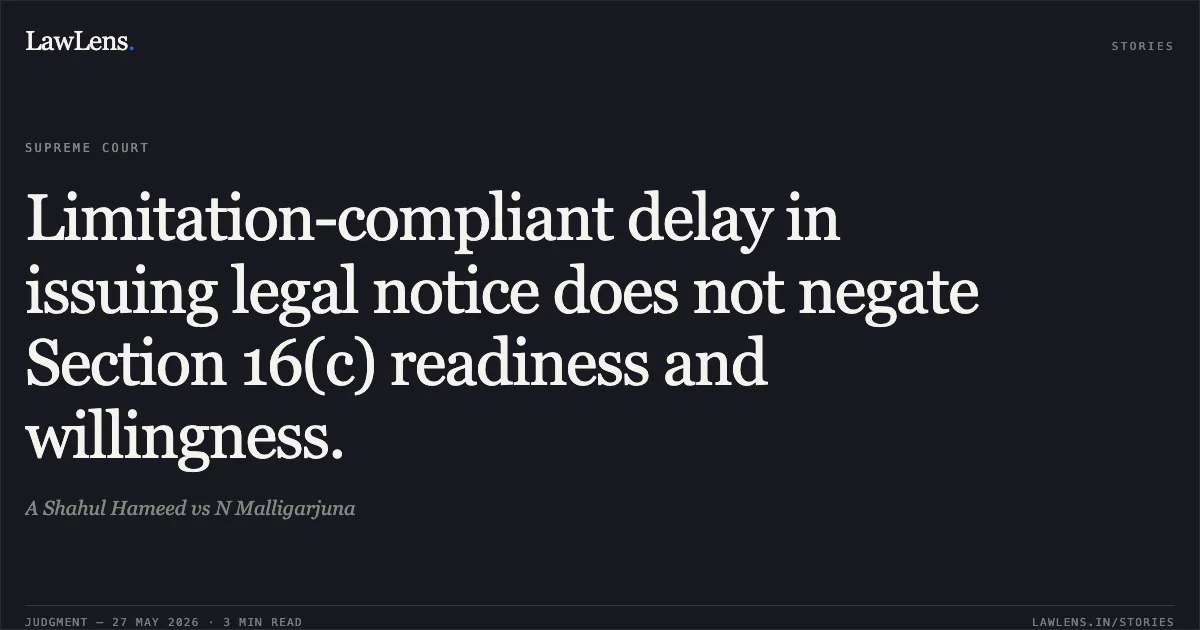
¶ 18A delay in issuing a legal notice beyond the contract's stipulated period does not automatically negate readiness and willingness if the suit is within the limitation period and the plaintiff’s conduct—such as approaching the vendor and reacting to evasiveness—remains consistent.
¶ 19-20The Defendants' failure to reply to the legal notice also warranted an adverse inference against their "security document" plea.
¶ 2105Holding
The High Court erred in interfering with concurrent findings of fact and the Plaintiff had sufficiently proved continuous readiness and willingness by paying the bulk of the consideration and acting promptly upon the Defendants' evasion.
¶ 16, 21The Supreme Court allowed the appeal, set aside the High Court and First Appellate Court judgments, and restored the Trial Court's decree for specific performance in favor of the Plaintiff.
¶ 22Original Court PDF
A Shahul HameedvsN Malligarjuna
Click to open original judgment
Original judgment, available to read, download and summarize on LawLens.in