Facts
The petitioners obtained a judgment and decree dated 22.03.2013 in Land Grabbing Case No.23 of 2009 before the Special Court under the Andhra Pradesh Land Grabbing (Prohibition) Act, 1982, declaring the respondents to be land grabbers and directing them to deliver vacant possession of the schedule property within three months.
Source reference: para. 4; p.4The respondents challenged the decree before the Telangana High Court in W.P. No.14625 of 2013, which was dismissed for non-prosecution on 06.08.2024.
Source reference: para. 6; p.5–6The petitioners thereafter initiated execution proceedings in 2025.
Source reference: no citationThe Chief Judge, City Civil Court, Hyderabad, rejected the execution petition as barred by limitation, holding that it had been filed more than twelve years after the original decree dated 22.03.2013.
Source reference: para. 4; p.4–5The petitioners’ review application under Order XLVII Rule 1 read with Section 114 CPC was also dismissed on 11.06.2026.
Source reference: paras. 3–5; p.3–6The present revision under Article 227 of the Constitution challenged the review order and, substantively, the rejection of the execution petition.
Source reference: paras. 1, 10–11; p.3, 8–9Issues
Whether the period of limitation for executing the judgment and decree dated 22.03.2013 commenced from the date of the original decree or from the date on which the writ petition challenging it was dismissed on 06.08.2024?
Source reference: para. 12; p.9–10Whether the pendency and subsequent dismissal of the writ petition attracted the doctrine of merger and constituted a fresh starting point for limitation, notwithstanding the absence of an interim stay?
Source reference: paras. 13–18; p.10–15Whether the executing court was justified in rejecting the execution petition as time-barred and whether the review order required interference under Article 227?
Source reference: paras. 10–11, 19–20; p.8–9, 15–16Law Applied
The Court applied the twelve-year limitation principle governing execution of decrees, together with the doctrine of merger, under which the decree or order of the superior forum becomes the final and operative decree after disposal of the challenge.
Source reference: no citationRelying on Kunjammal v. Krishna Chettiar, AIR 1954 Mad 170, the Court held that when a decree is carried to a higher forum, the decree resulting from the appellate proceedings is treated as the decree capable of execution and limitation runs from that decree.
Source reference: para. 15; p.11–12Relying on Kunhayammed v. State of Kerala, (2000) 6 SCC 359, it reiterated that the doctrine of merger applies where an order is subjected to a legally available superior remedy and the superior forum finally disposes of the matter, although its application depends on the nature and scope of the superior jurisdiction.
Source reference: para. 16; p.12–13The Court also relied on Gajanan v. Pralhad, Civil Appeal No.3524 of 2026, decided on 18.03.2026, for the rule that even dismissal of an appeal on a preliminary or technical ground, including non-prosecution, gives rise to a fresh starting point for execution limitation because the appeal is a continuation of the original proceedings.
Source reference: para. 17; p.13–14The Court treated the writ remedy as the functional equivalent of an appeal because the Land Grabbing Act provided no statutory appeal against the Special Court’s decision.
Source reference: para. 13; p.10–11Reasoning
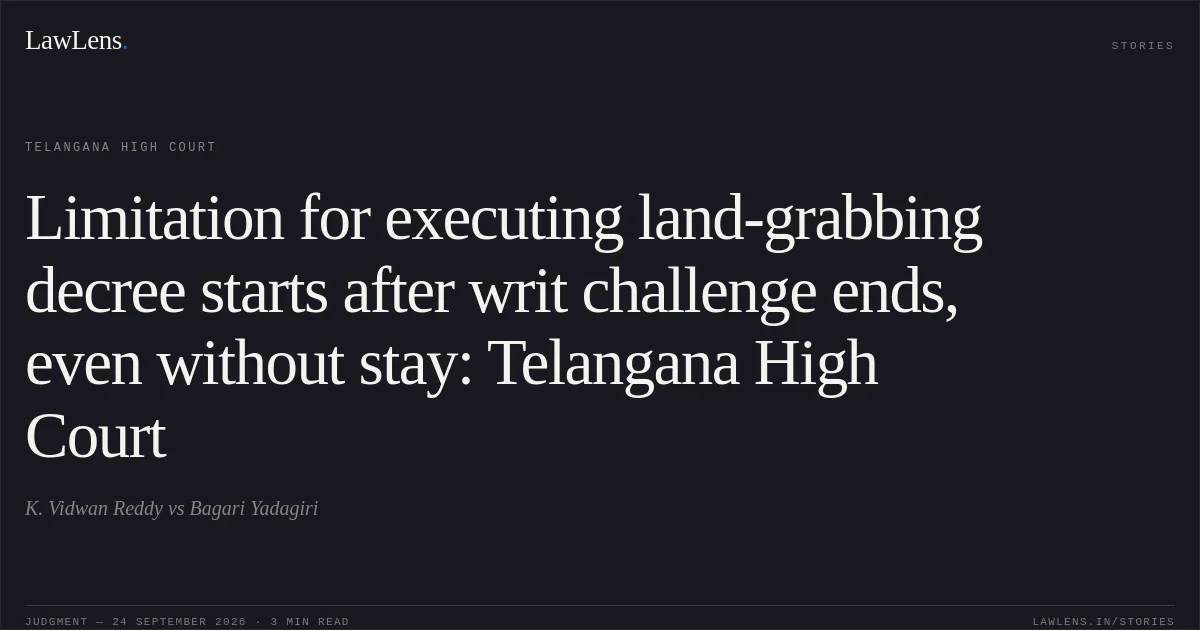
The Court held that the decree dated 22.03.2013 had been continuously subjected to challenge in the writ proceedings and therefore had not attained finality for execution purposes until the writ petition was dismissed on 06.08.2024.
Source reference: paras. 13–18; p.10–15Since the Land Grabbing Act contained no appellate remedy, the writ petition was, for practical purposes, the respondents’ appellate challenge to the decree.
Source reference: para. 13; p.10–11Applying the doctrine of merger and the principle stated in Gajanan, the Court concluded that dismissal of the writ petition—even for non-prosecution—finally disposed of the challenge and affirmed the original decree, thereby furnishing a fresh commencement date for limitation.
Source reference: paras. 16–18; p.12–15The absence of an interim stay did not alter the result, because the decree remained sub judice and its enforceability was treated as suspended until the challenge was finally disposed of.
Source reference: paras. 14, 18; p.10–11, 14–15Accordingly, the execution petition filed in 2025 could not be rejected as barred by limitation calculated from 22.03.2013.
Source reference: para. 19; p.15Holding
The High Court allowed the Civil Revision Petition and set aside the order dated 11.06.2026 dismissing the review application, along with the underlying rejection of the execution proceedings as time-barred.
It held that limitation for execution was to be reckoned from the dismissal of the writ petition on 06.08.2024, rather than from the original decree dated 22.03.2013.
Source reference: no citationThe matter was remitted to the Trial Court with directions to register and number the execution petition and decide it in accordance with law, ignoring the objection of limitation.
Source reference: para. 19; p.15–16No costs were awarded, and pending miscellaneous petitions were closed.
Source reference: paras. 20–21; p.16Acts & Sections Cited
3 provisions across 3 statutes referred to in this judgment. Each provision opens on LawLens.
Code of Civil Procedure, 19081
Andhra Pradesh Land Grabbing (Prohibition) Act, 19821
Limitation Act, 19631
Original Court PDF
K. Vidwan ReddyvsBagari Yadagiri
Click to open original judgment
Original judgment, available to read, download and summarize on LawLens.in