Facts
The Adjudicating Authority (NCLT New Delhi) passed an order on 11.06.2025 in the presence of the Appellant and his counsel.
Source reference: para. 1(i)The Appellant applied for a certified copy on 28.07.2025, which was delivered on 12.08.2025.
Source reference: para. 1(ii)The appeal was e-filed on 28.08.2025.
Source reference: para. 1(iii)The Appellant argued that although the order was orally passed in court, it was uploaded on the NCLT portal only on 04.07.2025; thus, limitation should trigger from the date of uploading, making the delay only 14 days (within the condonable limit).
Source reference: para. 4The Respondent contended that the limitation commenced from the date of pronouncement (11.06.2025), resulting in a delay of 49 days, which exceeds the statutory maximum condonable period of 15 days under Section 61(2) of the IBC.
Source reference: para. 2 & 5Issues
1. Whether the limitation period for filing an appeal under the IBC commences from the date of pronouncement of the order in open court or the date of its uploading on the portal.
Source reference: para. 92. Whether the delay of 49 days in filing the appeal can be condoned by the Appellate Tribunal.
Source reference: para. 22Law Applied
The Court applied Section 61(2) of the Insolvency and Bankruptcy Code (IBC), which prescribes a 30-day period for filing appeals with a further 15-day maximum condonable limit.
Source reference: para. 22It relied on Rule 150 and 151 of the NCLT Rules, 2016, regarding the "pronouncement of orders".
Source reference: para. 15The Tribunal further relied on the Supreme Court precedents in *V. Nagarajan v. SKS Ispat & Power Ltd.*, which established that limitation commences from pronouncement and the litigant must exercise due diligence in applying for a certified copy.
Source reference: para. 18-19The Tribunal further relied on *Sanjay Pandurang Kalate v. Vistra ITCL (India) Ltd.*, which distinguishes cases where no substantive order is passed on the date of hearing.
Source reference: para. 14-16Reasoning
The Tribunal noted that the Appellant explicitly admitted in their CoC meeting minutes and rejoinder affidavit that the order was pronounced in open court on 11.06.2025 in the presence of their counsel.
Source reference: para. 10-11Distinguishing *Sanjay Pandurang Kalate*, where limitation started from uploading because no order was pronounced on the hearing date, the Tribunal observed that in the present case, a substantive order was indeed pronounced on 11.06.2025.
Source reference: para. 17Under the principle established in *V. Nagarajan*, the clock for limitation begins at pronouncement, and the Appellant has a duty to apply for a certified copy immediately to avail of the exclusion of "time requisite" under Section 12 of the Limitation Act.
Source reference: para. 18-19Since the Appellant only applied for the certified copy on 28.07.2025—well after the initial 30-day period had expired—no exclusion of time could salvage the appeal.
Source reference: para. 20-21Consequently, the total delay reached 49 days.
Source reference: para. 22Holding
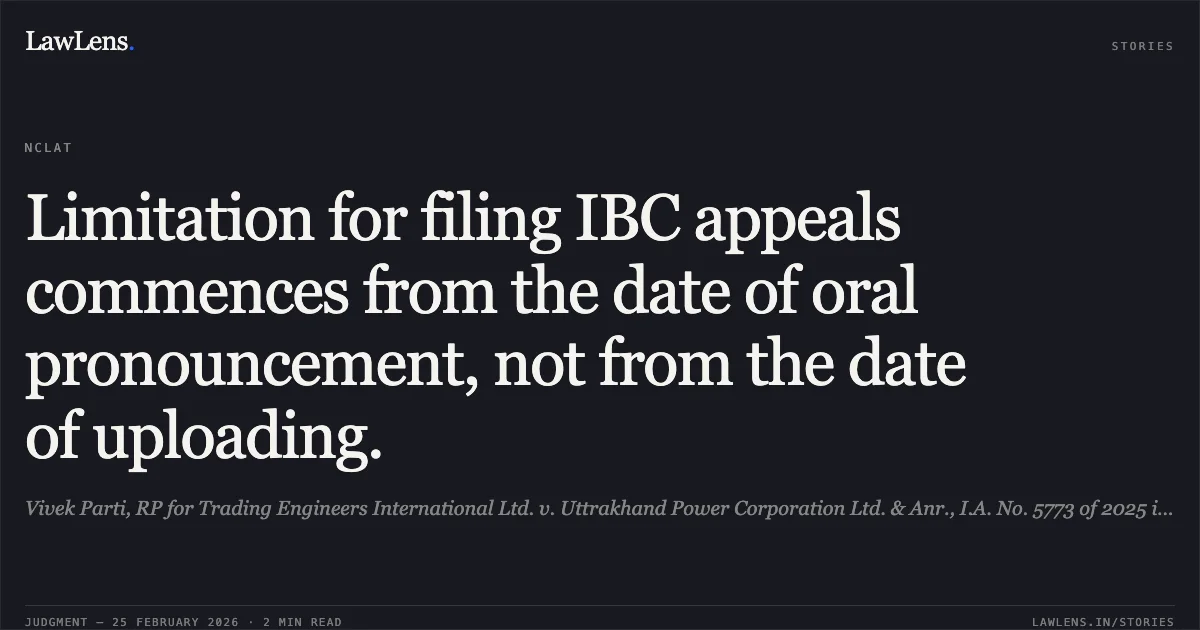
The Tribunal held that the limitation period commenced on 11.06.2025, the date of pronouncement, and not 04.07.2025, the date of uploading.
As the appeal was filed with a delay of 49 days, exceeding the statutory maximum condonable limit of 15 days under Section 61(2) of the IBC, the Tribunal ruled it had no jurisdiction to condone the delay.
Source reference: para. 21-22The delay condonation application (I.A. No. 5773 of 2025) and the Memo of Appeal were rejected.
Source reference: para. 22Original Court PDF
Vivek Parti, RP for Trading Engineers International Ltd. v. Uttrakhand Power Corporation Ltd. & Anr., I.A. No. 5773 of 2025 in Company Appeal (AT) (Insolvency) No. 1475 of 2025 (NCLAT New Delhi).
Click to open original judgment
Original judgment, available to read, download and summarize on LawLens.in