Facts
The respondent-plaintiff filed a civil suit for the recovery of Rs. 26,000, alleging that the amount was deposited with the appellants-defendants via four documents (Exs. P-1 to P-4) executed between October 1981 and January 1983
Source reference: para. 2The agreement stipulated a 2% monthly interest rate
Source reference: para. 2The plaintiff claimed that a part-payment of interest was made on 14.09.1984, but subsequent demands were ignored, leading to a legal notice on 05.08.1993 and the filing of the suit on 22.10.1994
Source reference: para. 2The Trial Court decreed the suit, rejecting the defendants' plea that the suit was time-barred
Source reference: para. 4The Trial Court had proceeded on unrebutted testimony as the defendants were denied the right to cross-examine witnesses due to the non-payment of a Rs. 50 cost
Source reference: para. 5The defendants appealed on the grounds of natural justice and limitation
Source reference: para. 5Issues
1. Whether the documents (Exs. P-1 to P-4) constituted "demand promissory notes" or simple loan acknowledgments for the purpose of calculating the limitation period
Source reference: para. 112. Whether the suit for recovery filed in 1994 was barred by the law of limitation under the Limitation Act, 1963
Source reference: para. 10, 14Law Applied
The court applied Section 2(5) of the Indian Stamp Act, 1899, to determine that the documents were not "bonds" as they were neither conditional nor attested by witnesses
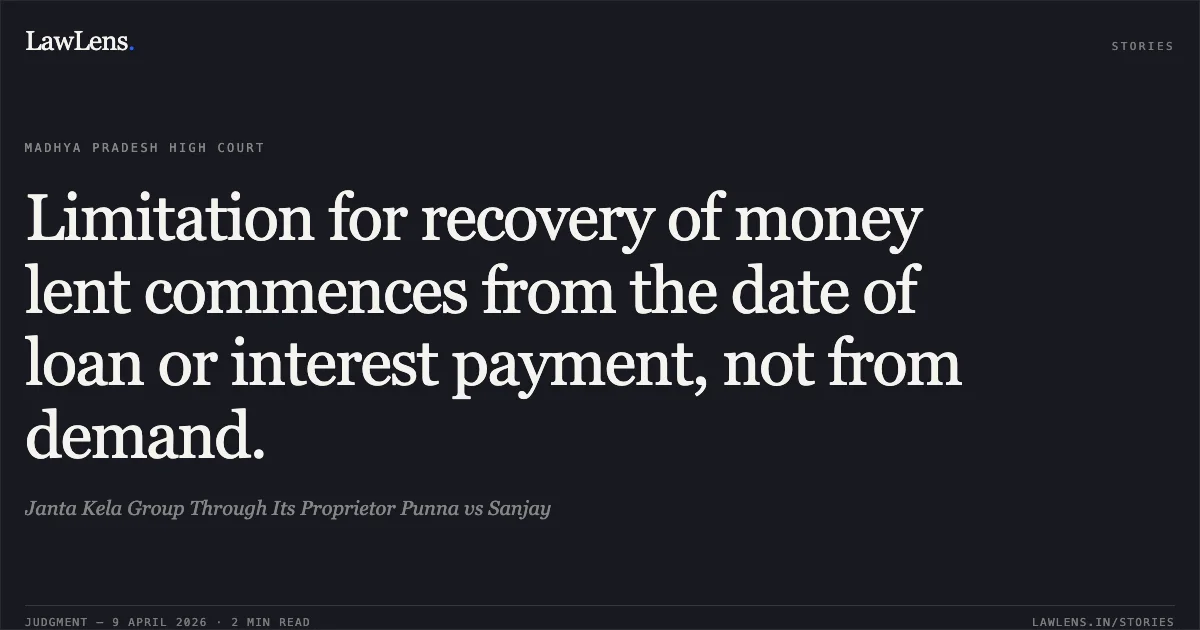
Source reference: para. 9It primarily applied Article 19 of Schedule II of the Limitation Act, 1963, which prescribes a three-year limitation period for money lent, beginning from the date the loan is made
Source reference: para. 10The court further utilized Section 19 of the Limitation Act, 1963, which dictates that where payment on account of a debt or of interest on a legacy is made before the expiration of the prescribed period, a fresh period of limitation shall be computed from the time when the payment was made
Source reference: para. 13Reasoning
The Court examined Exs. P-1 to P-4 and found they were simple loan documents acknowledging debt with a promise to pay interest, but they lacked any condition making the money payable "on demand" or on a "fixed date"
Source reference: para. 8-9Consequently, under Article 19 of the Limitation Act, the limitation period of three years began on the date the loans were made (between 1981 and 1983)
Source reference: para. 10Although the payment of interest on 14.09.1984 triggered Section 19 of the Limitation Act, creating a fresh three-year window, this renewed period expired in September 1987
Source reference: para. 12-14The court rejected the respondent's contention that the limitation should be computed from the date of his demand in 1993, ruling that the language of the documents did not support the classification of "demand promissory notes"
Source reference: para. 11Thus, the suit filed in 1994 was nearly seven years overdue
Source reference: para. 14Holding
The High Court allowed the appeal and set aside the judgment and decree of the Trial Court
The Court held that while the loan transaction was established by unrebutted evidence, the suit was clearly barred by the law of limitation
Source reference: para. 14-15Consequently, the respondent-plaintiff was not entitled to any relief, and the civil suit was dismissed
Source reference: para. 15Acts & Sections Cited
2 provisions across 2 statutes referred to in this judgment. Each provision opens on LawLens.
Indian Stamp Act, 18991
Limitation Act, 19631
Original Court PDF
Janta Kela Group Through Its Proprietor PunnavsSanjay
Click to open original judgment
Original judgment, available to read, download and summarize on LawLens.in