Facts
The respondent-plaintiff, a supplier of empty liquor bottles, deposited security amounts pursuant to separate tenders floated by the appellants for the years 1991–1992 and 1993–1994.
Source reference: paras. 2–5It claimed to have completed the required supplies and sought refund of securities amounting to ₹2,15,600, together with interest, and an injunction against forfeiture of the securities.
Source reference: paras. 2–5The appellants alleged short supply and breach of the tender conditions, claimed losses of ₹5,70,356, and stated that ₹1,70,000 had been forfeited towards security.
Source reference: para. 6The Trial Court held that the plaintiff had failed to comply with the supply schedule, that forfeiture was permissible under the contract, and that the suit was barred by limitation because it had not been filed within three years from completion of the contracts.
Source reference: para. 10The First Appellate Court reversed the decree, holding that the appellants had not proved the actual loss suffered and could not forfeit the security merely on the basis of the penalty clause.
Source reference: para. 11The appellants consequently filed the second appeal, which was admitted on three substantial questions of law.
Source reference: para. 12Issues
Whether the First Appellate Court erred in applying Section 74 of the Indian Contract Act, 1872 to the forfeiture of security deposits despite the contractual forfeiture clause and absence of a specific plea by the plaintiff?
Source reference: para. 12(i)Whether the First Appellate Court misread or failed to properly appreciate the pleadings and evidence concerning the alleged breach, loss, and forfeiture of security?
Source reference: para. 12(ii)Whether the suit for refund of the security deposits was barred by limitation, and whether the First Appellate Court erred in failing to decide the limitation issue?
Source reference: para. 12(iii)Law Applied
The Court applied Section 74 of the Indian Contract Act, 1872, holding that a contractual stipulation providing for forfeiture of a security deposit upon breach is in the nature of a penalty and permits recovery or forfeiture only of reasonable compensation, not exceeding the stipulated amount.
Source reference: paras. 32–33Relying on Fateh Chand v. Balkishan Das and Maula Bux v. Union of India, the Court held that Section 74 applies even where the amount already deposited is sought to be forfeited; proof of actual loss may not always be indispensable, but the claimant must establish a reasonable basis for the compensation claimed.
Source reference: paras. 32–33The Court also relied on Union of India v. Rampur Distillery and Chemical Co. Ltd., under which a security deposit cannot be forfeited for default where no loss is shown.
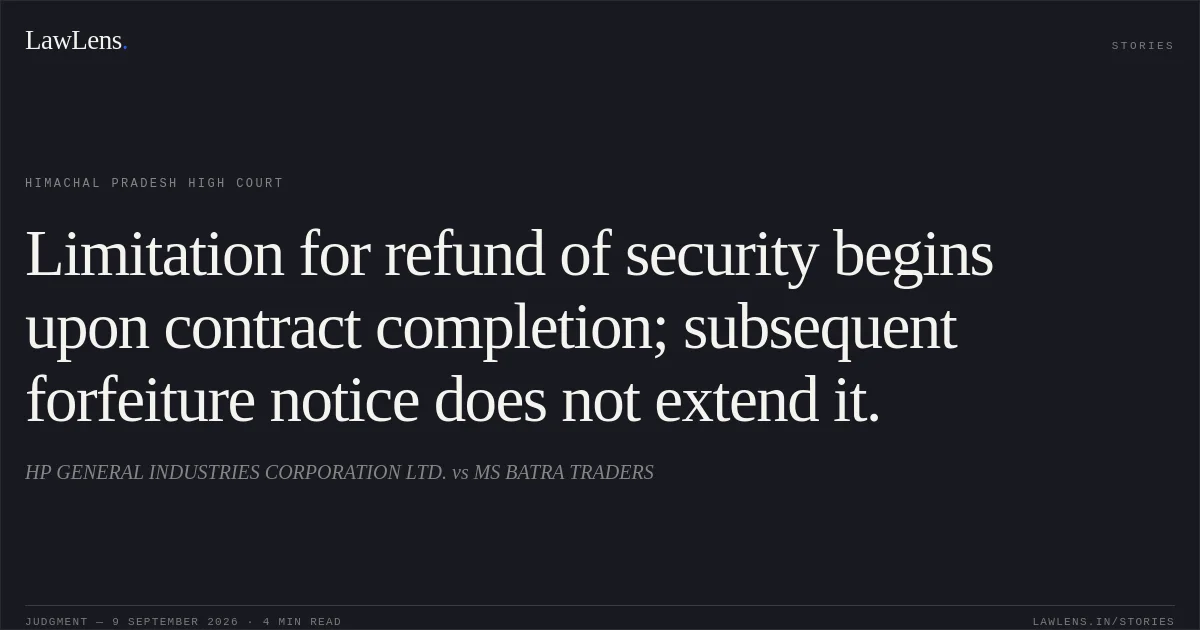
Source reference: para. 33As to limitation, the Court held that a claim for refund of security ordinarily accrues upon completion or expiry of the relevant contract and cannot be postponed until a later notice of forfeiture; the suit must therefore be instituted within the applicable three-year period.
Source reference: paras. 20–24, 26–31Reasoning
The Court held that the First Appellate Court was correct in applying Section 74 even though the plaintiff had not expressly pleaded it, because the Court is required to apply the governing law to the proved facts.
Source reference: para. 35The security deposits were made to secure performance and were not earnest money; therefore, forfeiture constituted a penalty subject to the requirement of reasonable compensation.
Source reference: para. 32Although the appellants alleged losses of ₹5,70,356, their witness merely stated that the appellants could not fulfil their obligations to the Excise Department.
Source reference: para. 34No documentary or other evidence established the quantity purchased from the market, the price difference, or the actual loss suffered.
Source reference: para. 34The alleged loss was consequently not proved, and forfeiture could not be justified merely by reference to the contractual clause.
Source reference: para. 34However, the Court found that the First Appellate Court had failed to determine the limitation issue.
Source reference: no citationThe contracts for 1991–1992 and 1993–1994 had ended when the respective tender periods expired, and the plaintiff itself had demanded refund as early as 1 June 1992.
Source reference: paras. 24, 26, 30The cause of action for refund therefore arose on completion of the relevant contracts or, at the latest, upon the demand for refund—not upon the subsequent notice threatening forfeiture dated 3 July 1997.
Source reference: paras. 24, 26, 30Since the suit was filed on 18 April 1998, it was beyond the applicable three-year period.
Source reference: no citationThe later notice of forfeiture could not revive an already time-barred claim.
Source reference: para. 31Holding
The Court answered the limitation issue in favour of the appellants and held that the suit was barred by limitation.
It nevertheless affirmed the First Appellate Court’s legal conclusion that the security could not be forfeited merely for breach without proof of reasonable compensation or loss under Section 74 of the Contract Act.
Source reference: paras. 32–35Since the suit itself was time-barred, the second appeal was allowed, the judgment and decree of the First Appellate Court were set aside, and the Trial Court’s decree dismissing the suit was restored.
Source reference: para. 37Acts & Sections Cited
1 provisions across 1 statute referred to in this judgment. Each provision opens on LawLens.
Indian Contract Act, 18721
Original Court PDF
HP GENERAL INDUSTRIES CORPORATION LTD.vsMS BATRA TRADERS
Click to open original judgment
Original judgment, available to read, download and summarize on LawLens.in