01Facts
The Appellant is a Personal Guarantor for M/s. Smaat India Pvt. Ltd. (Corporate Debtor), which received financial assistance of Rs. 6.39 crores from NABARD (Respondent No. 1) in December 2012
p. 2The Appellant executed a Personal Guarantee Deed on January 11, 2013, and subsequently resigned as a Director of the Corporate Debtor on April 1, 2013
p. 3Following a default by the Corporate Debtor, NABARD initiated proceedings under Section 95 of the Insolvency and Bankruptcy Code, 2016 (IBC) for the recovery of Rs. 6,24,89,526/-
p. 2The Appellant challenged the National Company Law Tribunal’s (NCLT) order dated February 20, 2025, which admitted the insolvency resolution process against him, primarily on the grounds of limitation
pp. 1-202Issues
i.1. Whether the insolvency resolution process initiated under Section 95 of the IBC was barred by limitation under Article 137 of the Limitation Act, 1963
p. 2 / para. 1ii.2. Whether the communications sent by the Creditor in 2016 and 2018 constituted a "loan recall notice" or "invocation of guarantee" for the purposes of determining the starting point of limitation
pp. 4-603Law Applied
The court applied Section 95 of the Insolvency and Bankruptcy Code, 2016, which governs the initiation of insolvency resolution processes against personal guarantors
p. 2It specifically referred to Section 95(4)(b) regarding the mandatory issuance of a demand notice to the debtor before filing an application
p. 6For the calculation of the limitation period, the court relied on Article 137 of the Limitation Act, 1963, which provides a three-year residual period from the date the right to apply accrues
p. 8Provisions in the judgment · 3 · Linked ones open on LawLens
Insolvency and Bankruptcy Code, 2016. Section 95
National Bank for Agriculture and Rural Development Act, 1981 Section 34
Limitation Act, 1963 Section 137
04Reasoning
The court evaluated three critical communications to determine the "cut-off" date for limitation.
First, it rejected the Appellant's contention that a letter dated January 29, 2016, triggered limitation, noting it was addressed to the Corporate Debtor—not the Appellant—and merely expressed an "intention" or "entitlement" to recall the loan rather than an actual recall
p. 4Second, the court dismissed the letter dated November 30, 2018, as a trigger point because it was an intimation of potential legal action and did not satisfy the requirements of a demand notice under Section 95(4)(b) of the IBC
p. 6Finally, the court identified the letter dated August 3, 2020, as the definitive invocation of the guarantee, as it explicitly stated, "We therefore, hereby invoke the aforesaid guarantee"
p. 7Connecting the law to these facts, the court reasoned that the right to apply accrued on August 3, 2020; therefore, the Section 95 application filed on February 9, 2023, fell within the three-year window prescribed by Article 137 of the Limitation Act
p. 805Holding
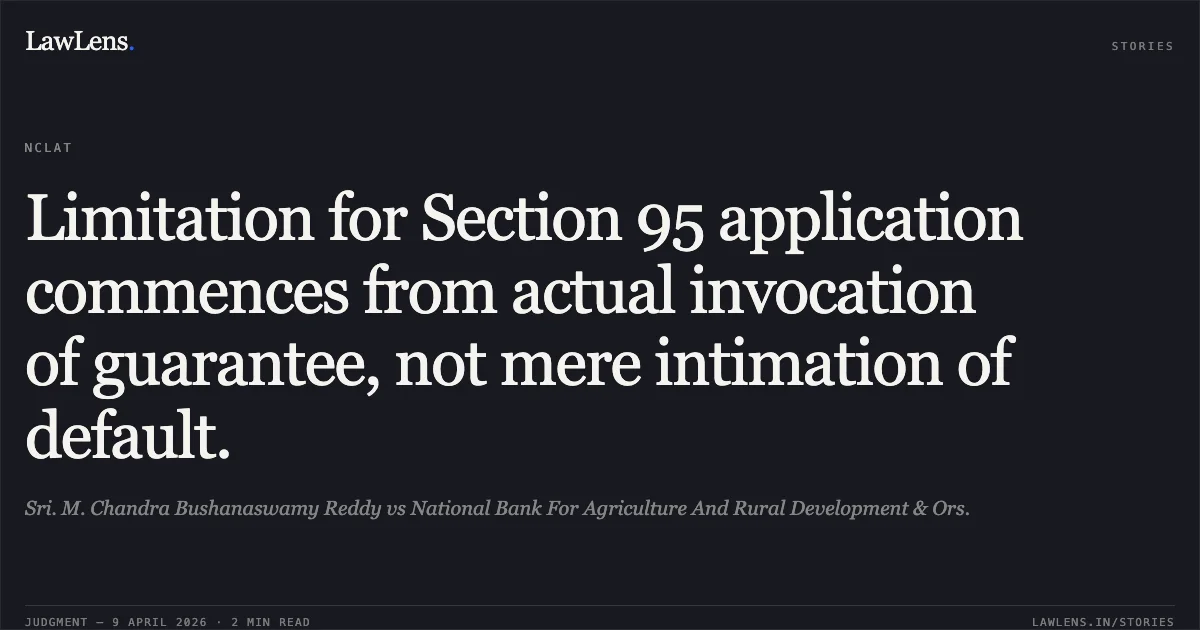
The Appellate Tribunal held that the proceedings under Section 95 were not barred by limitation because the actual revocation of the Personal Guarantee and the effective notice for initiation of proceedings occurred only on August 3, 2020
p. 8The court answered the issue of limitation against the Appellant, found the appeal lacking in merit, and dismissed it, thereby upholding the NCLT's order admitting the insolvency process
p. 9All pending interlocutory applications were closed
p. 9Original Court PDF
Sri. M. Chandra Bushanaswamy ReddyvsNational Bank For Agriculture And Rural Development & Ors.
Click to open original judgment
Original judgment, available to read, download and summarize on LawLens.in