Facts
The Appellant, a suspended director of M/s. Theme Exports Pvt. Ltd. (Corporate Debtor), executed a "Deed of Continuing Guarantee" on 06.01.2017 in favor of Respondent No. 2 (Bank of Baroda) for credit facilities totaling approximately ₹30.12 crore
Source reference: para 2(a)-(b)The Corporate Debtor’s account was classified as NPA on 07.01.2019, followed by a Section 13(2) SARFAESI notice on 27.02.2019, which the Bank characterized as the first invocation of the guarantee
Source reference: para 2(c)The Corporate Debtor entered CIRP on 29.08.2019 and was subsequently ordered into liquidation on 29.07.2020
Source reference: para 2(d)On 04.08.2020, the Bank issued a personal demand-cum-recall notice and filed a petition under Section 95 of the IBC on 30.12.2021
Source reference: para 2(e)-(f)The Adjudicating Authority (NCLT, New Delhi) admitted the petition under Section 100 IBC on 04.09.2024
Source reference: para 4Issues
1. Whether the petition under Section 95 of the IBC was barred by limitation on the grounds that the cause of action arose upon the execution of the guarantee deed in 2017?
Source reference: para 52. Whether inconsistencies in the debt amount claimed across different forums (DRT vs. NCLT) and the non-disclosure of the initial SARFAESI notice in the original petition invalidate the proceedings?
Source reference: para 5(a), 5(c)3. Whether the alleged conflict of interest and bias of the Resolution Professional (RP) is a valid ground to set aside the admission order under Section 100?
Source reference: para 5(d)Law Applied
Sections 95 and 100 of the Insolvency and Bankruptcy Code, 2016 (IBC), regarding the insolvency resolution process for personal guarantors
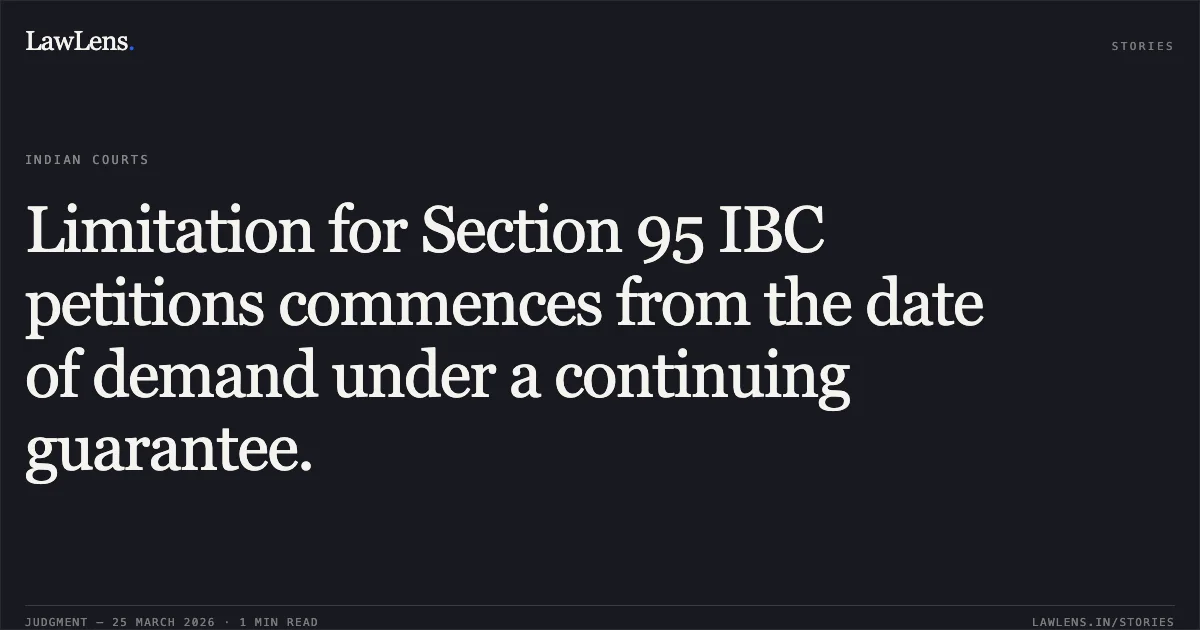
Source reference: para 1, 6(b)For a "continuing guarantee," the period of limitation begins to run only from the date of express invocation/demand, rather than the date of execution
Source reference: para 7(a)The ratio in Laxmi Pat Surana v. Union Bank of India (2021), distinguishing between prudential NPA classification and the juridical date of default
Source reference: para 5(b)Reasoning
The Tribunal rejected the Appellant's limitation argument, observing that the guarantee was "continuing" and enforceable upon demand.
Source reference: para 7(a)Since the Bank invoked the guarantee via a SARFAESI notice on 27.02.2019, the default crystallized on 27.04.2019; thus, the Section 95 petition filed on 30.12.2021 was well within the three-year limitation period
Source reference: para 7(a)Regarding the discrepancy in debt amounts (₹32.17 crore in DRT vs. ₹36.93 crore in IBC), the Tribunal noted these reflected different cut-off dates and that Section 100 requires proof of the existence of a debt and default, not a final adjudication of the exact quantum, which is the RP's subsequent task
Source reference: para 6(b), 7(b)On the issue of RP bias, the Tribunal held that while a conflict of interest might justify replacing an RP, it does not constitute a legal basis for setting aside an otherwise valid admission order under Section 100
Source reference: para 7(c)Holding
The NCLAT found no merit in the appeal and upheld the NCLT’s order admitting the Section 95 petition
The Tribunal held that the petition was within the limitation period as the cause of action arose from the demand notice, not the deed's execution
Source reference: para 7(a)The inconsistencies in the claimed amount were deemed insufficient to stall the insolvency process at the admission stage
Source reference: para 7(b)The appeal was dismissed without costs
Source reference: para 8Acts & Sections Cited
7 provisions across 2 statutes referred to in this judgment. Each provision opens on LawLens.
Securitisation and Reconstruction of Financial Assets and Enforcement of Security Interest Act, 20021
Insolvency and Bankruptcy Code, 2016.6
Original Court PDF
Nandani SinghvsSandeep Kr Bhatt And Anr. & Ors.
Click to open original judgment
Original judgment, available to read, download and summarize on LawLens.in