Facts
In 1978, Jagdish Prasad (predecessor of the respondents) executed a usufructuary mortgage of house No. 333 in Bareilly in favor of the petitioners for a debt of Rs. 15,000/-.
Source reference: para. 3The deed stipulated a four-year period, with possession handed to the petitioners and rent to be adjusted against interest.
Source reference: para. 4Jagdish Prasad died in 2015. On 30.12.2015, the respondents (heirs) tendered the principal amount via Bank Pay Order and demanded redemption, which the petitioners refused. The respondents filed a suit for redemption and possession in 2016.
Source reference: para. 4The petitioners moved an application under Order VII Rule 11 C.P.C., arguing the suit was barred by limitation as the 30-year period under Article 61 of the Limitation Act expired in 2012 (counting from the end of the four-year mortgage term in 1982). The trial court and revisional court rejected this application.
Source reference: para. 4Issues
1. Whether the limitation period for a usufructuary mortgage begins from the date of the mortgage/expiry of fixed term or from the date the mortgage money is paid/tendered.
Source reference: para. 5, 62. Whether the suit was barred by limitation under Article 61 of the Limitation Act, 1963.
Source reference: para. 5Law Applied
Section 60 of the Transfer of Property Act (TPA), which grants a statutory right of redemption unless extinguished by act of parties or court decree.
Source reference: para. 8, 11Section 62 of the TPA, which governs the right of a usufructuary mortgagor to recover possession upon payment of the mortgage money.
Source reference: para. 8Article 61(a) of the Limitation Act, 1963, which prescribes 30 years for redemption starting when the right to recover possession "accrues".
Source reference: para. 8Larger Bench precedent in Singh Ram (D) Thr. L.Rs. v. Sheo Ram and others (2014), which held that in usufructuary mortgages, the right to recover possession accrues only when the money is paid or tendered, effectively overruling previous views in Prabhakaran v. M. Azhagiripillai and Sampuran Singh v. Niranjan Kaur.
Source reference: para. 14, 15, 17, 18Reasoning
The court reasoned that a usufructuary mortgage is distinct because the mortgagee enjoys the usufruct in lieu of interest, and the mortgagor does not typically incur personal liability.
Source reference: para. 11, 13Applying the doctrine "once a mortgage, always a mortgage," the court noted that the right to redeem is a statutory right inseparable from the mortgage itself.
Source reference: para. 12, 19The court rejected the petitioners' argument that the four-year term in the deed triggered the limitation clock; instead, it held that such a term merely restricts the mortgagor from suing during that period.
Source reference: para. 21Following the Singh Ram mandate, the court found that for usufructuary mortgages, the limitation period under Article 61 only begins when the mortgagor tenders the debt. Since the respondents first tendered the amount on 30.12.2015, the "right to recover" accrued on that date.
Source reference: para. 22, 23Holding
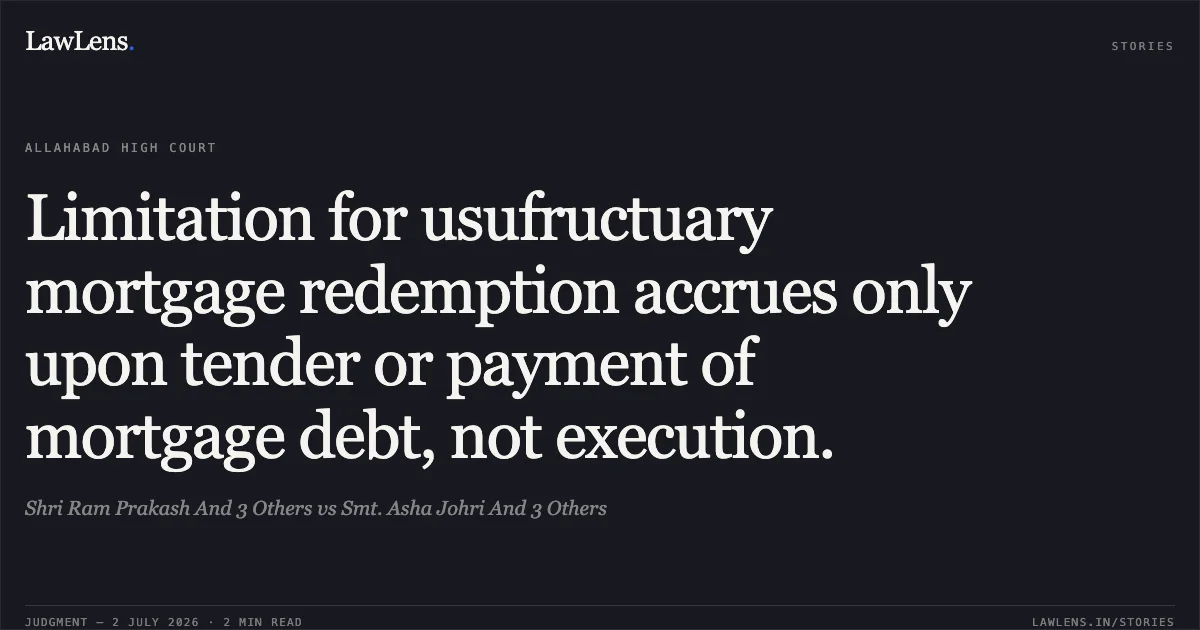
The court answered the issues by holding that in a usufructuary mortgage, limitation does not run from the date of execution but from the date of tender/payment of the mortgage debt.
Consequently, because the tender occurred on 30.12.2015 and the suit was filed on 03.03.2016, the suit was well within the 30-year limitation period. The court affirmed the lower courts' orders, dismissed the writ petition, and discharged any interim orders.
Source reference: para. 23, 24, 25, 27Acts & Sections Cited
6 provisions across 2 statutes referred to in this judgment. Each provision opens on LawLens.
Limitation Act, 19632
Transfer of Property Act, 18824
Original Court PDF
Shri Ram Prakash And 3 OthersvsSmt. Asha Johri And 3 Others
Click to open original judgment
Original judgment, available to read, download and summarize on LawLens.in


