Facts
The plaintiffs filed a suit for recovery, declaration/cancellation, and permanent injunction regarding a Sale Deed dated December 28, 2016, for land in Village Dichaun Kalan.
Source reference: p. 2The plaintiffs alleged that based on an Agreement to Sell dated September 26, 2014, a total consideration of ₹4,05,09,375 was agreed upon, but ₹2,09,90,125 remained unpaid.
Source reference: p. 6While the Sale Deed was executed on August 24, 2015, it was registered only on December 28, 2016.
Source reference: p. 3Defendant No. 1 filed an application under Order VII Rule 11 of the CPC, contending the suit was barred by limitation, arguing the cause of action arose on August 24, 2015, when the balance became payable.
Source reference: p. 2The plaintiffs countered that the defendants had assured payment at the time of mutation and only explicitly denied the liability on February 1, 2018, before the SDM.
Source reference: p. 8Issues
1. Whether the plaint is liable to be rejected under Order VII Rule 11 of the CPC on the ground of being barred by the Law of Limitation.
Source reference: p. 1–2 / para. 12. Whether the period of limitation for a suit seeking cancellation of a registered instrument based on fraud begins from the date of execution/registration or the date of the plaintiff’s actual knowledge of the fraud.
Source reference: p. 9–10 / para. 21–22Law Applied
Order VII Rule 11(d) of the CPC mandates the rejection of a plaint if the suit appears barred by any law.
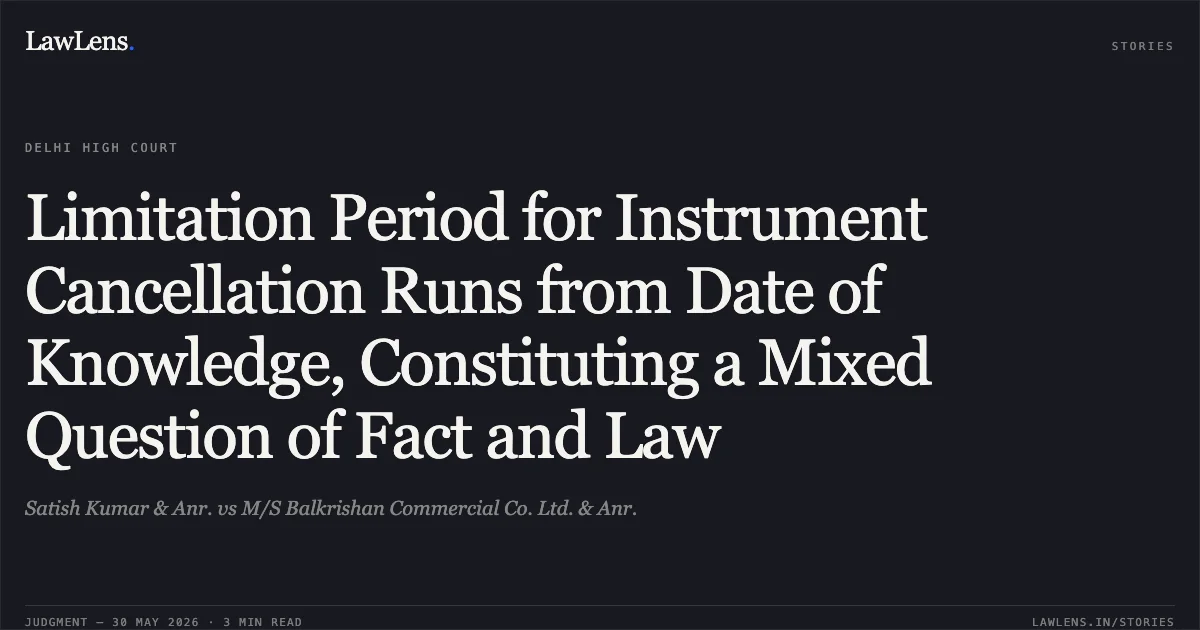
Source reference: p. 1, 4Article 59 of the Limitation Act, 1963, prescribes a three-year limitation period for cancelling an instrument, starting from when the facts entitling the plaintiff to relief "first become known" to him.
Source reference: p. 9In Popat and Kotecha Property v. State Bank of India Staff Association, it was held that only averments in the plaint are germane at this stage.
Source reference: p. 4–5In P. Kumarakurubaran v. P. Narayanan, it was established that where limitation hinges on the "date of knowledge" or allegations of fraud, it becomes a mixed question of law and fact.
Source reference: p. 10–11Reasoning
The court reasoned that under Order VII Rule 11, it must look exclusively at the averments in the plaint, taking them as true, without considering the defendant's written statement.
Source reference: p. 4The plaintiffs specifically pleaded that they were assured of payment during the mutation process and only discovered the categorical denial of the balance payment on February 1, 2018, when Defendant No. 1 made a statement before the SDM.
Source reference: p. 8-9The court observed that Article 59 emphasizes the accrual of the cause of action based on the "date of knowledge" of the fraud.
Source reference: p. 10Since the plaintiffs alleged that the Sale Deed was executed through fraud and misrepresentation regarding the payment of consideration, the court determined that the credibility of the plaintiffs' claimed date of knowledge is an evidentiary matter.
Source reference: p. 10Consequently, the court held that the plea of limitation could not be decided summarily as it involves triable issues of fact.
Source reference: p. 17Holding
The court dismissed the application under Order VII Rule 11 (I.A. 894/2019), holding that the issue of limitation in this case is a triable issue that cannot be decided at the threshold without evidence.
The court ruled that based on the plaint's narrative, the suit did not appear to be manifestly barred by law at this stage and listed the matters for further proceedings.
Source reference: p. 17Acts & Sections Cited
5 provisions across 2 statutes referred to in this judgment. Each provision opens on LawLens.
Code of Civil Procedure, 19083
Limitation Act, 19632
Original Court PDF
Satish Kumar & Anr.vsM/S Balkrishan Commercial Co. Ltd. & Anr.
Click to open original judgment
Original judgment, available to read, download and summarize on LawLens.in