Facts
The Government of India acquired 209.80 hectares of land in Shivpuri for an ITBP arms depot under the Land Acquisition Act, 1894, with a notification dated 21.02.1994.
Source reference: p. 1-2An award was passed on 30.03.1996, and Respondent No. 2 accepted compensation under protest on 26.08.2000.
Source reference: p. 2While Respondent No. 2 did not seek a Section 18 reference, other landholders did; their compensation was later enhanced by the Reference Court (01.05.2000) and further by the High Court (25.10.2017).
Source reference: p. 2Respondent No. 2 applied for re-determination under Section 28-A on 26.08.2000.
Source reference: p. 2, 5Following a High Court direction in 2021 to expedite the pending application, the Land Acquisition Officer (LAO) passed the impugned order on 16.08.2021, awarding Rs. 20,35,024/- plus interest.
Source reference: p. 3The Petitioners (Union of India) challenged this, alleging the application was time-barred.
Source reference: p. 3-4Issues
1. Whether the application for re-determination of compensation under Section 28-A was filed within the mandatory three-month limitation period from the date of the Reference Court's award.
Source reference: p. 5, 82. Whether the Land Acquisition Officer passed a reasoned and speaking order while adjudicating the jurisdictional facts and objections raised by the petitioners.
Source reference: p. 9Law Applied
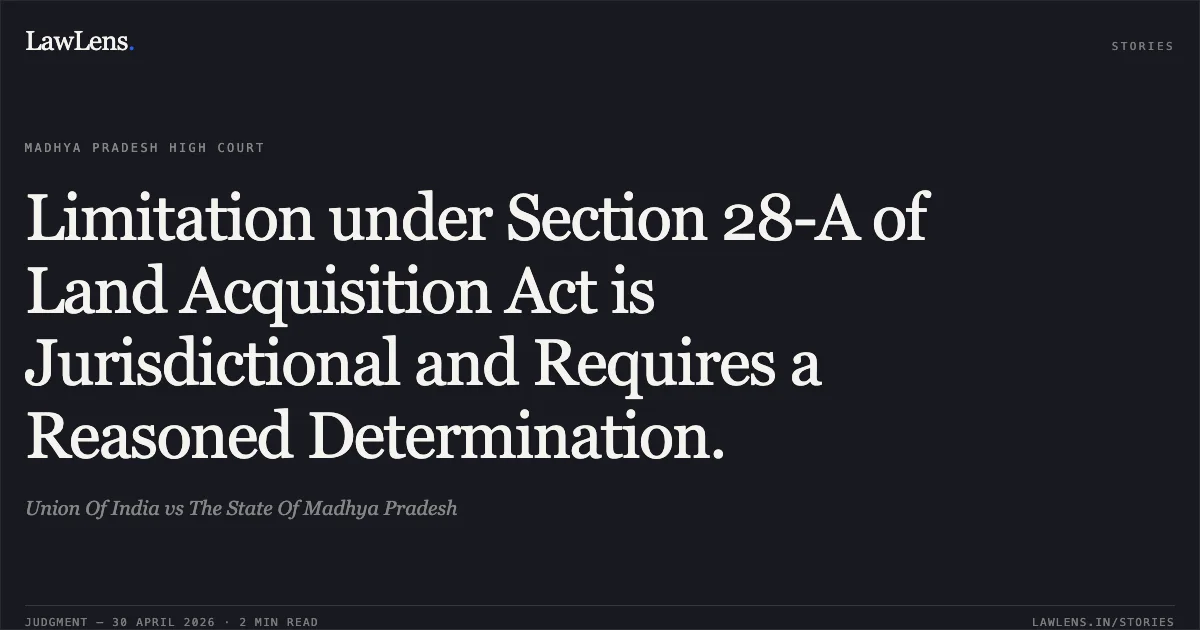
The court primarily applied Section 28-A of the Land Acquisition Act, 1894, which mandates that an application for re-determination must be filed within three months from the date of the award of the "Court" (Reference Court).
Source reference: p. 2, 5It relied on State of A.P. v. Marri Venkaiah (2003) 7 SCC 280 and Jose Antonio Cruz Dos R. Rodrigues v. Land Acquisition Collector (1996) 6 SCC 746, which established that the limitation period is strictly computed from the date of the Reference Court’s award, not appellate orders, and the Act provides no provision for condonation of delay.
Source reference: p. 5-6The court also invoked the principle that quasi-judicial authorities must pass reasoned orders to satisfy natural justice.
Source reference: p. 9Reasoning
The court observed that the LAO’s order recorded a conclusion that the application was within limitation but failed to provide any analysis of the relevant dates or the statutory requirements.
Source reference: p. 9The LAO did not address the petitioners' specific objections regarding Section 3(d) of the Act, which defines "Court" as the principal Civil Court of original jurisdiction, thereby excluding appellate orders from being the starting point for limitation.
Source reference: p. 5, 9The court found that the LAO’s failure to provide a clear basis for rejecting the limitation objection constituted a non-application of mind.
Source reference: p. 9Because the issue of limitation under Section 28-A is a jurisdictional prerequisite, the absence of a reasoned finding on this point vitiated the decision-making process.
Source reference: p. 9-10Holding
The Court held that the impugned order dated 16.08.2021 was unsustainable due to the lack of reasoned findings on the jurisdictional issue of limitation.
The order was set aside, and the matter was remanded to the Sub-Divisional Officer and Land Acquisition Officer, Karera, for fresh consideration which shall include passing a detailed, speaking order adjudicating all objections, including limitation, within three months.
Source reference: p. 10-11Acts & Sections Cited
7 provisions across 1 statute referred to in this judgment. Linked provisions open on LawLens.
Land Acquisition Act, 18947
Original Court PDF
Union Of IndiavsThe State Of Madhya Pradesh
Click to open original judgment
Original judgment, available to read, download and summarize on LawLens.in