Facts
On 09.05.2011, an altercation occurred between the appellant and Respondent No. 2 (an advocate) at the Moti Nagar court premises, leading to cross-FIRs.
Source reference: p.2-3FIR No. 121/2011 was registered by the appellant for offences under Sections 323 and 341 read with Section 34 of the IPC.
Source reference: p.2The Investigating Officer filed the charge-sheet on 29.05.2012, which was one year and 20 days after the date of the incident.
Source reference: p.2, 3The Metropolitan Magistrate took cognizance under Section 190(1)(b) Cr.PC.
Source reference: p.3-4Respondent No. 2 sought quashing of the FIR, arguing that the cognizance was barred by the one-year limitation period prescribed under Section 468(2)(b) Cr.PC for offences punishable with imprisonment up to one year.
Source reference: p.4-5, 9The High Court of Delhi allowed the petition and quashed the FIR on 30.01.2025, holding that the bar under Section 468 Cr.PC was absolute as the charge-sheet was filed beyond one year.
Source reference: p.6Issues
Whether the relevant date for computation of the period of limitation under Section 468 Cr.PC is the date of filing of the criminal complaint/FIR or the date on which the Court/Magistrate takes cognizance.
Source reference: p.6 / para. 5Law Applied
Section 468 of the Cr.PC, which bars courts from taking cognizance of certain offences after the expiry of the limitation period.
Source reference: p.7The Constitution Bench precedent in Sarah Mathew v. Institute of Cardio Vascular Diseases (2014) 2 SCC 62, which established that the date of filing the complaint or initiating prosecution is the relevant date for limitation, not the date of cognizance.
Source reference: p.10, 21The legal maxim actus curiae neminem gravabit (the act of the court shall prejudice no one).
Source reference: p.12The legal maxim nullum tempus aut locus occurrit regi (crime never dies).
Source reference: p.13Sections 469 (commencement of limitation), 470 (exclusion of time), and 473 (extension of period in the interest of justice) of the Cr.PC.
Source reference: p.7-8Reasoning
The Court observed that "taking cognizance" is a judicial act involving the application of mind by a Magistrate, a process subject to systemic or personal delays beyond the control of the complainant or prosecuting agency.
Source reference: para. 5.7.2Relying on Sarah Mathew, the Court reasoned that interpreting Section 468 to mean the date of cognizance would unjustly penalize a diligent complainant for judicial delays, rendering the provision potentially unconstitutional.
Source reference: para. 5.8.2The Court rejected the respondent's attempt to distinguish between a "complaint" (under Section 2(d)) and a "police report" (under Section 2(r)), clarifying that the principle applies to the "initiation of criminal proceedings," whether via FIR or private complaint.
Source reference: para. 7.2-7.3The Court further emphasized that the High Court's reliance on the date of filing the charge-sheet/cognizance was a fundamental error, as the FIR (initiation of proceedings) was registered on the very day of the incident, well within the limitation period.
Source reference: para. 10The Court criticized the practice of advocates re-litigating settled law established by Constitution Benches, noting that respecting binding precedents is a professional duty.
Source reference: para. 8.1-9Holding
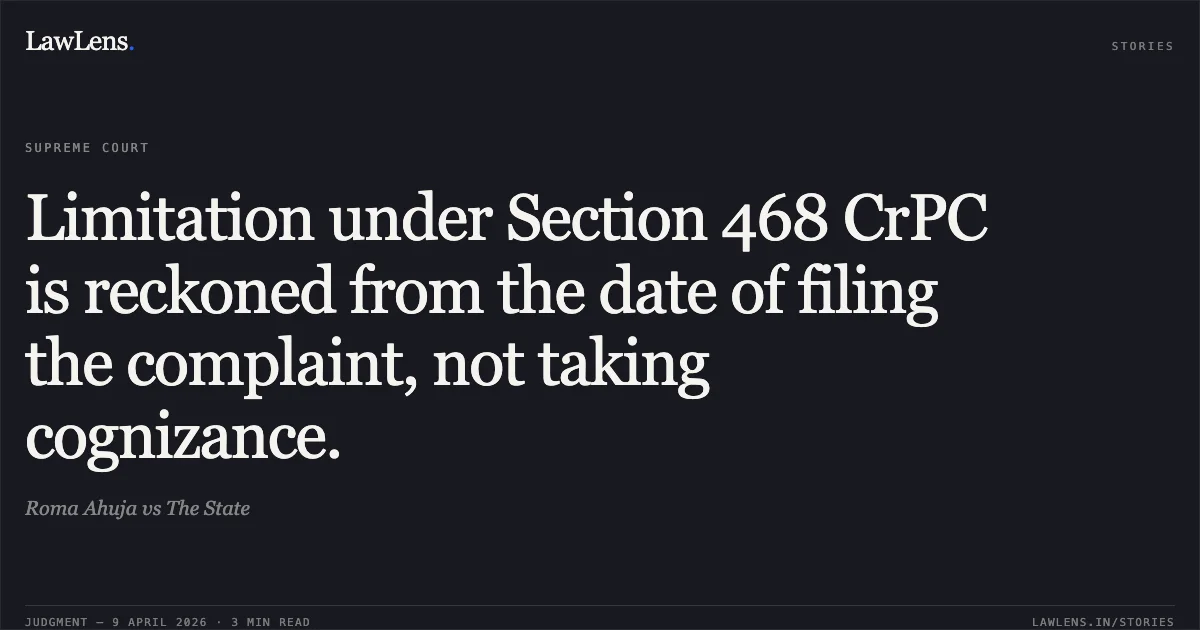
For the purpose of reckoning limitation under Section 468 Cr.PC, the relevant date is the date of filing the complaint or the initiation of criminal proceedings (lodging of FIR), and not the date on which the Magistrate takes cognizance.
The Supreme Court allowed the appeals and set aside the High Court’s order dated 30.01.2025.
Source reference: p.29Since the FIR was lodged on the date of the incident (09.05.2011), the proceedings were within limitation.
Source reference: para. 10The Court directed the trial to proceed expeditiously in accordance with the law.
Source reference: p.29Acts & Sections Cited
24 provisions across 3 statutes referred to in this judgment. Each provision opens on LawLens.
Code of Criminal Procedure, 1973
Indian Penal Code, 18607
Limitation Act, 19631
Original Court PDF
Roma AhujavsThe State
Click to open original judgment
Original judgment, available to read, download and summarize on LawLens.in


