Facts
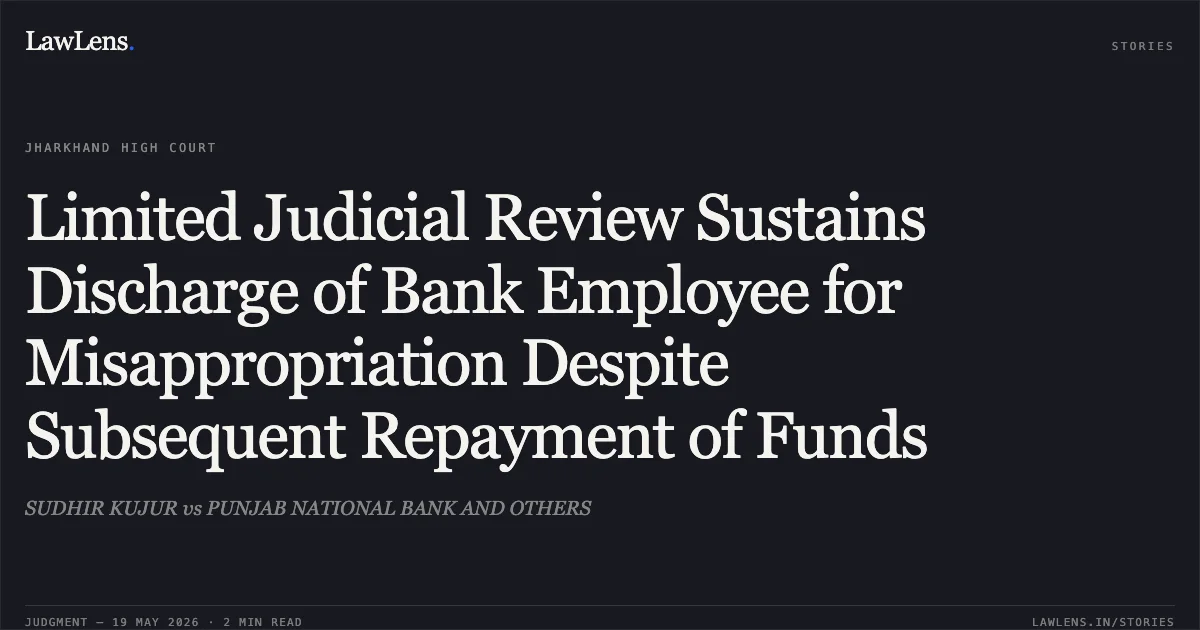
The petitioner, joined as a Clerk in 1985 and later served as a Clerk-cum-Cashier at Punjab National Bank.
Source reference: para. 10(i)In 2008, he was charged with three counts of gross misconduct involving financial irregularities: failure to post a voucher of ₹15,000 resulting in a cash imbalance, a system discrepancy of ₹15,508 leading to alleged embezzlement, and a cash shortage of ₹83,650.
Source reference: para. 12A departmental inquiry found the charges proved.
Source reference: para. 13Consequently, on 04.07.2011, the Disciplinary Authority passed an order of discharge from service with superannuation benefits, which was upheld by the Appellate Authority on 16.02.2012.
Source reference: para. 9, 13-14The petitioner challenged these orders via a writ petition, primarily arguing that the amount was subsequently deposited and the punishment was disproportionate.
Source reference: para. 15Issues
1. Whether the High Court, under Article 226, can reappreciate evidence in a departmental proceeding where the inquiry was conducted in accordance with the principles of natural justice?
Source reference: para. 28-312. Whether the punishment of discharge from service with superannuation benefits is shockingly disproportionate to the gravity of the misconduct involving bank funds?
Source reference: para. 37-38Law Applied
The Court applied the restrictive scope of judicial review under Article 226 of the Constitution, relying on Union of India v. P. Gunasekaran (2015), which prohibits the High Court from acting as a second court of appeal or reappreciating evidence unless the findings are perverse or based on no evidence.
Source reference: para. 28It further utilized the principles from Central Industrial Security Force v. Abrar Ali (2017) regarding the finality of facts in departmental inquiries.
Source reference: para. 29Regarding the standard of conduct for bank employees, the Court relied on UCO Bank v. P.C. Kakkar (2003) and SBI v. S.N. Goyal (2008), establishing that bankers deal with public trust and even temporary misappropriation constitutes serious misconduct requiring severe punishment.
Source reference: para. 32-34Reasoning
The Court observed that the petitioner did not fundamentally dispute the finding of misconduct but sought leniency.
Source reference: para. 37Applying the Gunasekaran guidelines, the Court found no violation of natural justice or perversity in the inquiry officer's report.
Source reference: para. 31, 40The court reasoned that bank employees occupy a position of high trust, and any financial irregularity jeopardizes the bank’s interest.
Source reference: para. 34It noted that the petitioner admitted to the cash imbalances and subsequent deposits, which confirmed the element of misconduct.
Source reference: para. 22-23Regarding proportionality, the Court applied the "shocks the conscience" test from Director General, RPF v. Ch. Sai Babu (2003), concluding that the Disciplinary Authority had already exercised leniency by granting superannuation benefits despite the gravity of the embezzlement charges.
Source reference: para. 38-40Holding
The Court answered both issues in the negative, holding that there was no ground for interference with the administrative decision.
The Court affirmed that the punishment was not disproportionate given the loss of confidence in a bank employee handling public money.
Source reference: para. 39-40The writ petition was dismissed, and the orders dated 04.07.2011 and 16.02.2012 were upheld.
Source reference: para. 41-42Acts & Sections Cited
1 provisions across 1 statute referred to in this judgment. Linked provisions open on LawLens.
Bipartite Settlement (alias, unresolved)1
Original Court PDF
SUDHIR KUJURvsPUNJAB NATIONAL BANK AND OTHERS
Click to open original judgment
Original judgment, available to read, download and summarize on LawLens.in