Facts
NTPC (Petitioner) invited bids for a "Make-up Water System Package" on September 17, 2003, and awarded two contracts (supply and installation) to Mudajaya (Respondent) on May 7, 2004, for approximately Rs. 22.52 Crores.
Source reference: p. 1-2The project, stipulated to be completed by October 6, 2006, was delayed by 35 months and completed only on September 3, 2009.
Source reference: p. 2While NTPC extended the completion time without penalty, it reserved the right to levy liquidated damages (LD) at a later date.
Source reference: p. 5Disputes regarding various claims for extra expenditures and losses led to arbitration, where the Arbitral Tribunal awarded several claims (Nos. 1, 5, 6, 8, 9, and 10) in favor of the Respondent, specifically awarding damages of Rs. 1,12,61,890/- by using the yardstick of Clause 26.2 of the General Conditions of Contract (GCC).
Source reference: p. 3, 5-6NTPC challenged this award under Section 34 of the Arbitration and Conciliation Act, 1996.
Source reference: p. 1Issues
1. Whether the Arbitral Tribunal erred in awarding damages to the contractor by adopting the yardstick of Clause 26.2 of the GCC (which provided for liquidated damages for contractor-driven delays) in the absence of a reciprocal clause for employer-driven delays.
Source reference: p. 3, 102. Whether damages can be awarded under Section 73 of the Indian Contract Act, 1872, in the absence of proof of actual loss or damage sustained by the contractor.
Source reference: p. 4, 8-93. Whether the findings of the Tribunal regarding the quantification of damages warranted interference under the limited scope of Section 34 of the Arbitration and Conciliation Act, 1996.
Source reference: p. 8Law Applied
Section 34 of the Arbitration and Conciliation Act, 1996, which limits judicial interference to cases of patent illegality, perversity, or conflict with the fundamental policy of Indian law.
Source reference: p. 8Section 73 of the Indian Contract Act, 1872, regarding compensation for loss caused by breach of contract.
Source reference: p. 7The court followed the principle from Kailash Nath Associates v. DDA, which held that where actual loss is impossible to assess with precision, the court can award reasonable compensation.
Source reference: p. 9The court applied the precedent from Numaligarh Refinery Ltd. v. Daelim Industrial Co. Ltd., establishing that an Arbitrator may adopt a reasonable yardstick (such as an existing LD clause) to assess damages even if the contract does not explicitly provide for reciprocal liquidated damages.
Source reference: p. 8, 10Reasoning
The court observed that the 35-month delay was undisputedly attributable to NTPC due to six distinct breaches, including failure to provide site possession and delays in statutory permissions.
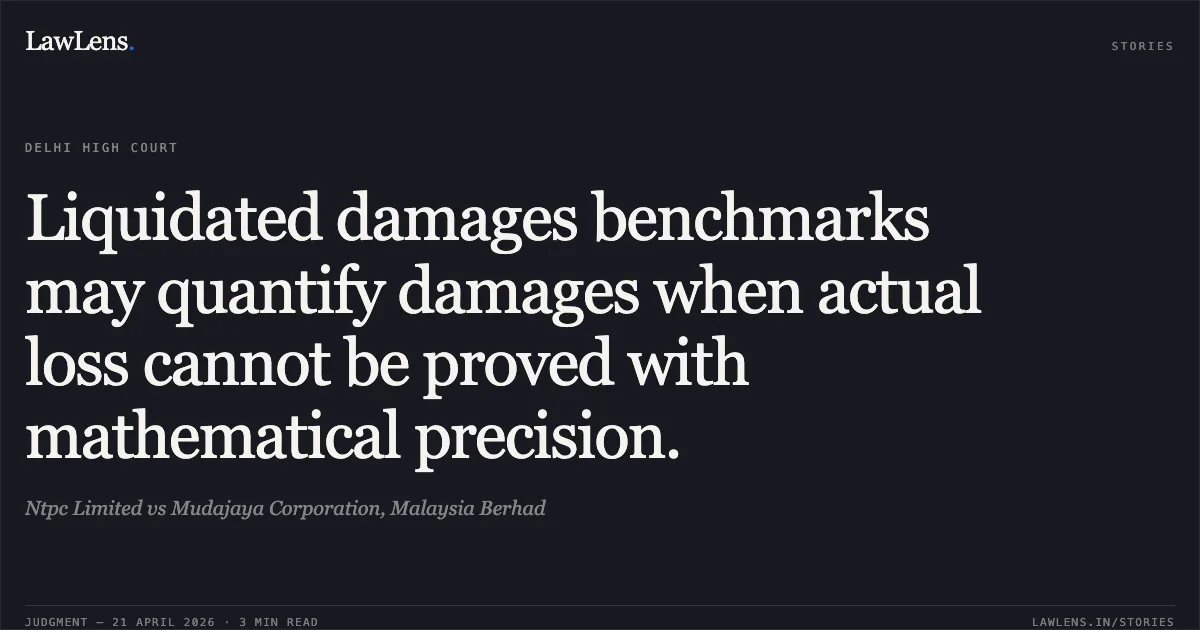
Source reference: p. 6While NTPC argued that damages require strict proof of actual loss, the court held that under Section 73, if the nature of the breach makes mathematical assessment of loss difficult, the Tribunal is entitled to perform "honest guesswork".
Source reference: p. 7, 10The Tribunal correctly distinguished between Section 74 (Liquidated Damages) and Section 73 (General Damages), determining that the Respondent's claims fell under the latter.
Source reference: p. 7The court found that the Tribunal did not "invoke" Clause 26.2 as a contractual right, but rather used the 5% cap mentioned therein as a "reasonable yardstick" for quantification.
Source reference: p. 10Since the Tribunal provided detailed reasons for its findings and the view taken was plausible, the court held that re-appreciation of evidence is impermissible under Section 34.
Source reference: p. 8, 11Holding
The court dismissed the petition, holding that the Arbitral Tribunal’s decision to award damages using the contractual LD percentage as a yardstick was a plausible and reasoned conclusion.
It affirmed that actual proof of loss is not a mandatory precursor to awarding reasonable compensation when such loss is difficult to quantify with precision.
Source reference: p. 9The court upheld the award of Rs. 1,12,61,890/- and found no grounds for interference under Section 34 of the Act. All pending applications were dismissed.
Source reference: p. 11Acts & Sections Cited
4 provisions across 2 statutes referred to in this judgment. Each provision opens on LawLens.
Arbitration and Conciliation Act, 19962
Indian Contract Act, 18722
Original Court PDF
Ntpc LimitedvsMudajaya Corporation, Malaysia Berhad
Click to open original judgment
Original judgment, available to read, download and summarize on LawLens.in