Facts
The appellant was the successful bidder for Lot No. 5 in a liquidation auction, with a reserve price of ₹25.56 crore.
Source reference: pp. 2–3, 7–8, 14–15The auction notice disclosed a dispute concerning the sale deed for part of the land, stated that the sale was on an “as is where is” basis, and provided for forfeiture of the amounts deposited if the successful bidder failed to pay the balance consideration.
Source reference: pp. 2–3, 7–8, 14–15The appellant paid ₹6.39 crore, comprising the ₹2.55 crore EMD and ₹3.84 crore toward the balance, but did not pay the remaining ₹19.17 crore within 30 days or within 90 days with interest.
Source reference: pp. 3–6It sought prior title deeds and relied, among other things, on a High Court direction in proceedings brought by another party concerning the property.
Source reference: pp. 3–6The NCLT ordered refund of the forfeited amount, applying a “Triple Test”; the NCLAT reversed that order.
Source reference: pp. 4–5, 9–10The appellant challenged the NCLAT’s decision before the Supreme Court.
Source reference: pp. 4–5, 9–10Issues
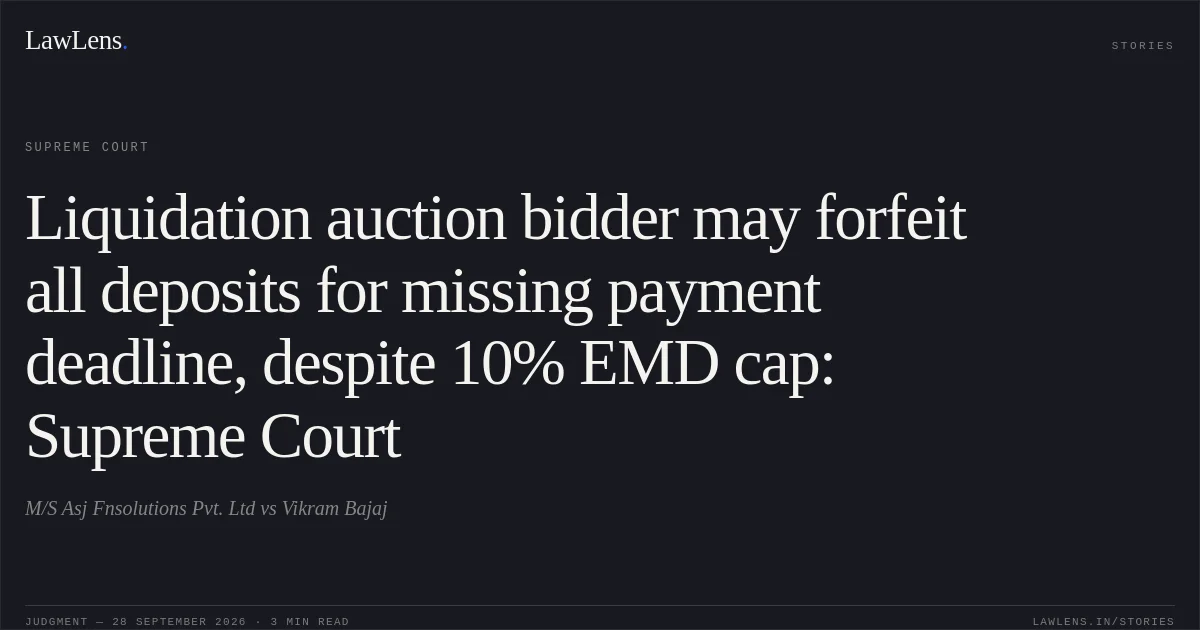
1. Whether the appellant was entitled to refund of the EMD and other amounts deposited despite failing to pay the balance sale consideration within the stipulated period.
Source reference: pp. 7–8, 11–132. Whether the forfeiture clause in the auction notice was enforceable notwithstanding the absence of an express forfeiture provision in Schedule I to the Liquidation Process Regulations, 2016.
Source reference: pp. 7–8, 13–153. Whether the appellant’s reasons for non-payment—including the title-deed dispute, the High Court proceedings, and alleged unequal treatment—justified setting aside the forfeiture.
Source reference: pp. 10–13Law Applied
The Court considered the Insolvency and Bankruptcy Board of India (Liquidation Process) Regulations, 2016, Schedule I, which limits the EMD to no more than 10% of the estimated value but does not itself expressly prescribe forfeiture for failure to pay the balance consideration.
Source reference: pp. 7–8, 13–14It applied the terms of the auction notice, which expressly permitted forfeiture of the entire amount paid, including EMD, if the successful bidder failed to pay the balance consideration as required.
Source reference: pp. 14–15The Court also considered the “Triple Test” referred to by the NCLT—whether the bidder acted with a hidden agenda to rig the auction, lacked genuine financial capacity, or was prevented by extraneous reasons from completing payment—but held it did not excuse forfeiture on these facts.
Source reference: pp. 9–10, 12It relied on *Westcoast Infraprojects Private Limited v. Ram Chandra Dallaram Choudhary* and *Potens Transmission & Power Pvt. Ltd. v. Apex Buildsys Ltd. (In Liquidation)*, noting that the former had upheld forfeiture under an auction-notice clause covering both EMD and other deposits.
Source reference: p. 13Reasoning
The appellant had notice of the title-deed issue before bidding and accepted the “as is where is” terms without seeking title verification during the auction process.
Source reference: pp. 2–3, 8, 11–12Its post-auction request for deeds, made shortly before the payment deadline, did not justify withholding the balance, and the High Court proceedings relied on by the appellant did not establish an extraneous impediment to payment.
Source reference: pp. 3–4, 11–12The appellant’s email expressing willingness to pay was not proof of financial capacity, and the record did not substantiate the alleged discriminatory extension granted to another bidder.
Source reference: pp. 9–10, 12Since the auction notice expressly provided for forfeiture and the appellant had paid the demanded amounts without protest, the Court held that forfeiture followed from the failure to pay the balance within time; the 10% EMD limit did not invalidate the separate forfeiture term.
Source reference: pp. 7–8, 13–15Holding
The Court answered against the appellant.
It held that the auction-notice clause permitted forfeiture of the EMD and other amounts deposited upon the appellant’s failure to pay the balance consideration, and that the appellant had shown no sufficient ground to avoid that consequence.
Source reference: pp. 14–15The appeal was dismissed, the NCLAT’s order was left undisturbed, and any pending applications were rejected.
Source reference: p. 15Acts & Sections Cited
1 provisions across 1 statute referred to in this judgment. Each provision opens on LawLens.
Insolvency and Bankruptcy Code, 2016.1
Original Court PDF
M/S Asj Fnsolutions Pvt. LtdvsVikram Bajaj
Click to open original judgment
Original judgment, available to read, download and summarize on LawLens.in