Facts
The respondent instituted Summary Suit No. 145 of 2014 against the petitioner. Although the petitioner appeared through an advocate, it did not file an application for leave to defend within the prescribed period under Order XXXVII Rule 3 of the Code of Civil Procedure, 1908.
Source reference: paras. 5–6; pp. 4–5The Trial Court consequently passed a money decree directing payment of ₹7,29,078 with 24% interest from 05.09.2014 until the date of decree, stated in the judgment as 07.12.2022.
Source reference: paras. 5–6; pp. 4–5The petitioner claimed that its advocate had not informed it about the decree and that it became aware of the decree only upon receiving notice in execution proceedings in December 2024.
Source reference: para. 7; p. 5It thereafter filed an appeal on 20.06.2025 with a delay of 869 days. The appellate court rejected the application for condonation of delay by order dated 11.11.2025.
Source reference: paras. 2–4, 7; pp. 1–3, 5The petitioner challenged that order under Article 227 of the Constitution and sought condonation of delay, or alternatively a remand for fresh consideration.
Source reference: paras. 2–4, 7; pp. 1–3, 5Issues
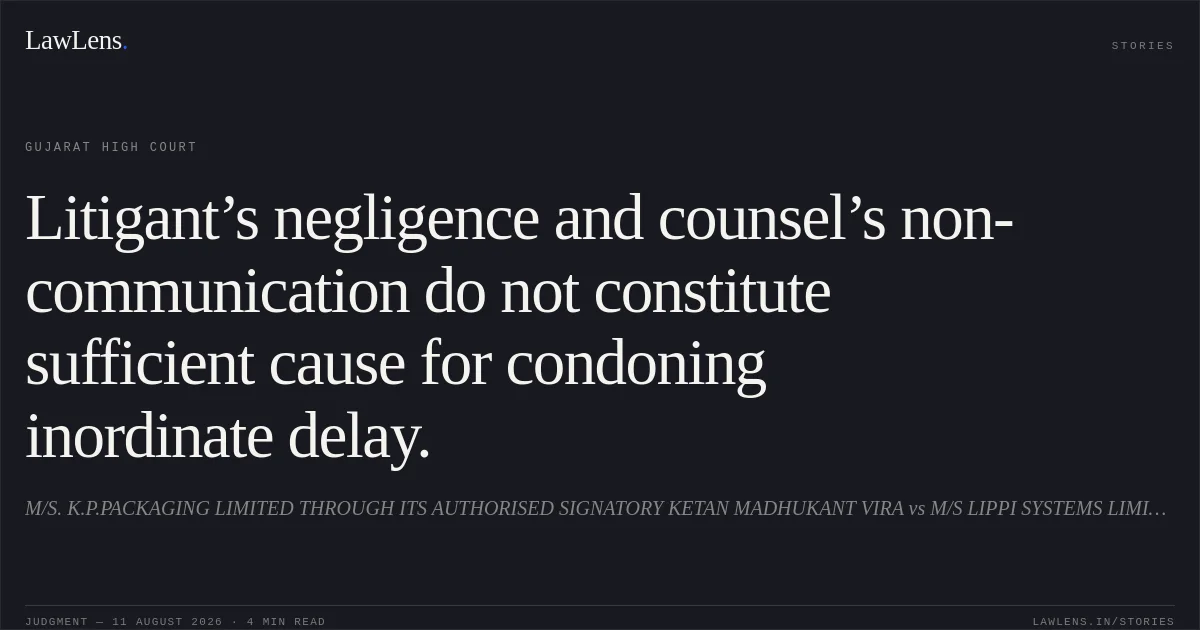
Whether the petitioner had shown sufficient cause for condoning the 869-day delay in filing the appeal, when its principal explanation was that its advocate had failed to communicate the judgment and decree?
Source reference: paras. 7–12; pp. 5–13Whether the delay could be condoned by imposing costs, in order to enable the petitioner to contest the matter on merits?
Source reference: paras. 3–3.2, 11.3–11.4; pp. 2–3, 10–12Whether the High Court should interfere under Article 227 with the appellate court’s rejection of the delay-condonation application?
Source reference: para. 13; p. 14Law Applied
The Court applied Order XXXVII Rule 3, including Rule 3(6)(a), CPC, under which failure to file leave to defend may result in a decree in a summary suit.
Source reference: paras. 5–6; pp. 4–5Under Section 5 of the Limitation Act, 1963, delay may be condoned only upon establishment of “sufficient cause”; although the provision receives a liberal and justice-oriented interpretation, such discretion is unavailable where the delay results from gross negligence, inaction, lack of bona fides or want of due diligence.
Source reference: para. 11.1; pp. 7–8The Court relied on Rajneesh Kumar v. Ved Prakash, 2024 (14) SCALE 406, holding that a litigant cannot ordinarily attribute inordinate delay entirely to the negligence of counsel and must remain vigilant.
Source reference: para. 11.1; pp. 7–8K.B. Lal v. Gyanendra Pratap, 2024 (4) SCALE 759, reaffirming that liberal construction does not excuse gross negligence or lack of bona fides.
Source reference: para. 11.2; pp. 8–10Pathapati Subba Reddy v. Special Deputy Collector (LA), 2024 INSC 286, holding that limitation serves the public policy of finality and that delay cannot be condoned merely on terms or conditions when sufficient cause is absent.
Source reference: para. 11.3; pp. 10–11Basawaraj v. Special Land Acquisition Officer, (2013) 14 SCC 81, holding that an inordinate delay caused by negligence or want of diligence cannot be condoned by imposing costs.
Source reference: para. 11.4; pp. 11–12Shivamma v. Karnataka Housing Board, 2025 INSC 1104, holding that the Court must first assess the bona fides of the explanation and should not begin with the merits of the main case.
Source reference: para. 11.5; p. 13The scope of Article 227 is supervisory and does not warrant interference with a well-reasoned discretionary order absent jurisdictional error or manifest illegality.
Source reference: para. 13; p. 14Reasoning
The Court found that the petitioner had been duly served in the summary suit and had entered appearance through counsel, but failed to file leave to defend and failed to remain sufficiently vigilant about the proceedings.
Source reference: paras. 5–8; pp. 4–6The explanation that the advocate did not communicate the decree was held insufficient, particularly because the petitioner did not assert that it had remained in regular contact with counsel or had taken steps to monitor the litigation.
Source reference: paras. 7–9, 12; pp. 5–6, 13The Court treated the 869-day delay as inordinate, unexplained and indicative of negligence, with the appeal appearing to have been prompted only after execution proceedings commenced.
Source reference: paras. 7–9, 12; pp. 5–6, 13Applying the cited precedents, the Court held that the petitioner could not shift the entire responsibility to its advocate and that the merits of the underlying dispute could not justify condonation where sufficient cause was absent.
Source reference: paras. 10–11.5; pp. 6–13It further held that costs could not cure the absence of sufficient cause, and found no basis under Article 227 to interfere with the appellate court’s order.
Source reference: paras. 12–13; pp. 13–14Holding
The Court answered the issues against the petitioner. The failure of the advocate to communicate the judgment and decree, without any showing of the petitioner’s own diligence, did not constitute sufficient cause for condoning the 869-day delay.
The delay could not be condoned merely by imposing costs.
Source reference: paras. 13–14; p. 14Finding the appellate court’s order legally sound and free from any ground for supervisory interference, the High Court dismissed the petition in limine and declined to grant any stay or other relief. No order was made as to costs.
Source reference: paras. 13–14; p. 14Acts & Sections Cited
2 provisions across 1 statute referred to in this judgment. Each provision opens on LawLens.
Original Court PDF
M/S. K.P.PACKAGING LIMITED THROUGH ITS AUTHORISED SIGNATORY KETAN MADHUKANT VIRAvsM/S LIPPI SYSTEMS LIMITED
Click to open original judgment
Original judgment, available to read, download and summarize on LawLens.in