01Facts
The applicants filed MAC No. 823/2016 seeking compensation under Section 166 of the Motor Vehicles Act following the death of Rajnarayan Yadav.
¶ 2On 30.06.2016, the High Court issued a peremptory order granting two weeks to remove defaults.
¶ 2Due to non-compliance, the case was dismissed on 03.08.2016.
¶ 2The applicants, described as poor and illiterate, alleged that their counsel failed to inform them of the status of the case.
¶ 2Upon engaging new counsel years later, they discovered the dismissal and filed the present Restoration Application (MCC) along with an application under Section 5 of the Limitation Act to condone a delay of 3,558 days.
¶ 2-302Issues
i.1. Whether the delay of 3558 days in filing the restoration application can be condoned under Section 5 of the Limitation Act based on the negligence of counsel and the illiteracy of the litigants.
¶ 1-3ii.2. Whether the original appeal (MAC No. 823/2016) should be restored to its original number in the interest of substantial justice.
¶ 903Law Applied
The court primarily applied Section 5 of the Limitation Act regarding the condonation of delay for "sufficient cause".
¶ 1It relied on Basawaraj v. Special Land Acquisition Officer (2013), which emphasizes that "sufficient cause" cannot be liberally interpreted if there is gross negligence or lack of bona fides.
¶ 4Furthermore, the court applied the principle from Dwarika Prasad v. Prithvi Raj Singh (2024) and Rafiq v. Munshilal (1981), which establishes that a modern litigant who has done everything in their power (engaging and paying a lawyer) should not suffer for the inaction, deliberate omission, or misdemeanour of their counsel.
¶ 5It also cited Imrat Lal v. Land Acquisition Collector (2014) regarding the liberal exercise of discretion in compensation matters involving similarly situated persons.
¶ 6Provisions in the judgment · 2 · Linked ones open on LawLens
Limitation Act, 1963 Section 5
Motor Vehicles Act, 1988 Section 166
04Reasoning
The court evaluated the applicants' explanation that their financial constraints, illiteracy, and dependence on counsel prevented them from taking timely steps.
¶ 2-3While acknowledging that limitation laws must be applied rigorously, the court noted that there was no evidence suggesting the delay was deliberate or mala fide.
¶ 7Applying the Supreme Court’s precedent that "courts should not shut out cases on mere technicalities," the judge reasoned that the fault lay with the advocates who failed to communicate the case status.
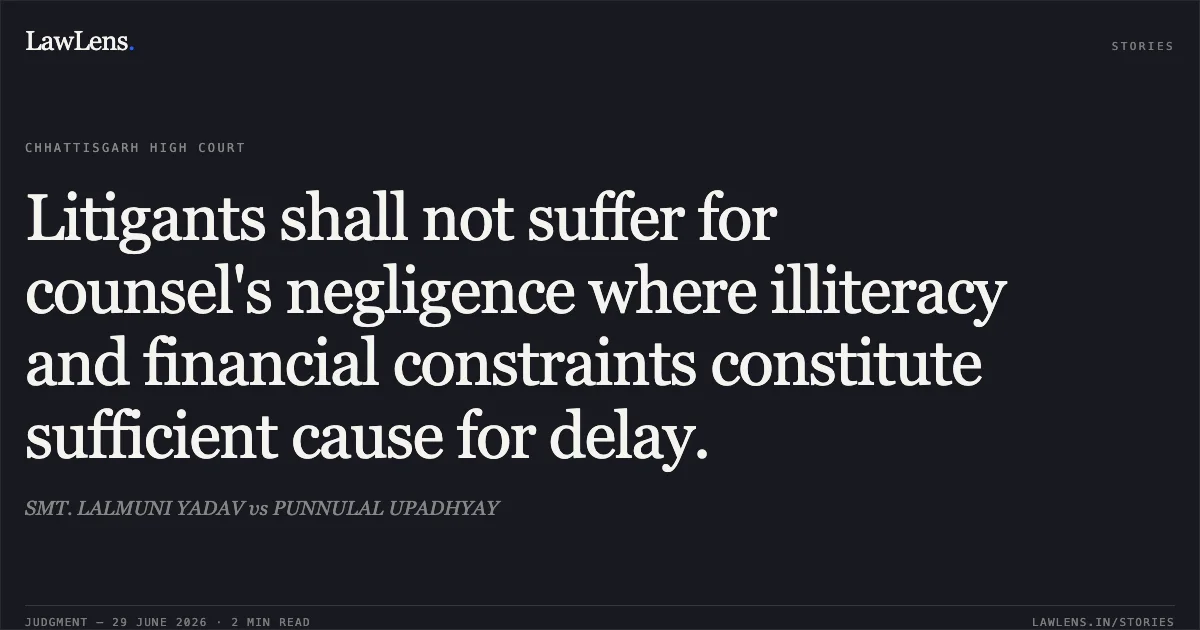
¶ 5The court determined that penalizing poor and illiterate litigants for their counsel’s negligence would lead to a miscarriage of justice, particularly in a matter involving statutory compensation.
¶ 7-805Holding
The court allowed the application, holding that the "sufficient cause" requirement was met to advance substantial justice.
¶ 8The delay of 3558 days was condoned, and the Registry was directed to restore MAC No. 823/2016 to its original number for adjudication on merits.
¶ 9Original Court PDF
SMT. LALMUNI YADAVvsPUNNULAL UPADHYAY
Click to open original judgment
Original judgment, available to read, download and summarize on LawLens.in