Facts
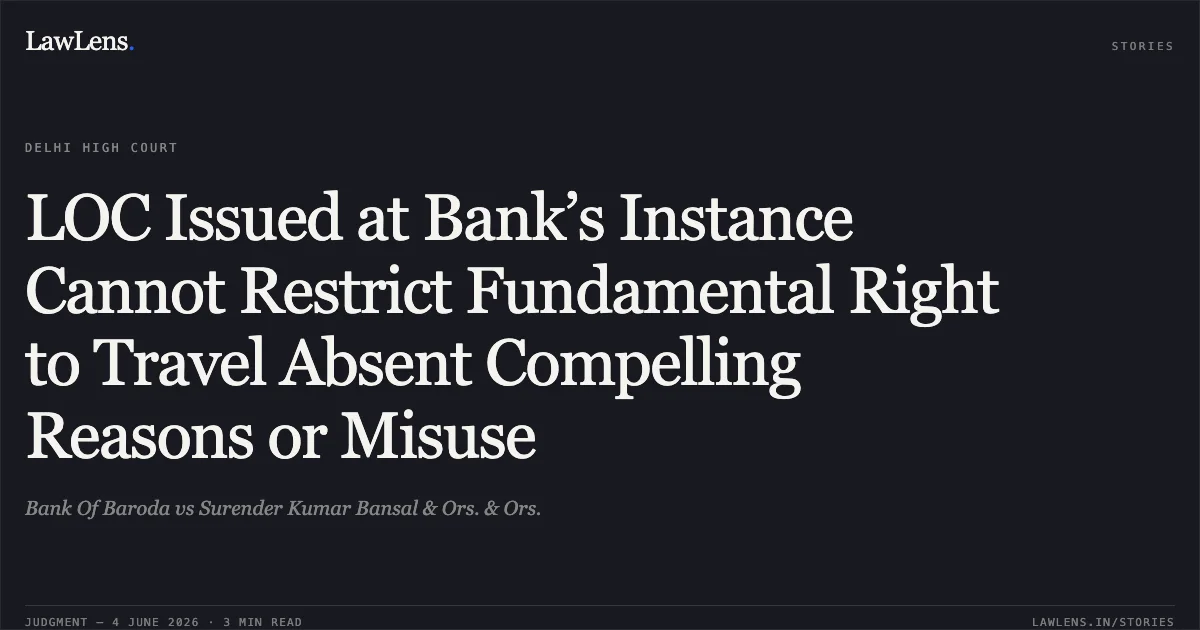
The Respondents (nos. 1 and 2) were Directors and personal guarantors of M/s. SSK Trading Private Limited, which defaulted on loans from a consortium of banks, leading to a declaration of Non-Performing Asset (NPA) and proceedings under the SARFAESI Act.
Source reference: para. 3Based on a complaint by the lead bank, the CBI registered an FIR in 2018; a charge-sheet followed, and the trial is currently pending.
Source reference: para. 4On January 3, 2020, a Look Out Circular (LOC) was opened against the Respondents, which they challenged via a writ petition.
Source reference: para. 5While the Debt Recovery Tribunal (DRT) ordered the Respondents to pay approximately ₹31.84 Crores, a learned Single Judge quashed the LOC on January 21, 2026, finding it an uncalled-for restriction on personal liberty given the Respondents' previous compliance with travel permissions.
Source reference: paras. 1, 6, 15, 17The Bank of Baroda appealed this quashing, arguing that the conditions imposed (cooperation with the Trial Court) did not adequately secure the bank's recovery interests.
Source reference: paras. 7, 10Issues
1. Whether the learned Single Judge erred in setting aside the Look Out Circular (LOC) despite the Respondents' substantial outstanding financial liabilities to the Bank.
Source reference: para. 102. Whether the conditions imposed by the Single Judge regarding travel permission from the Trial Court were sufficient to protect the interests of the creditor bank.
Source reference: para. 7, 19Law Applied
The Court applied the principles governing personal liberty under Article 21 of the Constitution of India, specifically the right to travel abroad as established in Maneka Gandhi v. Union of India (1978), which mandates that any deprivation of this right must follow a procedure established by law.
Source reference: para. 20The Court also relied on Rajesh Kumar Mehta v. Union of India (2024) to emphasize that an LOC is an "exceptional coercive measure" requiring great care and "compelling reasons".
Source reference: para. 20It further noted the Bombay High Court's ruling in Viraj Chetan Shah v. Union of India (2024), which struck down clauses allowing Public Sector Banks to request LOCs solely for financial reasons, and Anant Raj Kanoria v. Union of India (2026) regarding the unjustifiable long-term continuation of such restraints.
Source reference: paras. 9, 17Reasoning
The Court reasoned that the power to issue an LOC must not be used routinely for debt recovery if less restrictive measures suffice to ensure the presence of the accused.
Source reference: no citationThe Bench observed that the Respondents had traveled abroad on four prior occasions with court permission and had never misused that liberty.
Source reference: para. 15The Court highlighted that since the investigation was complete and a charge-sheet had been filed, the purpose of the LOC was largely served.
Source reference: para. 17Regarding the Bank’s financial concerns, the Court noted that the Respondents possess significant movable and immovable assets in India, some of which are already attached.
Source reference: para. 17Furthermore, because the Respondents’ passports are already in the custody of the Enforcement Directorate (E.D.) and the Single Judge’s order expressly required prior court permission for any travel, the legal safeguards were deemed adequate to prevent absconding.
Source reference: paras. 18-19Holding
The Court dismissed the appeal and upheld the Single Judge’s order quashing the LOC, holding that there was no "good ground" to interfere with the decision because the Respondents demonstrated a history of compliance and the existing conditions provided sufficient security.
The Court affirmed the directions that: (i) Respondents must file an affidavit of cooperation with the Trial Court; (ii) they must not travel abroad without the Trial Court's permission; and (iii) the Bank/CBI retains the liberty to seek a fresh LOC if any conditions are violated.
Source reference: paras. 1, 17No order as to costs was made.
Source reference: para. 23Acts & Sections Cited
2 provisions across 2 statutes referred to in this judgment. Each provision opens on LawLens.
Securitisation and Reconstruction of Financial Assets and Enforcement of Security Interest Act, 20021
Passports Act, 19671
Original Court PDF
Bank Of BarodavsSurender Kumar Bansal & Ors. & Ors.
Click to open original judgment
Original judgment, available to read, download and summarize on LawLens.in