Facts
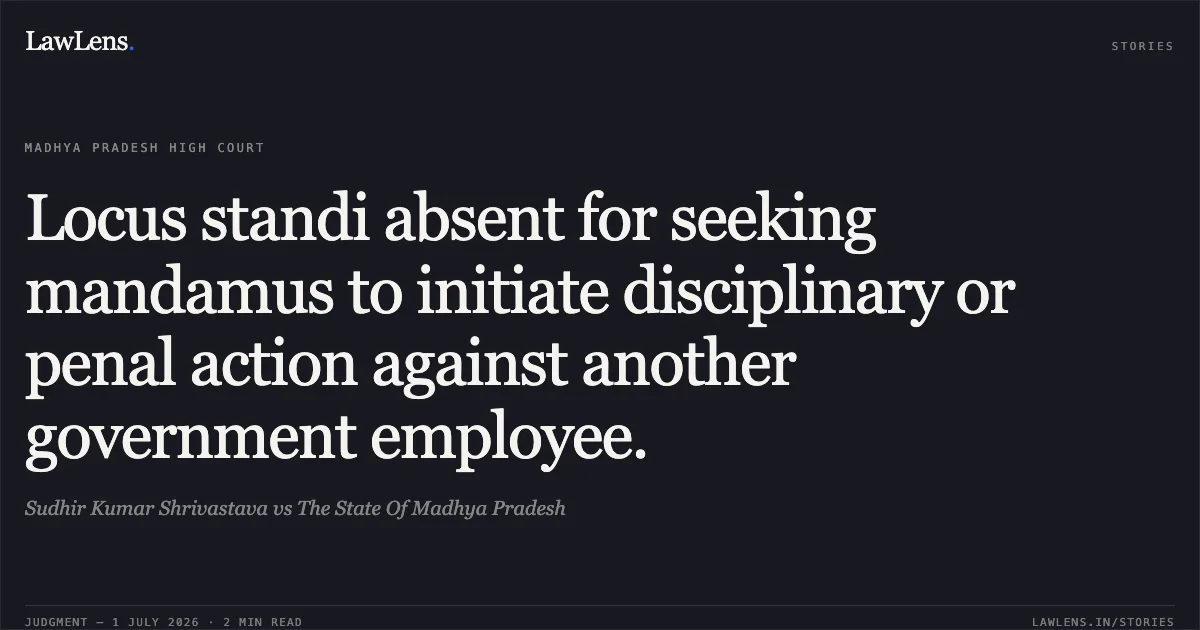
The petitioner filed a writ petition under Article 226 of the Constitution of India seeking directions to the respondent authorities to decide his pending representations regarding alleged financial irregularities and mismanagement by respondent No. 4
Source reference: p. 1-2The petitioner further sought a declaration of his own innocence regarding a charge-sheet issued to him by the department and requested compensation for mental agony
Source reference: p. 2The State argued that the petitioner lacked locus standi to demand disciplinary action against another employee and that the petition was not maintainable
Source reference: p. 2Issues
1. Whether a petitioner has the locus standi under Article 226 to seek a writ of mandamus directing the state to initiate disciplinary or criminal proceedings against another government servant
Source reference: p. 32. Whether the High Court can interfere with a departmental charge-sheet and declare the petitioner innocent at the stage of issuance
Source reference: p. 3Law Applied
The court applied the fundamental principle that a writ under Article 226 is maintainable only for the enforcement of a legal or fundamental right.
Source reference: p. 2It held that disciplinary proceedings are an administrative matter within the domain of the competent authority and statutory rules.
Source reference: p. 3Regarding the challenge to the charge-sheet, the court followed the established doctrine that writ jurisdiction is generally not exercised against a charge-sheet unless it is shown to be wholly without jurisdiction or actuated by malice in law.
Source reference: p. 3-4Reasoning
The court reasoned that the petitioner failed to demonstrate any infringement of a legally enforceable right resulting from the state's inaction against respondent No. 4.
Source reference: p. 3It clarified that a complainant does not possess a vested right to insist upon the initiation or conclusion of disciplinary proceedings against a third party.
Source reference: p. 3A mere representation does not create a legal right enforceable through mandamus.
Source reference: p. 3Regarding the petitioner's own disciplinary case, the court found the prayer for a "declaration of innocence" premature and misconceived, as the petitioner already has an adequate opportunity to participate in the inquiry and submit a reply to the authorities.
Source reference: p. 3-4Holding
The court answered both issues in the negative, holding that the petition was not maintainable for want of locus standi.
The Court dismissed the writ petition, ruling that no case for a writ of mandamus was made out and that no exceptional circumstances existed to warrant interference with the pending departmental charge-sheet.
Source reference: p. 4Original Court PDF
Sudhir Kumar ShrivastavavsThe State Of Madhya Pradesh
Click to open original judgment
Original judgment, available to read, download and summarize on LawLens.in