Facts
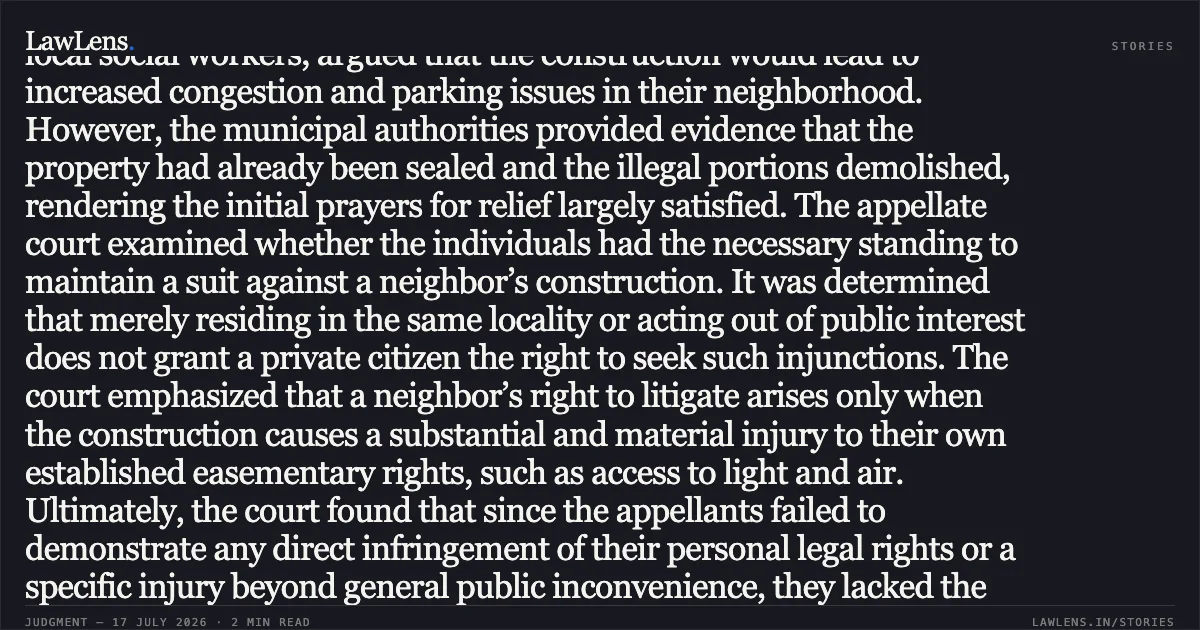
The Appellants, residents and social workers of Nabi Karim, filed a suit for permanent and mandatory injunction against Respondents Nos. 2 to 6 (officials of Respondent No. 1) to stop and demolish alleged unauthorized commercial construction at Property No. 6893, Qila Kadam Sharif.
Source reference: paras 3-4They alleged the construction would cause parking issues and congestion.
Source reference: para 5The Municipal Corporation (MCD/NDMC) filed status reports stating the property had been booked, partially demolished, and sealed twice due to seal tampering.
Source reference: paras 9-12The Trial Court dismissed the suit as the reliefs were either satisfied by the MCD's action or were premature regarding future construction.
Source reference: paras 13-15The First Appellate Court upheld the dismissal, further noting the Appellants lacked locus standi.
Source reference: paras 20-21Issues
1. Whether the Appellants have the locus standi to maintain a suit for injunction against unauthorized construction in their locality without proving infringement of personal legal rights.
Source reference: para 21, 312. Whether a suit for public nuisance can be maintained without complying with the requirements of Section 91 of the CPC.
Source reference: para 333. Whether the reliefs sought regarding demolition and injunction survived after the statutory authorities had already taken enforcement action.
Source reference: paras 13, 29Law Applied
Section 41(j) of the Specific Relief Act, 1963, which bars an injunction when the plaintiff has no personal interest in the matter.
Source reference: para 22, 37Section 91 of the Code of Civil Procedure, 1908, governing suits for public nuisance, which requires the leave of the court or a suit by two or more persons.
Source reference: para 33Sections 15 and 33 of the Easement Act, 1882, regarding the necessity of proving substantial damage to easementary rights like air and light.
Source reference: paras 34-35The precedent Rajinder Motwani v. MCD (RSA 243/2017), establishing that a neighbor has no right to sue against illegal construction unless their specific legal rights are affected.
Source reference: para 23, 34Reasoning
The Court reasoned that mere residence in a locality or status as a "social worker" does not confer a legal right to challenge construction unless a personal easementary right to light, air, or water is substantially diminished under the Easement Act.
Source reference: paras 32, 34-35Since the Appellants did not plead any such infringement, the suit was barred under Section 41(j) of the Specific Relief Act.
Source reference: para 37Regarding public nuisance, the Court noted the Appellants failed to obtain leave or fulfill the procedural mandate of Section 91 CPC.
Source reference: para 33The Court found that since the MCD had already booked, sealed, and partially demolished the unauthorized portions, the cause of action for a mandatory injunction was satisfied, and any prayer regarding "future" construction was purely speculative and premature.
Source reference: paras 29-30Holding
The High Court dismissed the Second Appeal, holding that no substantial question of law arose.
The Court affirmed that unauthorized construction per se does not give a neighbor a right to sue unless there is a breach of a legal right or compliance with Section 91 CPC. The findings of the lower courts—that the Appellants lacked locus standi and that the grievances were largely addressed by departmental action—were upheld as correct in fact and law.
Source reference: paras 33-35, 38-39Acts & Sections Cited
1 provisions across 1 statute referred to in this judgment. Each provision opens on LawLens.
Specific Relief Act, 19631
Original Court PDF
Ravinder Soni And OthersvsSanatan Dharam Sabha Hari Mandir Regd And Others
Click to open original judgment
Original judgment, available to read, download and summarize on LawLens.in


