Facts
The complainant, who was embroiled in maintenance and divorce proceedings with her husband, alleged that in 2016, the petitioner claimed to know the whereabouts of her daughter who had been abducted by her in-laws.
Source reference: p. 2-3She alleged that the petitioner demanded money or a physical meeting, subsequently raping her at a hotel and secretly recording the act to blackmail her into further sexual relations.
Source reference: p. 3The recordings were later sent to her husband and produced as evidence of adultery in Family Court on 10.11.2017.
Source reference: p. 4-5The complainant initially denied knowing the petitioner in her written reply to the divorce suit on 26.12.2018.
Source reference: p. 5However, she lodged the present FIR on 20.12.2019, alleging rape and criminal intimidation.
Source reference: p. 1The petitioner moved the High Court under Section 482 Cr.P.C. for quashing the FIR, contending the relationship was consensual and the FIR was a retaliatory afterthought to save her maintenance claim.
Source reference: p. 5-6Issues
1. Whether the FIR and subsequent proceedings constitute an abuse of the process of law, warranting quashing under Section 482 of the Cr.P.C.
Source reference: p. 8-102. Whether the delay in filing the FIR and the contradictions in the complainant's stances before the Family Court and the Police render the allegations inherently improbable.
Source reference: p. 10-11Law Applied
Section 482 of the Code of Criminal Procedure, 1973, concerning the inherent powers of the High Court to prevent abuse of process.
Source reference: p. 1The four-step analytical framework established in Pradeep Kumar Kesarwani v. State of Uttar Pradesh, which dictates that proceedings should be quashed if the accused presents "sterling and impeccable" material that refutes the factual basis of the complaint.
Source reference: p. 8-9Landmark principles from State of Haryana v. Bhajan Lal, which permit quashing when the allegations are so absurd or improbable that no prudent person could reach a just conclusion that there is sufficient ground for proceeding against the accused.
Source reference: p. 11Reasoning
The Court observed that while the FIR alleged serious cognizable offenses, the surrounding circumstances and "indubitable" documentary evidence suggested an ulterior motive.
Source reference: p. 9-10The Court noted a significant delay in filing the FIR; the alleged incident occurred in 2016, and the complainant was officially aware of the incriminating photographs/CDs by 10.11.2017, yet the FIR was only lodged in late 2019.
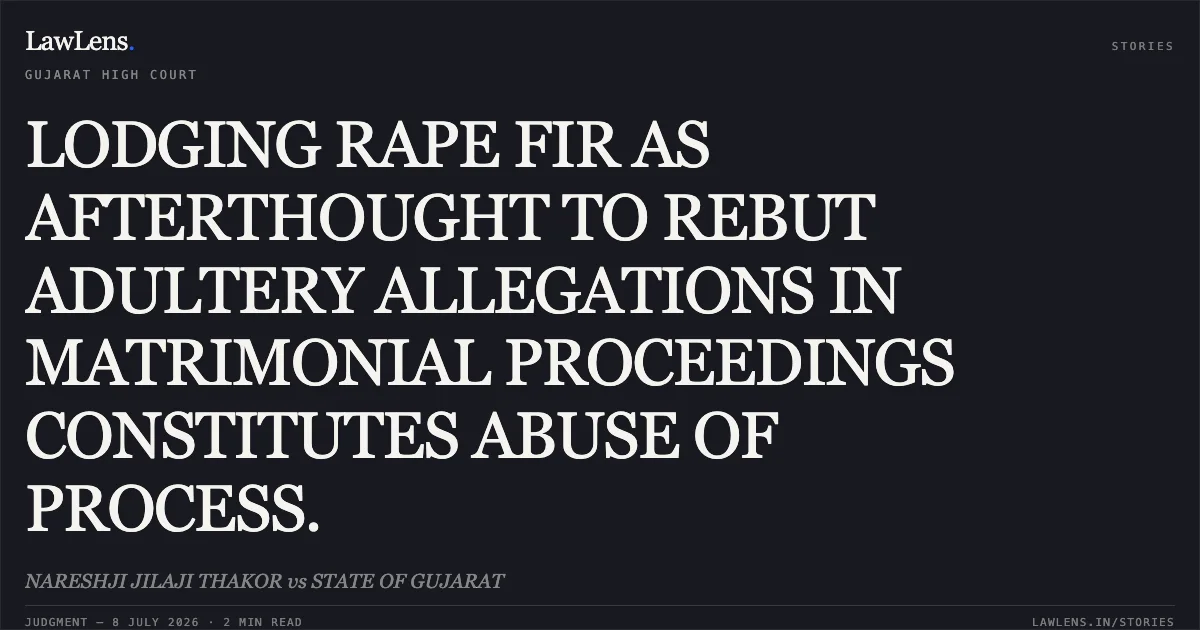
Source reference: p. 10The Court highlighted a "total somersault" in the complainant's conduct: she initially denied knowing the petitioner in Family Court proceedings in 2018 to contest adultery charges, but later filed the FIR alleging rape to explain the same evidence.
Source reference: p. 10Reasoning that both parties were adults (aged 30 and 26) who entered the relationship with "eyes wide open," the Court found the FIR to be an "afterthought" designed to protect the complainant's maintenance rights and contest the divorce.
Source reference: p. 10-11Consequently, the Court determined the case fell within the parameters for quashing as defined in Bhajan Lal.
Source reference: p. 11Holding
The Court answered the issues in the affirmative, holding that the criminal proceedings were an abuse of process.
The High Court allowed the application, quashing FIR C.R.No.I-154 of 2019 lodged at Gandhigram-2 (University) Police Station, Rajkot, and all consequential proceedings against the petitioner; the Rule was made absolute.
Source reference: p. 11Acts & Sections Cited
6 provisions across 2 statutes referred to in this judgment. Each provision opens on LawLens.
Code of Criminal Procedure, 19732
Indian Penal Code, 18604
Original Court PDF
NARESHJI JILAJI THAKORvsSTATE OF GUJARAT
Click to open original judgment
Original judgment, available to read, download and summarize on LawLens.in